Saturday, March 2, 2019

5G phones are here but there’s no rush to upgrade

This year’s Mobile World Congress — the CES for Android device makers — was awash with 5G handsets.

The world’s No.1 smartphone seller by marketshare, Samsung, got out ahead with a standalone launch event in San Francisco, showing off two 5G devices, just before fast-following Android rivals popped out their own 5G phones at launch events across Barcelona this week.

We’ve rounded up all these 5G handset launches here. Prices range from an eye-popping $2,600 for Huawei’s foldable phabet-to-tablet Mate X — and an equally eye-watering $1,980 for Samsung’s Galaxy Fold; another 5G handset that bends — to a rather more reasonable $680 for Xiaomi’s Mi Mix 3 5G, albeit the device is otherwise mid-tier. Other prices for 5G phones announced this week remain tbc.

Android OEMs are clearly hoping the hype around next-gen mobile networks can work a little marketing magic and kick-start stalled smartphone growth. Especially with reports suggesting Apple won’t launch a 5G iPhone until at least next year. So 5G is a space Android OEMs alone get to own for a while.

Chipmaker Qualcomm, which is embroiled in a bitter patent battle with Apple, was also on stage in Barcelona to support Xiaomi’s 5G phone launch — loudly claiming the next-gen tech is coming fast and will enhance “everything”.

“We like to work with companies like Xiaomi to take risks,” lavished Qualcomm’s president Cristiano Amon upon his hosts, using 5G uptake to jibe at Apple by implication. “When we look at the opportunity ahead of us for 5G we see an opportunity to create winners.”

Despite the heavy hype, Xiaomi’s on stage demo — which it claimed was the first live 5G video call outside China — seemed oddly staged and was not exactly lacking in latency.

“Real 5G — not fake 5G!” finished Donovan Sung, the Chinese OEM’s director of product management. As a 5G sales pitch it was all very underwhelming. Much more ‘so what’ than ‘must have’.

Whether 5G marketing hype alone will convince consumers it’s past time to upgrade seems highly unlikely.

Phones sell on features rather than connectivity per se, and — whatever Qualcomm claims — 5G is being soft-launched into the market by cash-constrained carriers whose boom times lie behind them, i.e. before over-the-top players had gobbled their messaging revenues and monopolized consumer eyeballs.

All of which makes 5G an incremental consumer upgrade proposition in the near to medium term.

Use-cases for the next-gen network tech, which is touted as able to support speeds up to 100x faster than LTE and deliver latency of just a few milliseconds (as well as connecting many more devices per cell site), are also still being formulated, let alone apps and services created to leverage 5G.

But selling a network upgrade to consumers by claiming the killer apps are going to be amazing but you just can’t show them any yet is as tough as trying to make theatre out of a marginally less janky video call.

“5G could potentially help [spark smartphone growth] in a couple of years as price points lower, and availability expands, but even that might not see growth rates similar to the transition to 3G and 4G,” suggests Carolina Milanesi, principal analyst at Creative Strategies, writing in a blog post discussing Samsung’s strategy with its latest device launches.

“This is not because 5G is not important, but because it is incremental when it comes to phones and it will be other devices that will deliver on experiences, we did not even think were possible. Consumers might end up, therefore, sharing their budget more than they did during the rise of smartphones.”

The ‘problem’ for 5G — if we can call it that — is that 4G/LTE networks are capably delivering all the stuff consumers love right now: Games, apps and video. Which means that for the vast majority of consumers there’s simply no reason to rush to shell out for a ‘5G-ready’ handset. Not if 5G is all the innovation it’s got going for it.
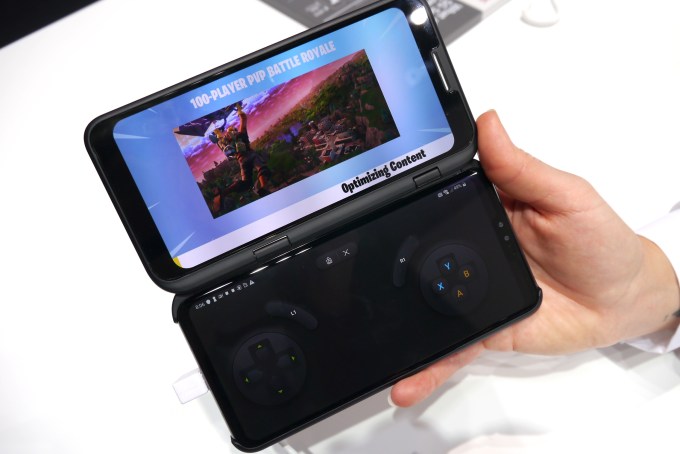
LG V50 ThinQ 5G with a dual screen accessory for gaming

Use cases such as better AR/VR are also a tough sell given how weak consumer demand has generally been on those fronts (with the odd branded exception).

The barebones reality is that commercial 5G networks are as rare as hen’s teeth right now, outside a few limited geographical locations in the U.S. and Asia. And 5G will remain a very patchy patchwork for the foreseeable future.

Indeed, it may take a very long time indeed to achieve nationwide coverage in many countries, if 5G even ends up stretching right to all those edges. (Alternative technologies do also exist which could help fill in gaps where the ROI just isn’t there for 5G.)

So again consumers buying phones with the puffed up idea of being able to tap into 5G right here, right now (Qualcomm claimed 2019 is going to be “the year of 5G!”) will find themselves limited to just a handful of urban locations around the world.

Analysts are clear that 5G rollouts, while coming, are going to be measured and targeted as carriers approach what’s touted as a multi-industry-transforming wireless technology cautiously, with an eye on their capex and while simultaneously trying to figure out how best to restructure their businesses to engage with all the partners they’ll need to forge business relations with, across industries, in order to successfully sell 5G’s transformative potential to all sorts of enterprises — and lock onto “the sweep spot where 5G makes sense”.

Enterprise rollouts therefore look likely to be prioritized over consumer 5G — as was the case for 5G launches in South Korea at the back end of last year.

“4G was a lot more driven by the consumer side and there was an understanding that you were going for national coverage that was never really a question and you were delivering on the data promise that 3G never really delivered… so there was a gap of technology that needed to be filled. With 5G it’s much less clear,” says Gartner’s Sylvain Fabre, discussing the tech’s hype and the reality with TechCrunch ahead of MWC.

“4G’s very good, you have multiple networks that are Gbps or more and that’s continuing to increase on the downlink with multiple carrier aggregation… and other densification schemes. So 5G doesn’t… have as gap as big to fill. It’s great but again it’s applicability of where it’s uniquely positioned is kind of like a very narrow niche at the moment.”

“It’s such a step change that the real power of 5G is actually in creating new business models using network slicing — allocation of particular aspects of the network to a particular use-case,” Forrester analyst Dan Bieler also tells us. “All of this requires some rethinking of what connectivity means for an enterprise customer or for the consumer.

“And telco sales people, the telco go-to-market approach is not based on selling use-cases, mostly — it’s selling technologies. So this is a significant shift for the average telco distribution channel to go through. And I would believe this will hold back a lot of the 5G ambitions for the medium term.”

To be clear, carriers are now actively kicking the tyres of 5G, after years of lead-in hype, and grappling with technical challenges around how best to upgrade their existing networks to add in and build out 5G.

Many are running pilots and testing what works and what doesn’t, such as where to place antennas to get the most reliable signal and so on. And a few have put a toe in the water with commercial launches (globally there are 23 networks with “some form of live 5G in their commercial networks” at this point, according to Fabre.)

But at the same time 5G network standards are yet to be fully finalized so the core technology is not 100% fully baked. And with it being early days “there’s still a long way to go before we have a real significant impact of 5G type of services”, as Bieler puts it. 

There’s also spectrum availability to factor in and the cost of acquiring the necessary spectrum. As well as the time required to clear and prepare it for commercial use. (On spectrum, government policy is critical to making things happen quickly (or not). So that’s yet another factor moderating how quickly 5G networks can be built out.)

And despite some wishful thinking industry noises at MWC this week — calling for governments to ‘support digitization at scale’ by handing out spectrum for free (uhhhh, yeah right) — that’s really just whistling into the wind.

Rolling out 5G networks is undoubtedly going to be very expensive, at a time when carriers’ businesses are already faced with rising costs (from increasing data consumption) and subdued revenue growth forecasts.

“The world now works on data” and telcos are “at core of this change”, as one carrier CEO — Singtel’s Chua Sock Koong — put it in an MWC keynote in which she delved into the opportunities and challenges for operators “as we go from traditional connectivity to a new age of intelligent connectivity”.

Chua argued it will be difficult for carriers to compete “on the basis of connectivity alone” — suggesting operators will have to pivot their businesses to build out standalone business offerings selling all sorts of b2b services to support the digital transformations of other industries as part of the 5G promise — and that’s clearly going to suck up a lot of their time and mind for the foreseeable future.

In Europe alone estimates for the cost of rolling out 5G range between €300BN and €500BN (~$340BN-$570BN), according to Bieler. Figures that underline why 5G is going to grow slowly, and networks be built out thoughtfully; in the b2b space this means essentially on a case-by-case basis.

Simply put carriers must make the economics stack up. Which means no “huge enormous gambles with 5G”. And omnipresent ROI pressure pushing them to try to eke out a premium.

“A lot of the network equipment vendors have turned down the hype quite a bit,” Bieler continues. “If you compare this to the hype around 3G many years ago or 4G a couple of years ago 5G definitely comes across as a soft launch. Sort of an evolutionary type of technology. I have not come across a network equipment vendors these days who will say there will be a complete change in everything by 2020.”
On the consumer pricing front, carriers have also only just started to grapple with 5G business models. One early example is TC parent Verizon’s 5G home service — which positions the next-gen wireless tech as an alternative to fixed line broadband with discounts if you opt for a wireless smartphone data plan as well as 5G broadband.

From the consumer point of view, the carrier 5G business model conundrum boils down to: What is my carrier going to charge me for 5G? And early adopters of any technology tend to get stung on that front.

Although, in mobile, price premiums rarely stick around for long as carriers inexorably find they must ditch premiums to unlock scale — via consumer-friendly ‘all you can eat’ price plans.

Still, in the short term, carriers look likely to experiment with 5G pricing and bundles — basically seeing what they can make early adopters pay. But it’s still far from clear that people will pay a premium for better connectivity alone. And that again necessitates caution. 

5G bundled with exclusive content might be one way carriers try to extract a premium from consumers. But without huge and/or compelling branded content inventory that risks being a too niche proposition too. And the more carriers split their 5G offers the more consumers might feel they don’t need to bother, and end up sticking with 4G for longer.

It’ll also clearly take time for a 5G ‘killer app’ to emerge in the consumer space. And such an app would likely need to still be able to fallback on 4G, again to ensure scale. So the 5G experience will really need to be compellingly different in order for the tech to sell itself.

On the handset side, 5G chipset hardware is also still in its first wave. At MWC this week Qualcomm announced a next-gen 5G modem, stepping up from last year’s Snapdragon 855 chipset — which it heavily touted as architected for 5G (though it doesn’t natively support 5G).

If you’re intending to buy and hold on to a 5G handset for a few years there’s thus a risk of early adopter burn at the chipset level — i.e. if you end up with a device with a suckier battery life vs later iterations of 5G hardware where more performance kinks have been ironed out.

Intel has warned its 5G modems won’t be in phones until next year — so, again, that suggests no 5G iPhones before 2020. And Apple is of course a great bellwether for mainstream consumer tech; the company only jumps in when it believes a technology is ready for prime time, rarely sooner. And if Cupertino feels 5G can wait, that’s going to be equally true for most consumers.

Zooming out, the specter of network security (and potential regulation) now looms very large indeed where 5G is concerned, thanks to East-West trade tensions injecting a strange new world of geopolitical uncertainty into an industry that’s never really had to grapple with this kind of business risk before.

Chinese kit maker Huawei’s rotating chairman, Guo Ping, used the opportunity of an MWC keynote to defend the company and its 5G solutions against U.S. claims its network tech could be repurposed by the Chinese state as a high tech conduit to spy on the West — literally telling delegates: “We don’t do bad things” and appealing to them to plainly to: “Please choose Huawei!”
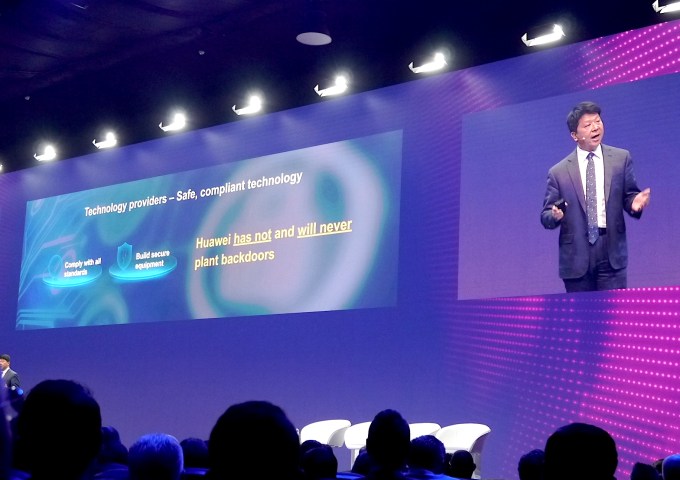
Huawei rotating resident, Guo Ping, defends the security of its network kit on stage at MWC 2019

When established technology vendors are having to use a high profile industry conference to plead for trust it’s strange and uncertain times indeed.

In Europe it’s possible carriers’ 5G network kit choices could soon be regulated as a result of security concerns attached to Chinese suppliers. The European Commission suggested as much this week, saying in another MWC keynote that it’s preparing to step in try to prevent security concerns at the EU Member State level from fragmenting 5G rollouts across the bloc.

In an on stage Q&A Orange’s chairman and CEO, Stéphane Richard, couched the risk of destabilization of the 5G global supply chain as a “big concern”, adding: “It’s the first time we have such an important risk in our industry.”

Geopolitical security is thus another issue carriers are having to factor in as they make decisions about how quickly to make the leap to 5G. And holding off on upgrades, while regulators and other standards bodies try to figure out a trusted way forward, might seem the more sensible thing to do — potentially stalling 5G upgrades in the meanwhile.

Given all the uncertainties there’s certainly no reason for consumers to rush in.

Smartphone upgrade cycles have slowed globally for a reason. Mobile hardware is mature because it’s serving consumers very well. Handsets are both powerful and capable enough to last for years.

And while there’s no doubt 5G will change things radically in future, including for consumers — enabling many more devices to be connected and feeding back data, with the potential to deliver on the (much hyped but also still pretty nascent) ‘smart home’ concept — the early 5G sales pitch for consumers essentially boils down to more of the same.

“Over the next ten years 4G will phase out. The question is how fast that happens in the meantime and again I think that will happen slower than in early times because [with 5G] you don’t come into a vacuum, you don’t fill a big gap,” suggests Gartner’s Fabre. “4G’s great, it’s getting better, wi’fi’s getting better… The story of let’s build a big national network to do 5G at scale [for all] that’s just not happening.”

“I think we’ll start very, very simple,” he adds of the 5G consumer proposition. “Things like caching data or simply doing more broadband faster. So more of the same.

“It’ll be great though. But you’ll still be watching Netflix and maybe there’ll be a couple of apps that come up… Maybe some more interactive collaboration or what have you. But we know these things are being used today by enterprises and consumers and they’ll continue to be used.”

So — in sum — the 5G mantra for the sensible consumer is really ‘wait and see’.



Source: TechCrunch http://j.mp/2tJhvtR

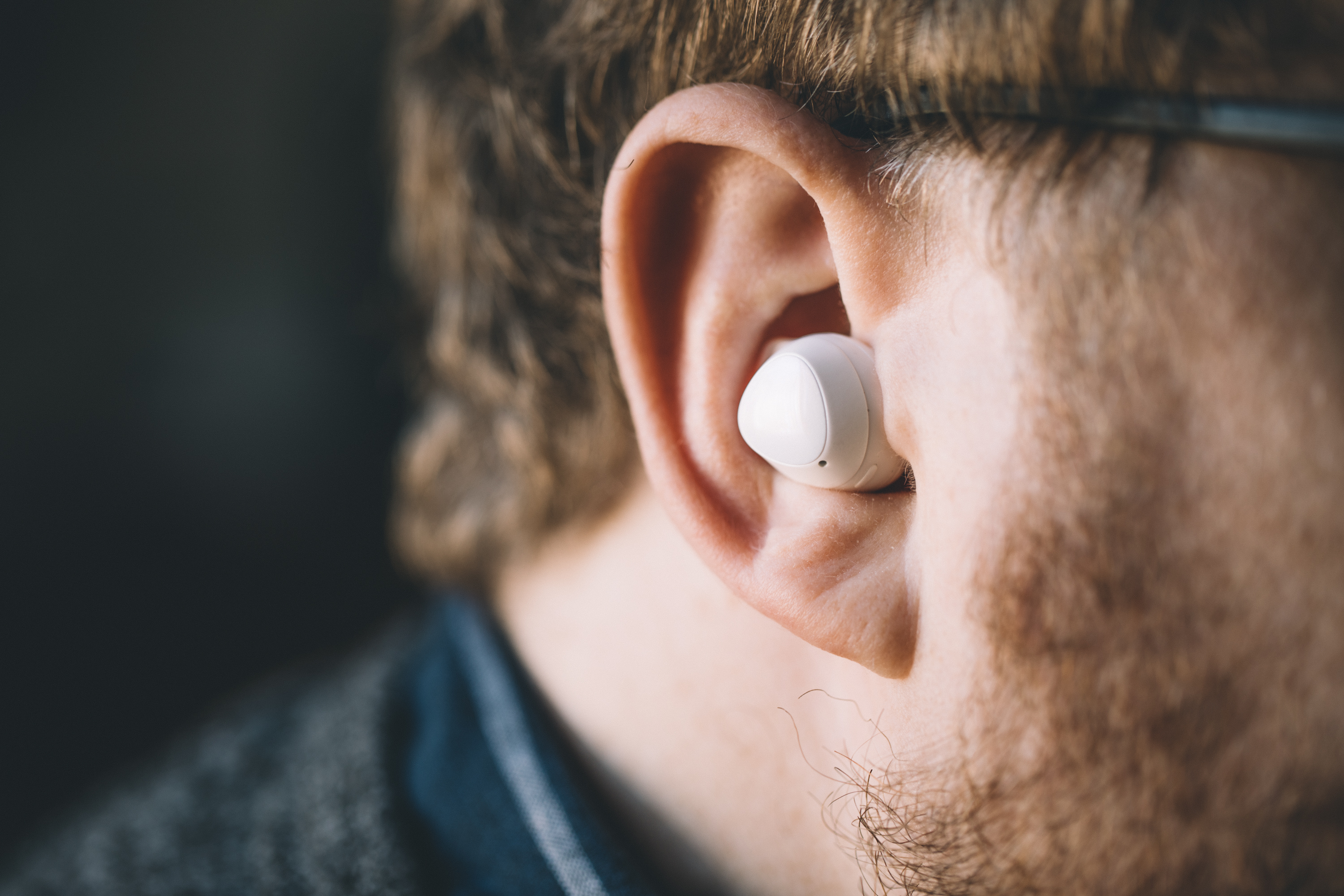
Samsung finally gets Bluetooth earbuds right

Granted, this news is maybe a bit too late. Samsung’s already sold out of the free Galaxy Buds it was throwing in with S10 pre-orders. That said, the new Bluetooth earbuds are worth the $129 asking price, especially for Galaxy device owners.

As with many fellow S10 reviewers, I’ve been using the Buds for about a week now. They happily hitched a ride in my ears from San Francisco to Barcelona and then back home to New York. And I’ve been digging them the whole time.

This certainly isn’t Samsung’s first wireless earbud rodeo, but frankly, it took the company taking more than a few pages out of Apple’s playbook to get things right here.

The Galaxy Buds are heavily inspired by the AirPods’ simple “just works” approach to the category, bucking Samsung’s tendency to overstuff products. That approach mostly works like a charm on handsets, but the best thing a set of earbuds can do is fade into the background. On that front, the Galaxy Buds work like a charm.

The AirPod comparisons are clear the moment you open the Galaxy Buds case the first time, triggering a dialog box on the screen of your Galaxy device. Like Apple’s version, the headphones will work with any Bluetooth device, but they work best with the company’s own products. Ecosystems, people. For other Android devices, you’ll need to download Samsung’s SmartThings or Galaxy Wearable apps for the proper effect.

The charging case itself is a bit more bulky and bulbous than the AirPods, but it’s certainly small enough to carry around in your jeans pockets. I also actually kind of prefer the pill shape to Apple’s Glide dental floss design.

The case offers two other distinct advantages:

  1. There’s a charging light on the outside
  2. It can be wirelessly charged

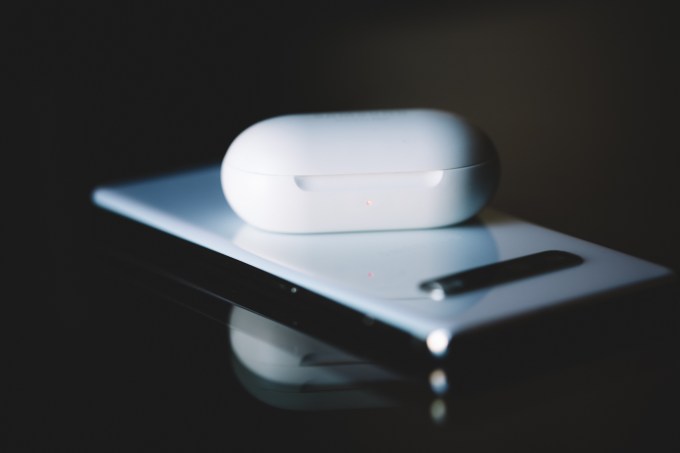
Apple’s no doubt working on that latter bit with the AirPods 2 (remember AirPower?), but Samsung’s beat the company to the punch here — and for that matter, with Wireless PowerShare, which lets you charge the case by simply placing it on the back of the S10. That was one less cable I needed to pack.

The battery should last you a while regardless. The Buds are 58 mAh each and the case is 252 mAh. That should translate to six hours a go on the Buds and seven hours with the case. I know I didn’t run out of juice during the day.

The Buds fit well and the silicon tips should ensure they fit more ear sizes. They also form a nice seal, keeping sound in and passively canceling out ambient noise. They’ll stay put pretty well — I didn’t have any issues keeping them on at the gym. The sound, tuned by Samsung-owned AKG, is solid. It’s not the best I’ve heard in a pair of wireless buds, but it’s perfectly fine for walking around and hitting the coffee shop.

All in all, a nice little surprise from Samsung, and a great addition to the Galaxy ecosystem. Perhaps they’re even good enough to convince Samsung to drop the headphone jack — but hopefully not.


Source: TechCrunch http://j.mp/2BYzq4k

Saturday's Best Deals: Red Dead Redemption Bundle, RoboVacs, Amazon Fire Tablets, and More

A digital magazine Gold Box, security cameras, bike helmets and a streaming box lead off Saturday’s best deals from around the web.

Read more...


Source: Gizmodo http://j.mp/2IMr4m3

Friday, March 1, 2019

The best of MWC 2019

After years of promises, 5G finally arrived at MWC 2019 — kind of, sort of. Barcelona served as the launching pad for several 5G handsets, set to arrive later this year. Though your actual 5G mileage may vary.

Foldable displays, another long-promised smartphone tech, also had its moment in the sun. Several companies debuted foldable — some were actual handsets with actual price tags, while others fell firmly within the concept camp. And pretty much all of them were behind glass.

Other notable trends for the event included cameras, AR/VR and security of all sorts. Here are the highlights and lowlights from the world’s biggest mobile show. All in all, we’re here for the weirdness.


5G Comes of Age

It’s been an MWC talking point for years now, but at this week’s show, the first 5G handsets finally arrived.

–Huawei Mate X
–LG V50 ThinQ 5G
–Samsung Galaxy Fold
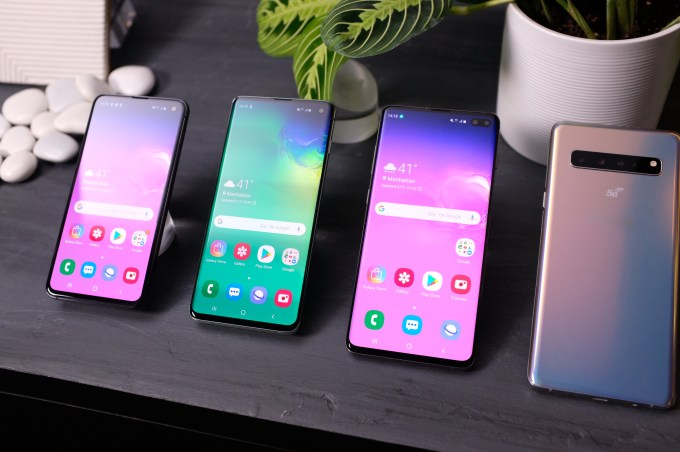
–Samsung Galaxy S10
–Xiaomi Mi Mix 3
–ZTE Axon 10 Pro 5G

OnePlus, which promised last year that it would be among the first to hop on the 5G train didn’t have a handset to announce, but it did demo a prototype and announce an initiative for 5G app devs.

Unfolding the future 

Time to unfold the checkbook. The first foldables are here, carrying an average price of ~$2,000. That’s like two phones for the price of, well, two phones. Whether or not the phones will be worth it, however, is another question entirely.

–Huawei Mate X
–Samsung Galaxy Fold

TCL showed off a prototype at the show, promising to deliver a more affordable take on the space at some point next year. Oppo, too, is still very much in the prototype phase.

AR/VR/MR

The biggest hit of the world’s biggest phone show may not have been a phone at all. Microsoft used the event to launch the second generation of its HoloLens, a headset firmly focused on business.

–Microsoft HoloLens 2
–Microsoft Azure Kinect
–Vive Focus Plus
–Qualcomm XR chips

Security

Huawei had a lot to say about accusations of security threats around its 5G equipment. Ditto for the European Commission’s digital commissioner. Android, meanwhile, will be getting more password-less logins.

Misc

–Energizer’s 18,000 mAh phone
–Light is expanding from smartphone cameras to self-driving cars
–HTC’s blockchain phone can now be purchased with fiat currency
–Sprint to launch 5G service in 4 cities in May
–Facebook expands its internet infrastructure projects
–New microSD format promises insane transfer speeds, better battery life
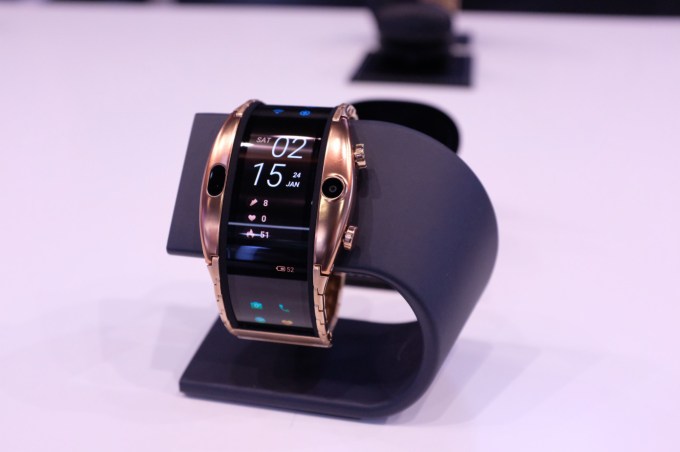
–Nubia’s ‘wearable smartphone’ might be the next step for flexible displays


Source: TechCrunch http://j.mp/2UcEf0M

Samsung Galaxy S10+ review

Launching around the globe a few days ahead of the world’s largest mobile show was the ultimate big-dog move. Samsung celebrated the 10th anniversary of its flagship phone line by launching its latest device on Apple’s sometimes-stomping grounds at San Francisco’s Bill Graham Civic Center.

The timing was less than ideal for all of us jet-lagged gadget reviewers, but the effect clearly paid off. Dozens of the world’s highest-profile reviewers have been roaming the streets of Barcelona with the S10 in hand and Galaxy Buds in ears. You couldn’t pay for that kind of publicity.

And, naturally, none of us minded testing those new photo features in one of Europe’s most beautiful cities.

But the 10th anniversary Galaxy arrives at a transitional time for Samsung — and the industry at large. The last couple of years have seen smartphone sales plateau for the first time since anyone started keeping track of those sorts of numbers, and big companies like Samsung and Apple are not immune.

That manner of existential crisis has led to one of the most eventful Mobile World Congresses in memory, as companies look to shake the doldrums of a stagnant market. It also led Samsung to open last week’s Unpacked event with the Galaxy Fold — first the cryptic product video and then the product unveil.

It’s a heck of a lead in, and, quite frankly, a recipe for disappointment. Here’s a look at the future, and now let’s talk about the present. Several people saw that I was carrying around a new Samsung device, got excited and were ultimately disappointed with the fact that I couldn’t unfold the thing.

None of this is any reflection on the quality of the S10 as a device, which I will happily state is quite high. But unlike the iPhone X, Apple’s 10th anniversary handset, the new Galaxy isn’t an attempt at a radical departure. Instead, it’s a culmination of 10 years of phone development, with new tricks throughout.

The Galaxy S10 doesn’t offer the same glimpse into the future as the Fold. But it does make a strong claim for the best Android smartphone of the moment. Starting at $1,000, it’s going to cost you — but if Samsung’s $1,900 foldable is any indication, smartphones of the future could make it look like a downright bargain.

Screen time

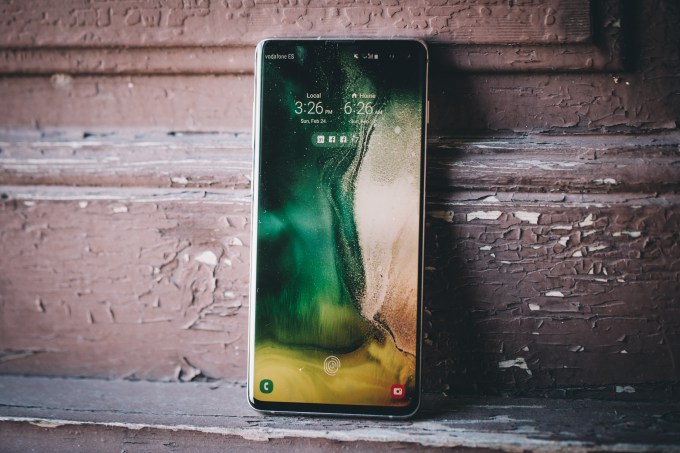
The Samsung Galaxy S10+ has been my daily driver for a week now. It joined me on an international road trip, through several product unveils from the competition and is responsible for all of the images in this post. Sometimes the best camera is the one in your pocket, as the saying goes.

Like other recent Samsung flagships, it’s going to be a tough device to give up when review time comes to a close. It’s a product that does a lot of things well. Tending, as Samsung often does, toward jamming as much into a product as possible — the polar opposite of chief competitor Apple’s approach.

But in the case of the Galaxy line, it all comes together very nicely. The S10 doesn’t represent a radical stylistic departure from its predecessor, maintaining the same manner of curved design language that helps the company cram a lot of phone into a relatively limited footprint, including a 93.4 percent screen-to-body ratio in the case of the S10+.

That means you can hold the handset in one hand, in spite of the ginormous 6.4-inch screen size. This is accomplished, in part, by the curved edges of the display that have been something of a Samsung trademark for a few generations now. It has also helped the Infinity-O design display, a laser cutout in the top-right of the screen, to fit the front-facing camera in as small a space as possible. In the case of the S10+, it’s more like an Infinity-OOO display.

Samsung was going to have to give in to the cutout trend sooner or later, opting to go ahead and skip the whole notch situation. The result is a largely unobtrusive break in the screen. Just for good measure, the phone’s default wallpapers have gradually darkening gradients that do a good job obscuring the cut out while not in use.

But while the whole more-screen-less-body deal is generally a good thing, there is a marked downside. I found myself accidentally triggering touch on the sides of the display with the edge of my palms, particularly when using the device with one hand. This has been a known issue for some time, of course.

Oh, and there’s one more key aspect in helping the S10+ go full screen.

Putting your finger on it

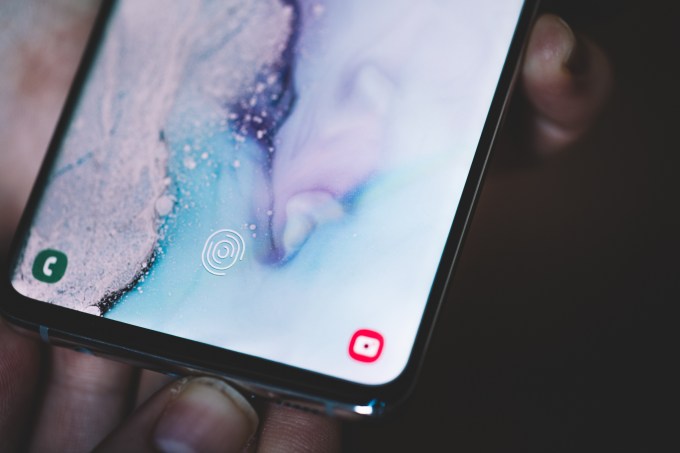
As with many of the features here, Samsung can’t claim to be the first to have the under-display fingerprint sensor. OnePlus, in a rare push to be first to market, added a similar technology to the 6T, which arrived last fall. But Samsung’s application takes things a step further.

The S10 and all of its variants are among the first to implant the fingerprint technology that Qualcomm announced at its Snapdragon Summit in Hawaii last year. The key differentiator here is an extra level of security. If the OnePlus’ fingerprint sensor is akin to your standard face unlock, this is more in line with what you get on the iPhone or LG’s latest handset.

The ability to sense depth brings another layer of security to the product — quite literally. Here’s how Qualcomm describes it:

Combining a smartphone’s display and fingerprint reader for a seamless and sleek look, 3D Sonic uses technological advances and acoustics (sonic waves) to scan the pores of a user’s finger for a deeply accurate 3D image. An ultra-thin (0.2 mm) sensor enables cutting-edge form factors such as full glass edge-to-edge displays, and can be widely used with flexible OLED displays.

Setup proved a bit fussier than the standard physical fingerprint button. Once everything is squared away, the reader is actually fairly responsive, registering a rippled water animation and unlocking the phone in about a second.

Getting your finger/thumb in the right spot might take a couple of tries on the first go, but after that, it’s muscle memory. There’s also a small fingerprint shaped guide that pops up on the lock screen for help. It can still be a bit tricky for those times you’re not looking directly at the display, or if you switch between hands.

It’s also worth noting that the unlock can be tricky with some screen protectors. Samsung will be working with accessory manufacturers to design compatible ones, but picking the wrong company could severely hamper the unlock function.

In some ways, though, the in-display fingerprint reader beats face unlock. I tend to lay my device down next to my keyboard when I work. Lifting the phone up to my eyes in order to read notifications is a bit of a pain. Same goes for when I need to check messages in bed. Here you can simply touch, check the notifications and go on with your life.

Ports in a storm

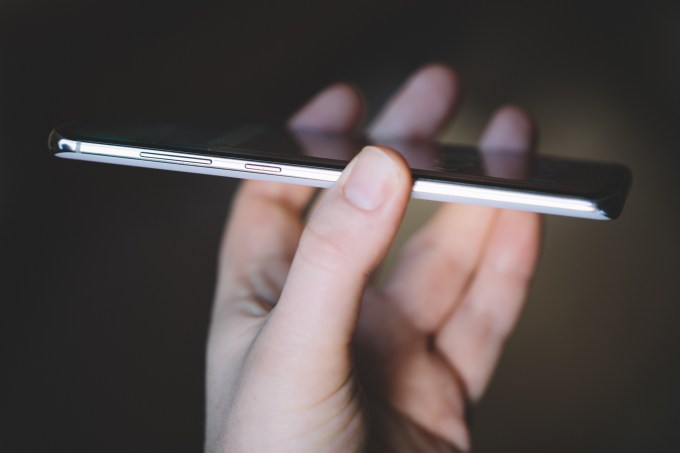
Around the edge is a mirrored metal band that houses the power button on one side and volume rocker and devoted Bixby button on the other. Yes, the Bixby button is back. And no, it won’t be going anywhere anytime soon. Samsung is wholly devoted to the smart assistant, and the company’s mobile devices are the one foothold Bixby currently commands.

The complaint about the Bixby button mostly stems from the fact that the assistant was, quite honestly, pretty useless at launch — particularly when compared to Android’s default assistant. In fact, when Google announced this week at Mobile World Congress the upcoming arrival of Assistant buttons on third-party devices, the news was generally welcomed by the Android crowd.

Samsung, meanwhile, gets hounded about the Bixby button, as though its inclusion is a way of forcing its assistant on users. Once again, Samsung relented, giving users the ability to remap the button in order to launch specific apps instead. This has played out time and again with the last several Galaxy devices.

The fact is, after an admittedly rocky start, Bixby has slowly been getting better, feature by feature. But the assistant still has catching up to do with Google’s headset, and frankly doesn’t offer a ton of reasons to opt into it over Android’s built-in option. Samsung has certainly made big promises of late, coupled with the imminent arrival of the Galaxy Home Hub.

Of course, that device was announced more than half a year ago, and when it does finally arrive, it will likely be carrying a prohibitive price tag. Beyond that, Bixby is currently the realm of things like Samsung refrigerators and washing machines. None of this adds up to a particularly compelling strategy for a multi-million-dollar AI offering that has become something of an inside joke in the industry.

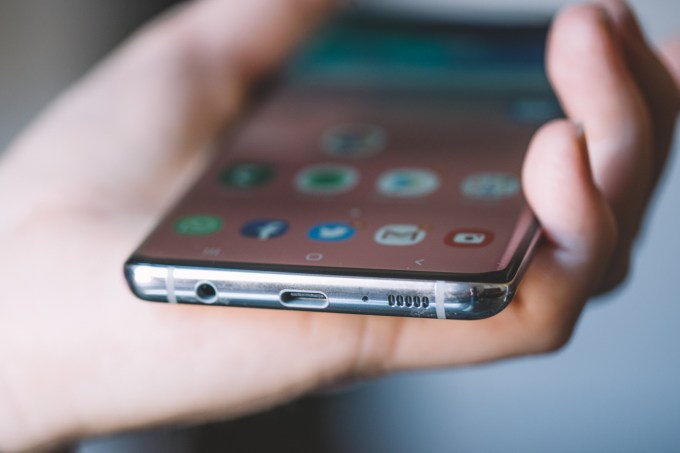
But Samsung sticks to its guns, for better or worse. Sometimes that means Bixby, and sometimes that means defiantly clinging to the headphone jack. Turns out if you avoid a trend for long enough, you can become a trendsetter in your own right — or at least a respite from the maddening crowd.

It’s been a few years since the beginning of the end came for the jack, and the whole thing still leaves plenty of users with a sour taste. Even the once-defiant Google quickly gave in and dropped the jack. Samsung, however, has stood its ground and the decision has paid off. What was ubiquitous is now a differentiator, and even as the company hawks another pair of Bluetooth earbuds, it’s standing its ground here.

All charged up

The back of the device, like the front, is covered in Gorilla Glass 6. The latest from Corning, which debuted over the summer, promises to survive “up to 15 drops.” But don’t try this at home with your shiny new $1,000 smartphone, as your results may vary.

The material also helps facilitate what is arguably the device’s most compelling new feature: Wireless PowerShare. Samsung’s not the first company to roll out the feature — Huawei introduced the feature on the Mate 20 Pro last year. Still, it’s a cool feature and, perhaps most importantly, it beat Apple to the punch.

The feature needs to be activated manually, by swiping down into notifications (it will also automatically shut off when not in use). From there, tapping Wireless PowerShare will pop up a dialog box, letting you know the feature is ready to us. Turn the phone face down on a table and place a compatible phone on top, face up, and the S10 will go to work charging it.

Placement can be a bit tough to get right the first couple of times. The trick is making sure both devices are centered. Once everything is where it should be, you’ll hear a quick notification sound and the phone will register as charging. In the case of the new Galaxy Buds, the sound is accompanied by the appearance of the case’s charging light.

It’s a neat feature, for sure. I can certainly imagine lending some ill-prepared friend a little juice at the bar one night. I wouldn’t go throwing out my power bank just yet. For one thing, one of the phones needs to be face-down the whole time. For another, wireless charging isn’t nearly as fast as its wired counterpart, so beyond the initial novelty of the feature, it may not ultimately be one you end up using a lot.

And, of course, you’re actively draining the battery of the phone sharing power. It’s a little like a Giving Tree scenario, albeit with the lowest stakes humanly possible. Thankfully, the handsets all sport pretty beefy batteries. In the case of the S10+, it’s a massive 4,100 mAh (with the 5G model getting an even nuttier 4,500 mAh).

It’s clear the days of Samsung’s Note 7-induced battery cautions are well behind it, thanks in no small part to the extensive battery testing the company implemented in the wake of a seemingly endless PR nightmare. As it stands, I was able to get around a full day plus two hours with standard usage while roaming the streets and convention center halls of Barcelona. That means you shouldn’t have to worry about running out of energy by day’s end — and you may even have a bit to spare before it’s all over.

Camera ready

You know the drill by now, Samsung and Apple come out with a new flagship smartphone, which quickly shoots to the top of DxOMark’s camera ratings. The cycle repeats itself yet again — with one key difference: It’s a three-way tie.

[Left: Standard, Right: Full zoom]

Really, there’s no better distillation of the state of the smartphone industry in 2019 than this. The latest iPhone, which is now half-a-year-old, is now a few spots down the list, with Samsung in a three-way tie for first. The other two top devices are, get this, both Huawei handsets. It’s been a banner year for the Chinese handset maker on a number of fronts, and that’s got to leave the Apples and Samsungs of the world a bit nervous, all told.

[gallery ids="1790609,1790610,1790611,1790612,1790613,1790614,1790615,1790617,1790618,1790619,1790620,1790621,1790622,1790623,1790624,1790625,1790626,1790627,1790628,1790629"]

For now, though, there’s a lot to like here… 109 points’ worth, in fact. The last several generations of camera races have resulted in some really well-rounded camera gear. It’s a setup that makes it difficult to take bad shots (difficult, but hardly impossible, mind), with the combination of hardware and software/AI improvements we’ve seen over the course of the last few devices.

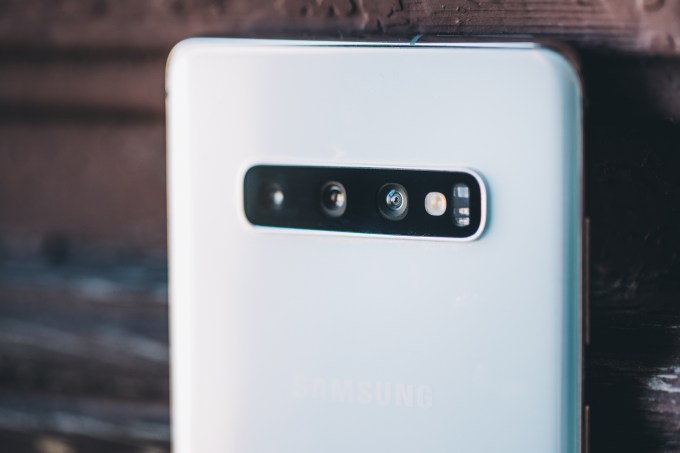
The camera setup varies from device to device, so we’re going to focus on the S10+ — the device we’ve spent the past week with (though, granted, the 5G model’s camera warrants its own write-up). The plus model features a three-camera array, oriented horizontally in a configuration that brings nothing to mind so much as the original Microsoft Kinect.

[Left: Samsung S10+, Right: Pixel 2]

It’s been fascinating watching companies determine the best use for a multi-camera array. Take Nokia’s new five-camera system, which essentially compiles everything into one super-high-res shot. Here, however, the three lenses capture three different images. They are as follows:

Wide (Standard): 12 MP, 26mm
Telephoto: 12 MP, 52mm
Ultrawide: 16 MP, 12mm

The system is configured to let you seamlessly switch between lenses in order to capture a shot in a given situation. The telephoto can do 2x shots, while the ultrawide captures 123-degree shots. The 5G model, meanwhile, adds 3D-depth cameras to the front and rear, which is a pretty clear indication of where Samsung plans to go from here.

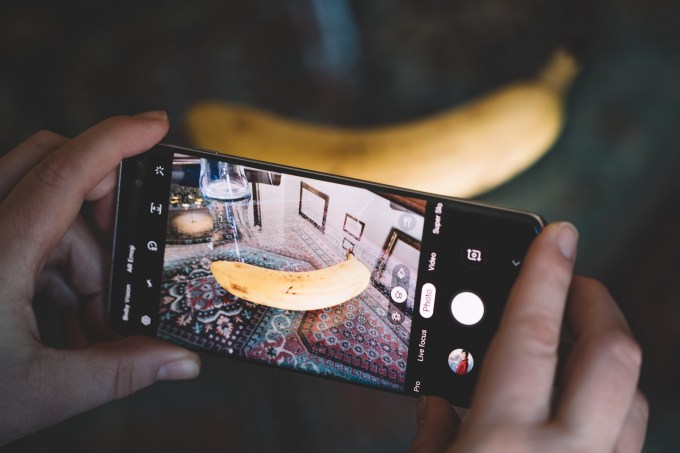
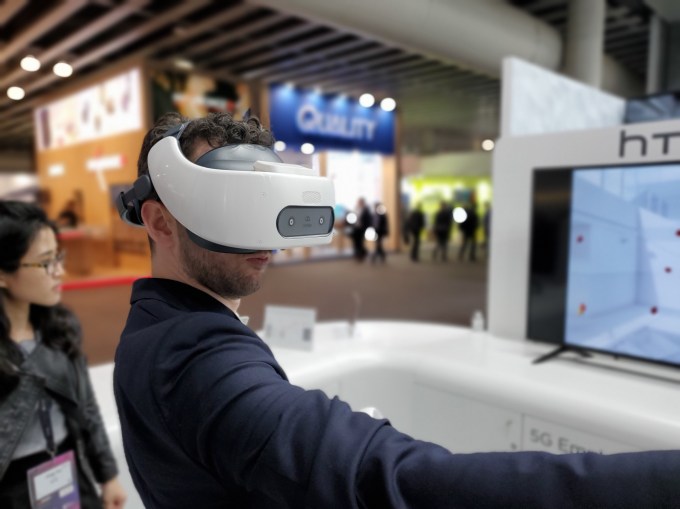
That said, the current setup is still quite capable of pulling off some cool depth tricks. This is no better exemplified than with the Live Focus feature, which applies a Portrait Mode-style bokeh effect around the objects you choose. The effect isn’t perfect, but it’s pretty convincing. Above is a shot I took on the MWC show floor and used in the led for a story about the HTC Vive.

There are some fun tricks as well, like the above Color Point effect. I’m not sure how often I’d end up using it, but damn if it doesn’t look cool.

All of that, coupled with new touches like wide-image panorama and recent advances like super-slow-motion and low-light shooting make for an extremely well-rounded camera experience. Ditto for scene identification, which does a solid job determining the differences between, say, a salad and a tree and adjusting the shooting settings accordingly.

Oh, and a low-key solid upgrade here are the improved AR Emojis, as seen above. They’re 1,000 times less creepy than the originals. I mean, I’m still not going to be sharing them with people unironically or anything, but definitely a step in the right direction.

Today’s Galaxy

The present moment is an exciting one for the mobile industry. There were glimmers of promise all over the MWC show floor and a week prior at Samsung’s own event. A stagnant industry has caused the big players to get creative, and some long-promised technologies are about to finally get real.

The Samsung Fold feels like a clear peek into the future of one of the industry’s biggest players, so it’s only natural that such an announcement would take some of the wind out of its flagship’s sails.

The S10 isn’t the smartphone of the future. Instead, it’s the culmination of 10 solid years of cutting-edge smartphone work that’s resulted into one of today’s most solid mobile devices.


Source: TechCrunch http://j.mp/2NELpIY