Tuesday, July 2, 2019

Despite Trump’s promised reprieve, Commerce Department tells staff to continue treating Huawei as blacklisted

President Donald Trump recently promised to ease the ban on American companies doing business with Huawei, but the Commerce Department is requiring its staff to treat Huawei as if the blacklist is still in place, reports Reuters.

Enforcement staff were sent an internal letter this week by John Sonderman, the Deputy Director of the Office of Export Enforcement, to continue treating Huawei as blacklisted. The letter, viewed by Reuters, said applications from companies that want to sell to Huawei should be considered on merit and flagged with language that notes Huawei is on the entity list. The applications should also still be viewed under a “presumption of denial” policy that applies to companies on the blacklist. This means license applications are scrutinized more closely and most of them are rejected.

Along with 70 other companies, Huawei was added in May to an “entity list” of companies that U.S. companies are forbidden to do business with. As a result, many of Huawei’s most important component suppliers, including Qualcomm and Intel, severed ties with Huawei, while Google cut off its access to Android--a major headache for Huawei, which is the third-largest smartphone maker in the world. Huawei founder and CEO Ren Zhengfei said the ban would result in $30 billion in lost revenue.

According to Reuters, this is the only guidance enforcement officials have received since Trump’s surprise announcement, made after he met with Chinese premier Xi Jinping at the G20 summit. In an apparent concession to China, which sees Huawei as major sticking point in the U.S.-China trade war, Trump suggested that the U.S. will allow American companies to resume selling hardware to Huawei as long as it doesn’t pose a “great national emergency problem,” and would hold meetings about Huawei’s trade status.

After Trump’s announcement, Ren downplayed the effect of the promised partial reprieve, telling the Financial Times that the ban has helped the company “become more united than ever.” He added “if we aren’t allowed to use U.S. components, we are very confident in our ability to use components made in China and other countries.”


Source: TechCrunch http://j.mp/2JitLc2

Lawsuit Accuses Android Co-Founder Andy Rubin of Hiding Wealth From Wife, Running 'Sex Ring'

Court documents from a civil complaint brought by disgraced former Google executive Andy Rubin’s estranged spouse, Rie Hirabaru Rubin, and obtained by BuzzFeed News, claim that Rubin left Google after an “inappropriate relationship” with a subordinate, hid his fortune from his ex-wife, and engaged in disturbing…

Read more...


Source: Gizmodo http://j.mp/2KUdTj5

Newly unsealed court documents reveal additional allegations against Andy Rubin

Newly unsealed documents have revealed a spate of bombshell allegations against Android founder Andy Rubin. BuzzFeed’s Ryan Mac has made the documents available as a PDF, and there’s a lot to unpack.

The nearly 40 pages detail a pre-marital agreement made with Rubin’s now-ex-wife, Rie Hirabaru Rubin, three days before their wedding. The documents refer to the agreement as “unconscionable, capping spousal support and stripping Plaintiff of her community property rights under California law without informed consent.”

“This is a family law dispute involving a wife who regrets her decision to execute a prenuptial agreement,” Rubin’s attorney said in a statement to TechCrunch. “It is full of false claims and we look forward to telling our side of the story.”

The Essential Phone and Playground Global founder has largely operated in the background since The New York Times published an explosive story in late-2018 detailing sexual misconduct and massive severance package from his former employer, Google.

The documents go on to allege that her attorney, Stephen Peters, had previously represented Rubin in a prior divorce without her knowledge. This lawsuit seeks to make that prenuptial agreement invalid.

“Plaintiff was not aware of this pre-existing attorney-client relationship or the extent of Peters’ detailed knowledge regarding Rubin’s property and assets which were not fully disclosed at the time,” according to the document, “his detailed knowledge of Rubin’s extravagant payments to women or sex or that Peters was in reality working for the benefit of Rubin, and to the Plaintiff’s detriment.”

Allegations of Rubin’s improprieties echo many of the claims reported in the 2018 Times piece, including, “ownership relationships […] whereby Rubin would pay for their expenses in exchange for offering them to other men.”

Over the last several months, Rubin and his ex-wife have been battling in court regarding whether or not the complaint would remain sealed. In April, a California state judge tentatively concluded that small portions of the complaint could be sealed. In May, the plaintiff argued that much of the material in the complaint had already been reported and that there was a notable public interest in the case. For example, Rubin’s alleged payments to women for sex — in the sum of hundreds of thousands of dollars — has already been reported and is relevant to the plaintiff’s case, she argued.

“Rubin hid these payments from Plaintiff during their marriage by using his individual bank account and routing payments through his wholly owned company Cosmofion LLC,” the plaintiff states in a court filing. “These allegations show, and the evidence at trial will prove, that Rubin was highly motivated to coerce and defraud Plaintiff to enter into an unconscionable Premarital Agreement so that he would be able to conceal and continue to engage in these illicit sexual activities and continue to make payments of hundreds of thousands of dollars to these women without being detected by Plaintiff.”

Regarding the parts of the document that remain under seal, the judge ruled they either involve post-marital allegations and/or information that is covered by a stipulated protective order.

Update: Rubin’s lawyer Ellen Stross has offered TechCrunch the following comment on the matter. “This is a family law dispute involving a wife who regrets her decision to execute a prenuptial agreement. It is full of false claims and we look forward to telling our side of the story.”


Source: TechCrunch http://j.mp/2XjSBNu

KKR has acquired Corel (including its recent acquisition Parallels), reportedly for $1B+

Only six months after snapping up virtualization specialist Parallels, Canadian software company Corel is itself getting acquired. TechCrunch has learned and confirmed with multiple sources that private equity giant KKR has closed a deal to buy the company from Vector Capital, which has owned some or all of Corel since 2003.

KKR’s interest in Corel was first rumored in May, when PE Hub reported the two were in talks for a sale valued at over $1 billion. At the time, representatives of Corel declined to comment, although our sources inside the company indicated that the reports were not inaccurate.

Fast-forward to today, and both KKR and and a spokesperson for Parallels/Corel declined to comment. But, we now have a copy of the memo provided by an internal source that has been sent out to staff announcing that the deal has indeed closed, and that Corel is now officially part of the KKR family of companies.

According to the memo, KKR is very optimistic about Corel’s prospects. It plans to give Corel an “infusion of capital” to accelerate its growth, which will go into two areas. First will be expanding operations for the existing business: Corel is the company behind a number of longstanding software brands including WordPerfect, Corel Draw, WinZip, PaintShop Pro. Second will be making acquisitions (and the sheer proliferation of promising startups in the last decade dedicated to all variety of apps and other software that may have found it a challenge to scale means Corel could have rich pickings).

There are no layoffs planned as part of the deal, and the official announcement had been planned to go out next week, but now looks like it may be moved up to tomorrow (Wednesday).

Vector and Corel itself have never publicly disclosed much on user numbers or financials, but Vector has described the company as “highly profitable,” with dividends of more than $300 million to date. The memo we’ve seen notes that Corel (including Parallels) has millions of customers across its various software platforms and apps.

The acquisition of Corel by KKR marks another chapter in the company’s long corporate history.

Founded in the 1980s — when personal computers were just starting to enter the mainstream but well before we had anything like the internet (not to mention the world of cloud-based apps) that we know today — Corel once positioned itself as a potential competitor to Microsoft in the software wars.

When Corel purchased WordPerfect from Novel in 1996, Corel founder Michael Cowpland viewed the software package as an integral part of that rivalry, describing it as the Pepsi to Microsoft’s Coke — that is, Word.

Microsoft proved the mightier of the two, and it even eventually signed a partnership with Corel that saw it investing in the company: a sell out, as one disappointed Canadian journalist described it at the time. The two have also sparred over patents.

Corel, which went public early in its life, got battered in the first dot-com bust (which was not helped by an insider trading scandal that led to Cowpland’s departure). Vector stepped in and took it private in 2003.

After restructuring the company, Vector listed Corel again in 2006. But, amid another recession that again hit Corel hard, it once more took it private in 2010. In the intervening years, Corel has been focused on modernising its offerings, bringing in e-commerce, direct downloads, subscriptions and acquisitions to bring the company’s products and wider business closer to how consumers and workers use computers today.

Parallels was a part of that strategy: its products help people work seamlessly across multiple platforms, letting employees (and IT managers) run a unified workflow regardless of the device or operating system, with Parallels providing support for Windows, Mac, iOS, Android, Chromebook, Linux, Raspberry Pi and cloud — a timely offering in the current, fragmented IT market.

If the $1 billion+ figure is accurate, that strategy seems to have worked: across the two times that Vector took Corel private, it never paid more than $124 million for the company (the second time, as its stock was tanking, it paid just $30 million).


Source: TechCrunch http://j.mp/2J4u5MB

Netflix’s ‘Stranger Things’ comes to Roblox ahead of its July 4 premiere

Netflix is bringing its hit TV show Stranger Things to Roblox. On Monday, Roblox announced the launch of limited-time, Stanger Things-themed items that will be made available to its over 90 million players, who can earn them by solving daily riddles and puzzles. Other free, limited-time items like a “Scoops Ahoy” hat and Demogorgon mask will also be offered as virtual items for players’ Roblox avatars.

The first of the two themed items are live now and will be free to download through July 12. Four more items can be unlocked by solving daily riddles and puzzles, with a new clue arriving each day ahead of the July 4 premiere of Stranger Things Season 3.

Roblox will also share clues across its social media accounts on FacebookTwitter, and Instagram, it says.

What’s interesting about the Roblox integration is that it may reach children younger than those ages 14 and up — the ages that the series itself is rated for (TV-14). (Likely, some braver tweens are already familiar with the show and are watching alongside mom or dad…or at least with their approval).

However, the Roblox partnership is only one of several gaming-focused initiatives Netflix has planned to market some of its most anticipated programming, including both Stranger Things and other titles.

At this year’s E3, Netflix detailed a series of gaming initiatives, including integrations with partners like Ubisoft, Behavior Interactive, and even Fornite, in addition to Roblox. Already, some Fornite players had found the “Scoops Ahoy” easter egg back when Season 9 launched, Netflix said.

Plus, the company is preparing not one but two new Stranger Things-themed games. The first, called Stranger Things 3: The Game, will launch across platforms including Nintendo Switch, Xbox One, PlayStation 4, PC, Mac, Android and iOS on the same day the third season premieres. Like its predecessor, also by developer BonusXP, the game is meant to be a companion to the current season and features 16-bit action for a nostalgic feel.

Next year, Netflix is planning another new Stranger Things title, with a mobile game for iOS and Android. This one is a location-based RPG/puzzler where players explore The Upside Down hidden all around them, while working with other players to “overcome its emerging evils.”

Netflix is also preparing to launch a turn-based tactics game adapted from the Netflix Original series The Dark Crystal: Age of Resistance, on Nintendo Switch, Xbox One, PlayStation 4, PC and Mac.

A wave of digital marketing isn’t entirely new for the streaming service.

In the past, it toyed with mobile experiences to advertise its shows — like the standalone Orange is the New Black app it launched back in 2014, or the “FakeBlock” app introduced to advertise the new season of Arrested Development.

The company also toyed around with a cross between games and TV with the 2018 launch of Minecraft: Story Mode, which some could consider a form of gaming. Netflix, however, did not. It even claimed at the time that the company did not have any plans “to get into gaming.”

Well, that’s no longer true.

While many of the integrations and games themselves are built by partnered developers, Netflix is clearly involved. And unlike the throwaways apps from years prior, these are more series efforts on Netflix’s part — not just promotional vehicles for its shows.

The marketing doesn’t stop at digital games either.

Netflix’s Stranger Things is more than just a show, its a whole business unto itself. It’s Baskin Robbins ice cream flavors, and Target exclusives like a Stranger Things bike, toys and apparel. It’s posters, games, and all kinds of other merch, too. And that’s just one show. An analyst previously said Netflix’s merch biz could be a billion-dollar addition to the company’s revenue.

Beyond gaming and other stuff to buy, the Stranger Things empire extends to brand deals with Coke, Levi’s, H&M, Nike, Eggo, Schwinn, Trivial Pursuit, Burger Kind, and more. 

The Roblox and Fornite integrations are live now. The Season 3-themed game arrives July 4.


Source: TechCrunch http://j.mp/2KVLDMY

File storage app 4shared caught serving invisible ads and making purchases without consent

With more than 100 million installs, file sharing service 4shared is one of the most popular apps in the Android app store.

But security researchers say the app is secretly displaying invisible ads and subscribes users to paid services, racking up charges without the user’s knowledge — or their permission — collectively costing millions of dollars.

“It all happens in the background… nothing appears on the screen,” said Guy Krief, chief executive of London-based Upstream, which shared its research exclusively with TechCrunch.

The researchers say the app contains suspicious third-party code which allowed the app to automate clicks and make fraudulent purchases. They said the component, built by Hong Kong-based Elephant Data, downloads code which is “directly responsible” for generating the automated clicks without the user’s knowledge. The code also sets a cookie to determine if a device has previously been used to make a purchase, likely as a way to hide the activity.

Upstream also said the code deliberately obfuscates the web addresses it accesses and uses redirection chains to hide the suspicious activity.

Over the past few weeks Upstream said it’s blocked over 114 million suspicious transactions originating from two million unique devices, according to data from its proprietary security platform, which the company said would cost consumers if they are not blocked. Upstream only has visibility in certain parts of the world — Brazil, Indonesia, and Malaysia to name a few — suggesting the number of observed suspicious transactions was likely a fraction of the total number.

Then in mid-April, 4shared’s app suddenly disappeared from Google Play and was replaced with a near-identical app with the suspicious components removed.

At the time of writing, 4shared’s new app has more than 10 million users.

Irin Len, a spokesperson for 4shared, told TechCrunch that the company was “unaware” of the fraudulent ad activity in its app until we reached out, but confirmed the company no longer works with Elephant Data.

Len said the old app was removed by Google “without reason,” but its suspicions quickly fell on the third-party components, which the company removed and relaunched the app. But because their old app was pulled from the app store, 4shared said it wasn’t allowed to push an update to existing users to remove the suspicious components from their devices.

Google did not respond to TechCrunch’s request for comment.

We sent Elephant Data several questions and follow-up emails prior to publication but we did not hear back.

4shared, owned by New IT Solutions based in the British Virgin Islands, makes a brief reference to Elephant Data in its privacy policy but doesn’t explicitly say what the service does. 4shared said since it’s unable to control or disable Elephant Data’s components in its old app, “we’re bound to keep the detailed overview of which data may be processed and how it may be shared” in its privacy policy.

Little else is known about Elephant Data, except that it bills itself as a “market intelligence” solution designed to “maximize ad revenue.”

The ad firm has drawn criticism in several threads on Reddit, one of which accused the company of operating a “scam” and another called the offering “dodgy.” One developer said he removed the components from his app after it began to suffer from battery life issues, but Elephant Data was “still collecting data” from users who hadn’t updated yet their apps.

The developer said Google also banned his app, forcing him to resubmit an entirely new version of his app to the store.

It’s the latest app in recent months to be accused of using invisible ads to generate fraudulent revenue. In May, BuzzFeed News reported similar suspicious behavior and fraudulent purchases in Chinese video app VidMate.


Source: TechCrunch http://j.mp/2FNKWRH

Samsung shuts down its AI-powered Mall shopping app in India

Samsung has quietly discontinued an app that it built specifically for India, one of its largest markets and where it houses a humongous research and development team. The AI-powered Android app, called Samsung Mall, was positioned to help users identify objects around them and locate it on shopping sites to make the purchase.

The company has shut down the app a year and a half after its launch. Samsung Mall was exclusively available for select company handsets and was launched alongside the Galaxy On7 Prime smartphone. News blog TizenHelp was first to report about the development.

At the time of the launch, Samsung said Mall app will complement Bixby, the company’s virtual assistant. Bixby already offers a functionality that allows users to identify objects through photos. But it does not let users make the purchase.

“The first insight while developing Samsung Mall was that consumers may be looking to find the price, the colour, delivery options and a lot of other things. Indian consumers want to find the best deals first. They aren’t tied up with one particular portal as well,” Sanjay Razdan, Director of Samsung India told local outlet India Today at the time of the launch.

Samsung had partnered with Amazon, Shopclues and TataCLiQ to show relevant results from these retailers on its “one-stop online experience” app. Users were also able to compare prices to see which website was offering them the item at lowest cost.

Samsung Mall app was downloaded about five million times from Google Play Store in India since March 2018, Randy Nelson, Head of Mobile Insights at analytics firm SensorTower told TechCrunch. The app had begun to lose its popularity in recent months, though.

“Downloads in May totaled 275,000 — which was down 38% year-over-year from 476,000 in May 2018. It was ranked No. 1,055 by downloads in India’s Google Play store in May — down from 487 a year ago,” said Nelson.

Once the top smartphone vendor in India, Samsung has lost that crown to Xiaomi. The Chinese smartphone maker has held the tentpole position in India for two straight years now, according to research firm IDC.

A Samsung spokesperson in India, reached out by TechCrunch on Monday, has yet to comment on the story.


Source: TechCrunch http://j.mp/2Nv63i0

Monday, July 1, 2019

China silences podcast and music apps as online crackdown widens

Audio apps are flying high in China. In 2018, online listeners in the country grew 22.1% to surpass 400 million, at a rate far exceeding that of the mobile video and e-reading populations, according to market researcher iiMedia.

But the fledgling sector is taking a hit. On Friday, a total of 26 audio-focused apps were ordered to terminate, suspend services, or have talks with regulators as they were investigated and deemed to have spread “historical nihilism” and “pornography,” according to a notice posted by the Cyberspace Administration of China (CAC).

The clampdown has, in a way, been foreshadowed by a recent attack of user-generated audio content. Last month, Apple restricted Chinese users from accessing podcasts that aren’t hosted by its local partners, effectively preventing those with a Chinese Apple account from consuming content unchecked by Chinese censors.

It’s not uncommon for Chinese authorities to take aim at a rising media field. As short-form videos took off in 2018, the government issued similar directives demanding Douyin (TikTok for China), Kuaishou and many others to purge “illicit” content. The year before, a raft of live streaming apps were in the crosshairs.

CAC, the country’s top internet regulator, only disclosed four of the apps it’s attacking. These services are dwarfed in user size by mega-apps like WeChat or Douyin, with the most successful one — Soul — used on six million devices in May, per data from analytics firm iResearch.

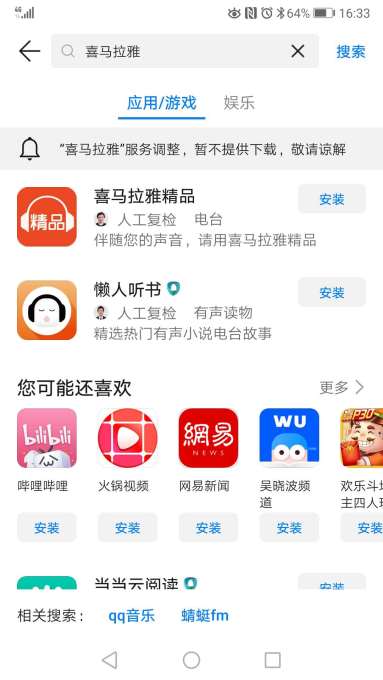
Nonetheless, people reported on social media that more prominent services have also gone missing from app stores. China’s top podcast sharing app Himalaya FM and its smaller rival Lizhi FM, for example, have been pulled from certain Chinese Android markets including one operated by Xiaomi.

Himalaya FM has been pulled from a number of Chinese Android stores. Screenshot: TechCrunch

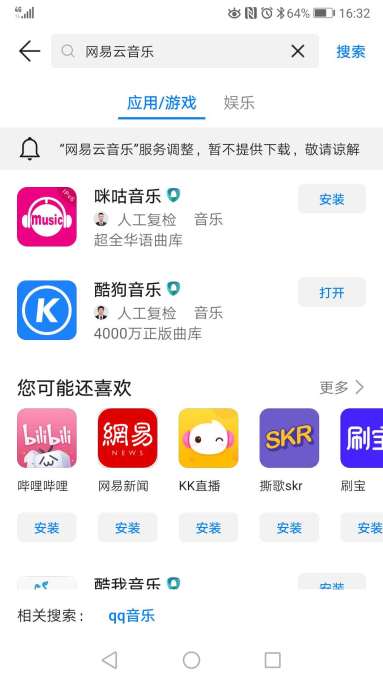
Music apps seem to be under fire as well. Searches for “NetEase Cloud Music,” a music streaming service operated by internet titan NetEase, on a few local Android stores returned the alert that the app is unavailable for download due to ongoing “maintenance”.

NetEase Cloud Music has been pulled from a number of Chinese Android stores. Screenshot: TechCrunch

As of Monday afternoon, Himalaya FM, Lizhi FM and Netease Cloud Music are still available for download via Apple’s Chinese App Store, where Beijing’s oversight has historically been slower to come.

This is hardly the first time online music platforms get scrutinized in China. The government has occasionally disavowed and censored songs, including most recently works of Li Zhi, an outspoken musician who’s reportedly gone missing ahead of the 30th anniversary of the Tiananmen Square crackdown. None of Li’s songs can be found on China’s major music streaming apps now.

li zhi

Popular rock musician Li Zhi’s songs are missing from all major Chinese music streaming apps. / Screenshot: TechCrunch

Himalaya FM, Lizhi FM, and NetEase could not be reached for comment at the time of writing. We will update the story if we hear back from the companies.

China’s audio market has been left to “run rampant” for a long time and create “harmful influence” on teenagers, so measures must be taken, said the CAC. The regulator accused firms of chasing eyeballs with personalized podcasts containing content like pornography, superstition and, to some surprise, “two-dimensional culture,” a term referring to a fast-growing industry consisting of anime, comics and games inspired by Japanese pop culture.

The Communist Party is certainly on the watch for the expanding universe of imported content from a country over which it has historical grievances. Besides suppression, the party has also responded by making its own anime — one about Karl Marx — to attract the younger generations. Of course, the series was scheduled to broadcast on Bilibili, the Nasdaq-listed video-streaming platform that’s long been a favorite haven for China’s fans of 2D and youth cultures.


Source: TechCrunch http://j.mp/301ZBRc