Wednesday, October 2, 2019

Google rolls out new privacy tools for Maps, YouTube and Assistant

Google today announced a handful of new consumer privacy tools for some of its most-used products, including Google Maps, YouTube, and Google Assistant. The tools are meant to better allow users to control, manage and erase the data Google collects from those who use its services or prevent Google from collecting that data in the first place, in some cases.

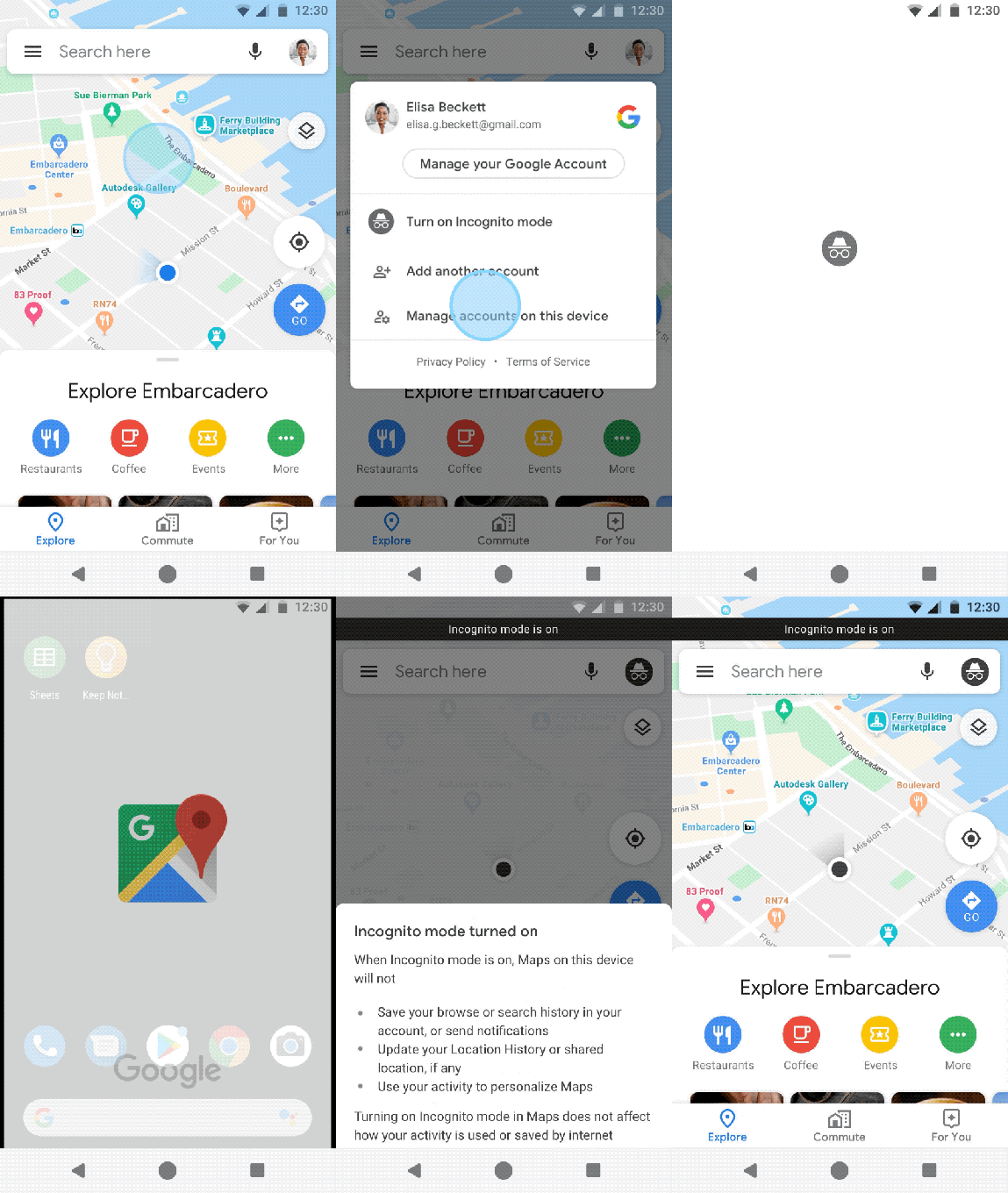
In Google Maps, there’s now an incognito mode option that works similar to the one available in the Chrome browser and, more recently, YouTube.

The idea is that there are times when you don’t want Google to track your usage of Maps, including when you search for particular places or travel about town.
IncognitoMarketingGIF 2019.10.01

There are a number of reasons why you might want to opt-out of being tracked in Maps — maybe you don’t want to taint your personalized recommendations with irrelevant data. Or maybe you don’t like the idea that a company tracks your every search and precise location because that’s just creepy!

You can access incognito mode from the menu that appears when you tap on your profile photo in Maps. The feature launches on Android this month, with iOS to follow.

On YouTube, Google is launching the ability to auto-delete your YouTube History. This means you’re able to set a particular time period where you want to keep your YouTube History available, like 3 or 18 months. The rest will be deleted automatically. You can also choose to manually delete the history, if you prefer.

YT retention

Finally, Google is addressing privacy issues on Google Assistant.

You’ll be able to ask “Hey Google, how do you keep my data safe?” for more information, though it’s doubtful most consumers will ever think to utter this command.

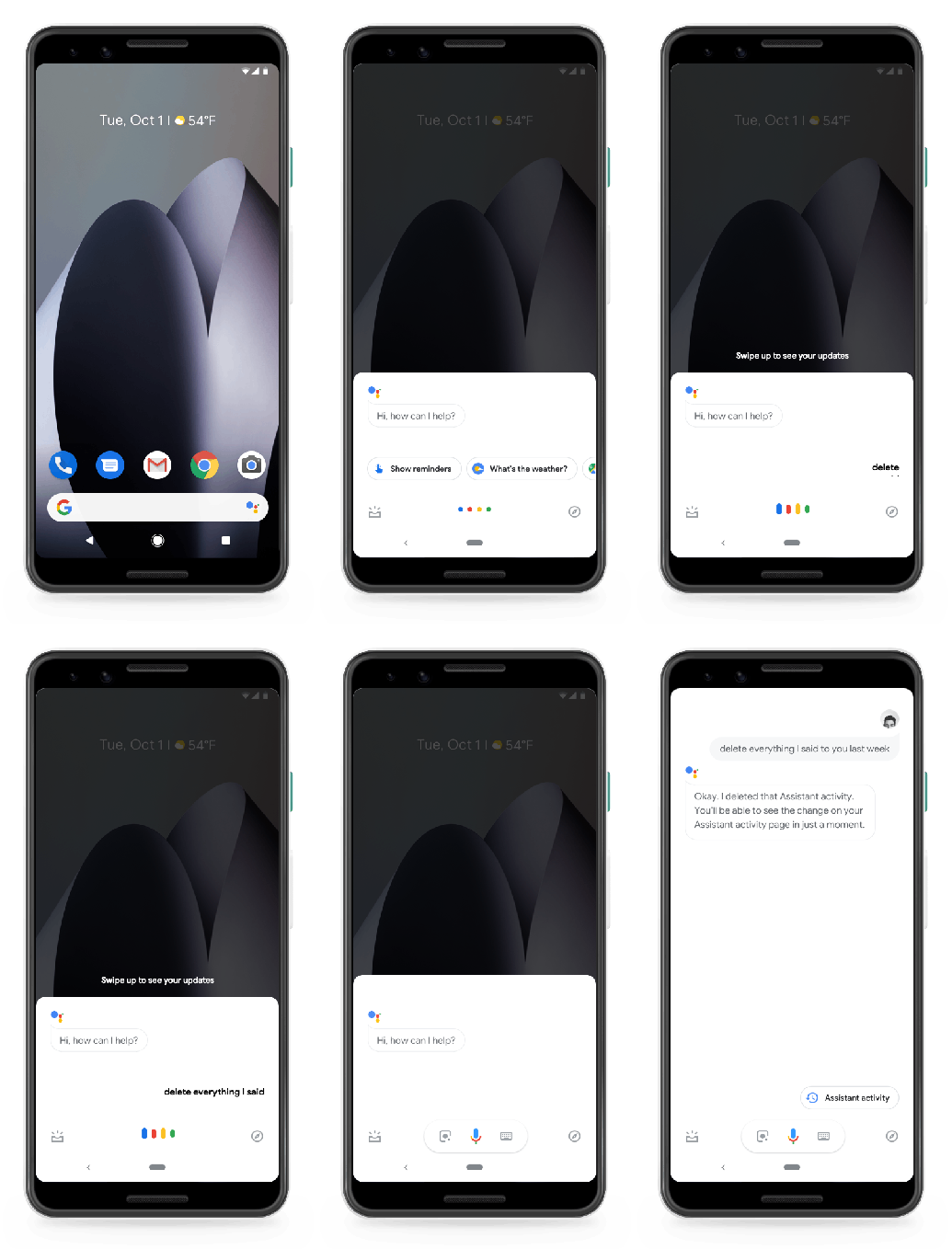
More importantly, a new feature will launch in the next few weeks that will let you delete your Assistant activity with voice commands.

For example, “Hey Google, delete the last thing I said to you,” or “delete everything I said to you last week.”

If you need to delete further back than a week, the Assistant will direct you to the account settings page where you can make that happen. That’s a bit more cumbersome, but at least it puts the settings in closer reach than before.

The issues around voice assistants’ data retention have recently been making waves, as news media alerted consumers to the fact that these smart assistants weren’t exactly unmanned operations — actual humans were reviewing the retained voice log files in order to tweak and improve the assistants’ reactions and responses.
privacy actions last week 1

Google Assistant, Alexa and even Apple’s Siri came under fire for their lack of attention to privacy controls in this emerging area, and all three have now responded accordingly.

Amazon, for example, allows Alexa users to opt out of having recordings manually reviewed, and Apple suspended its Siri response grading program worldwide until it could address the issue with privacy controls through a future software update.

Google says its new voice commands for deleting Assistant data will roll out in the next few weeks, starting in English this week and all other languages next month.

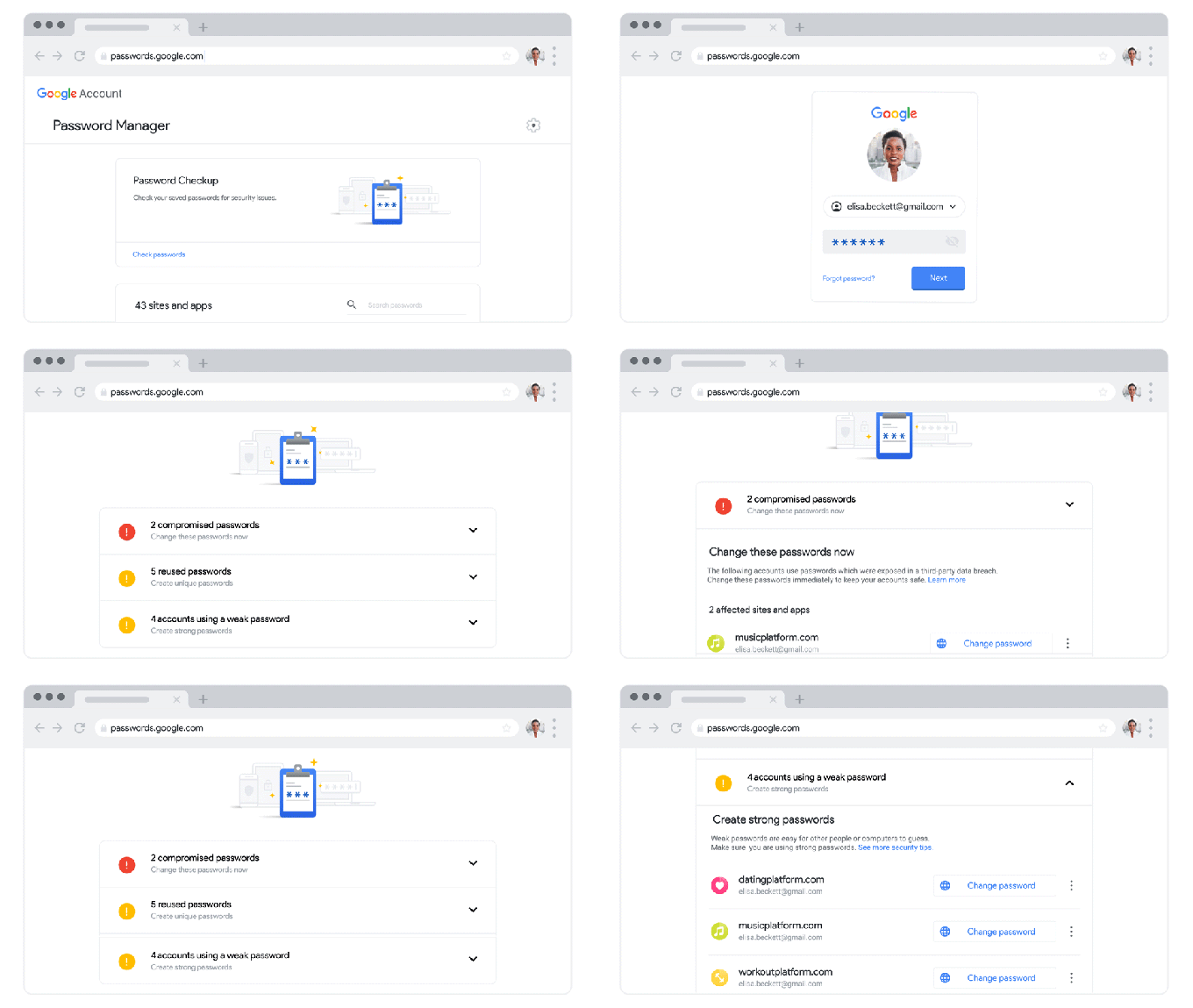
In another security-related improvement, Google also said it would introduce a new feature called Password Checkup to its password manager that will tell you if any of your passwords are weak, whether you’ve reused them across multiple sites, or if Google has discovered they’ve been compromised.
PWCheckup Gif 1

This is a standard feature for most third-party password management apps, so it makes sense for Google to now incorporate it, as well.

Currently, this is available at passwords.google.com, but is being added to Chrome later this year.


Source: TechCrunch http://j.mp/2oBz937

Microsoft just announced a dual-screen Surface phone

In spite of everything else leaking out at this morning’s Surface event, Microsoft still able to save one big surprise for the end. The company’s getting back into phones. Not only that, it’s introducing a foldable. Though, as with the Neo, the Duo doesn’t actually have a foldable display like the Galaxy Fold. Instead, it’s two connected displays, more akin to the ZTE Axon M.

Interestingly (not that it’s not all interesting, of course), Microsoft is teaming with Google on this one. Rather than porting or forking Windows 10 (a la Windows 10 X introduced for the Neo), the company’s using Android here.

Developing…


Source: TechCrunch http://j.mp/2owD0P4

Duet adds Android tablet support for its second screen app

Sidecar is great. It’s my favorite software thing Apple has introduced in years. I’m using it right now, as I type this, in fact. For a handle of app developers, however, the feature’s arrival with macOS Catalina was an expected, but still potentially devastating piece of news. We spoke to Duet Display and Astropad about the phenomenon of “Sherlock” that would profoundly impact their respective models. 

“We actually have a couple of other big product launches that are not connected to the space this summer,” Duet Founder and CEO Rahul Dewan said at the time. “We should be fairly diverse.” It seems Android tablet compatibility was pretty high on that list. Today the company announced a release for Google’s operating system, after several months of beta testing.

“Our users have frequently asked us to bring our product to Android, and since early this year, we have been working on an Android release of Duet so that we can expand our technology to new platforms,” Duet writes. “We have privately been beta testing with hundreds of users, working hard to create a robust product that performs well across as many Android devices as possible.”The app operates similarly to the iPad version, making it possible to use an Android tablet as a second display. That means, among other things, a much more affordable way to get a second screen for your laptop. The connection will work both wired and wireless. Current users will have to update the latest version of the Mac or Windows desktop version of the app.

It’s tough not to feel bad for a small developer effectively getting sidelined by native support (and really solid implementation in the case of Sidecar), but it’s nice to see Duet continuing to fight.


Source: TechCrunch http://j.mp/2nOwGT6

Rune raises $2M to help you find new friends in mobile games, starting with Brawl Stars

Multiplayer games are more fun when you get to play with the same crew regularly. Playing with the same people means better cooperation, deeper strategies, and, if all goes well, more wins.

But what if none of your friends play the game you want to play?

Rune, a company out of Y Combinator’s Winter 2019 class, wants to use AI to help you find the right people to play with, connecting you via voice chat. And they’ve just closed a $2M seed round to get it done.

The round was led by the gaming-focused firm Makers Fund, and backed by byFounders, E14 Fund, VentureSouq, and Gmail creator Paul Buchheit.

The first game they’re supporting is Brawl Stars, the popular free-to-play mobile game built by Clash of Clans creator Supercell. It’s a pretty perfect game for something like this — it’s a game where strategic teams have a solid advantage, but where building such a team from scratch can be tough. Brawl Stars will automatically match you with teammates if you’re playing alone, but in-game communication is limited and random players tend to only hang around for a game or two.

brawl stars

Supercell’s Brawl Stars

When you first sign up, Rune asks you a handful of questions to start tuning their matchmaking algorithm. Which language(s) do you speak? How much Brawl Stars have you played (how many “trophies” have you earned?) What sort of gameplay are you looking for right now — are you just messing around, or are you looking for nothing but wins? Push a button, and the matchmaking system starts its search.

The more you play, the better the algorithm is tuned. If you seem to have longer play sessions with certain players, for example, it can prioritize matchmaking you with players their algorithms see as similar. (For the curious: while they will tune the matchmaking algorithms based on metadata like who you’re chatting with and for how long, Rune co-founder Sanjay Guruprasad tells me that they don’t store or analyze the actual voice communication in any way.)

The company says that players have collectively spent around 50,000 hours chatting through the app since launching in March of 2019.

Rune’s matchmaking and voice chat systems are currently limited to two players. Since Brawl Stars (and plenty of other Battle Royale/arena style games) have game modes that support up to three players per team, Sanjay tells me that 3-player matchmaking and voice chat are “both in the pipeline and will come out soon.”

Rune plans to support other games beyond Brawl Stars in the future — in fact, driving traffic to other games is part of their plans to monetize the free app. Once you’ve befriended someone, you’re free to use Rune for voice chat with whatever game you want; it just runs in the background, so what you’re playing doesn’t matter too much.

Rune is available for free on iOS here, and on Android here.


Source: TechCrunch http://j.mp/2plqy5n

Twitter and TweetDeck are experiencing partial outages

It’s not just you, Twitter has gone wobbly again. Users of the social network in Asia and Europe are reporting a range of problems tweeting and viewing certain types of content this morning.

Among the problems being reported are not being able to post certain types of content to the site (such as polls and media), though at least some users are still able to post text tweets saying they’re having problems.

Other users aren’t seeing latest replies to their tweets. In my case I’m unable to view latest replies on Twitter’s desktop product but can see them on an (older) version of Twitter’s iOS app.

Some Twitter users are also reporting problems posting to Android. Trending topics also appears to be down.

A Twitter spokeswoman confirmed to TechCrunch it’s having problems — pointing us to a tweet from @TwitterSupport where the company says it’s experiencing outages across both Twitter and its alternative client, TweekDeck.

The problem is also affecting being able to view DMs, per the tweet.

“We’re currently working on a fix, and should be back to normal soon,” Twitter adds, without providing detail about the cause of the issues.

The flakey service comes a few months after a major outage for Twitter.

Back in July Twitter’s service went down for a full hour. In that case an “internal configuration change” caused the issue — which Twitter subsequently rolled back.

It also suffered problems with direct messages in the same month.

Coincidentally or not, the company rolled out a major redesign of its desktop product this summer.

Twitter’s new ‘Facebook-style’ look has not been universally popular, to put it politely. Whether the redesign is the root cause of the recent bout of service flakiness remains to be seen.

Twitter’s status page sheds zero light on the matter — currently reporting that “all systems are operational” when that’s patently not the case.

We’ll update this report with any further details on the problems from Twitter.


Source: TechCrunch http://j.mp/2mWhqTS

Tuesday, October 1, 2019

Pandora puts its personalization powers to work in a revamped app

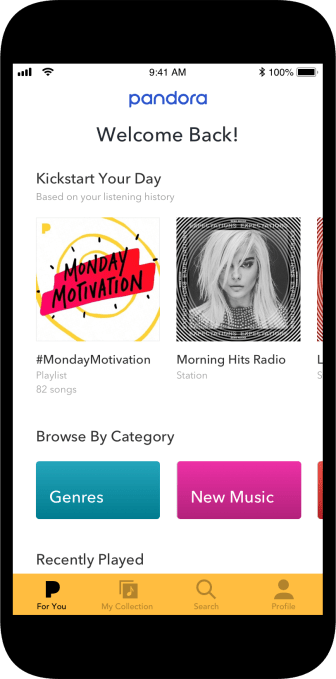
Pandora is doubling down on personalization and revamping its app in order to better compete with rivals like Spotify and Apple Music. Today, the company is introducing a new mobile experience which includes a dedicated “For You” tab where a continually updated feed of content is presented to users, including both music and podcast recommendations and more. This content is personalized to the individual, based on factors like the day of the week, the time of day, and Pandora’s predictions about your mood, among other things.

The new personalized feed will also help the company to better showcase more of its exclusive content — like its music-and-podcast combos, called “Pandora Stories,” for example. Or the dozens of SiriusXM talk shows that became Pandora podcasts, following its acquisition.

“Our listeners have told us that they love the utility of Pandora — it’s drop-dead easy, it works, it knows me, It’s really simple,” explains Pandora’s Chief Product Officer, Chris Phillips. “But what they haven’t been able to understand and have easy enough access to is all the content and programming that we have available on Pandora — the new content, new programming, and the unique content that you can’t get other places,” he says.

The For You tab aims to change that by turning Pandora’s personalization capabilities onto its broader catalog and exclusives, then crafting a scrollable feed with dozens of ways to listen.

SuperbrowseHeroStatic 002

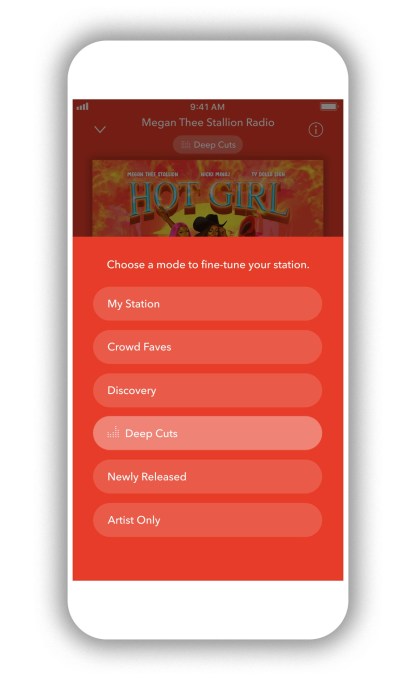
Here, you’ll be able to tap into Pandora Modes,  for example, which is a new way to listen to Pandora Stations. The feature was previously available on the web, and has now come to mobile for the first time with today’s launch.

Pandora Modes let you toggle between ways to customize your stations. You can opt for modes that will tweak the station to play things like the most popular songs (“crowd faves”), the deep cuts, new releases, artist-only tracks, and more.  You can also opt for a “discovery” mode to have Pandora introduce you to new artists you may like, as related to the station in question.

Another section in the For You tab lets you browse by categories, including by genre, by new music, podcasts, moods, playlists, decades and by trending.

The “Moods & Activities” section, meanwhile, will present collections of music based on current trends — for example, one of the available “moods” is “fall” and another could be “rainy day,” matched up with the day’s weather. You can also dig into this section for moods to match your activity, like workout, gaming, studying, family time, and more.

As you scroll down the For You page, you’ll come across your podcast recommendations and personalized playlists. And Pandora can create some 80 different versions of the latter, which include playlists by moods, activities, genres, and more all powered by its Music Genome.

Plus, the combined Pandora and SiriusXM editorial team of around 25 creates hundreds of human-curated playlists, too.

PandoraModes BlogImage

In total, there are some 35 different modules in Pandora’s new For You feed, some of which are shown to every user while others appear dynamically based on time of day and day of week. Its suggestions will also be tailored to your own likes and interests, thanks to your own listening behavior and explicit signals, like thumbs up and thumbs down.

That means your For You tab will be unique to you, and you can later be targeted with specific promotions — like the content to emerge from that deal between SiriusXM/Pandora and Drake, for example, if relevant to your interests. (Hey, it’s better than that time when Spotify put Drake’s face on every playlist.)

Despite the personalization, the feed will still include some insights powered by the larger Pandora population, so you can see what’s popular and trending more broadly across the service.

In time, Pandora plans to roll out even more modules to build out the experience further.

100 billion thumbs are what’s powering all this,” adds Phillips, speaking of Pandora’s recent milestone, which measured the number of thumbs up and down clicks from users. Until now, he says, Pandora “hadn’t really brought together the community…and the power of our personalization, but not just for stations — for all the playlists, albums, songs, and artists,” Phillips continues. “And then the idea that we lay on top of all of this…the idea of what time of day it is, and what might be interesting based on what we predict your mood is right now,” he says.

The “For You” tab and other features are arriving today on Pandora for iOS and Android.


Source: TechCrunch http://j.mp/2ogKWUl

WhatsApp is testing a self-destructing messages feature

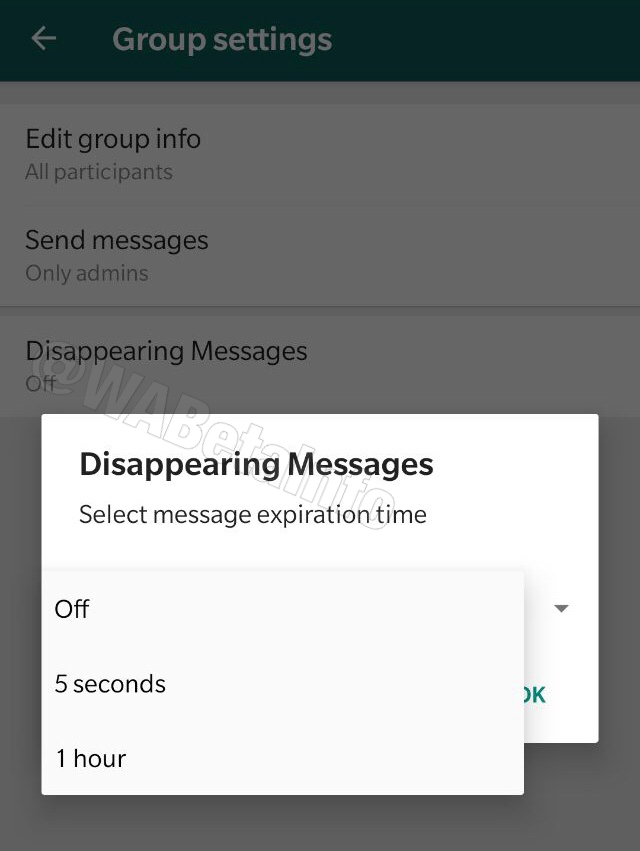
WhatsApp users may soon get the ability to have their messages self-destruct after a set period of time. That’s according to a highly-reliable tipster who spotted the feature combing through the code of a beta version of the app.

Twitter user WABetaInfo said on Tuesday that the recently released public beta of WhatsApp for Android — dubbed v2.19.275 — includes an optional feature that would allow users to set their messages to self-destruct.

The ability to have messages disappear forever after a fixed amount of time could come in handy to users who share sensitive information with friends and colleagues on the app. It’s one of the most popular features on instant messaging client Telegram, for instance.

2EE9D669 87D1 4CC2 842F 2644E7549ED9

Image: WABetaInfo

Telegram offers a “secret chat” feature wherein users can engage with each other and their messages disappear from their devices after a set amount of time. The messaging platform says it does not store the text on its servers and restricts users from forwarding the messages, or take a screenshot of the conversation, to ensure there is “no trail” of the texts.

“All secret chats in Telegram are device-specific and are not part of the Telegram cloud. This means you can only access messages in a secret chat from their device of origin. They are safe for as long as your device is safe in your pocket,” it explains.

Facebook, which owns WhatsApp, also offers a “secret chat” feature on its Messenger app. But there, the secret chat feature only encrypts end-to-end messages and media content shared between two users. On WhatsApp, messages between users are end-to-end encrypted by default.

Currently, WhatsApp is testing the feature in a group setting that supports participation from multiple individuals. Messages could be set to self-destruct as soon as five seconds after they have been sent and as late as an hour. Additionally, an image shared by WABetaInfo shows that group administrators will have the ability to prevent other participants in the group from texting.

Some third-party WhatsApp apps have allowed self-destructing messages feature in the past. But in recent years, WhatsApp has started to crack down on third-party services to ensure safety of its users.

It remains unclear how soon — if ever — WhatsApp plans to roll out this feature to all its users. We have reached out to them for comment.


Source: TechCrunch http://j.mp/2oWFeYd