Thursday, April 2, 2020

Consumers spent record $23.4 billion on apps in Q1 2020, thanks to being stuck indoors

Time spent in mobile apps has been surging, as people stuck at home due to the coronavirus outbreak have been turning to apps to do their shopping, manage their finances, find new exercises, work from home, and stay entertained. According to new data from App Annie, released today, Q1 2020 was the largest-ever quarter in terms of consumer spend on apps. In addition, the average weekly time spent in apps and games worldwide was up 20% year-over-year in the quarter, based on an analysis of Android devices.
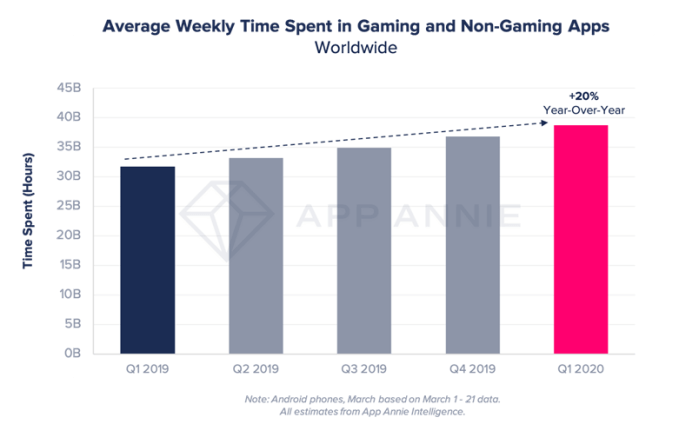
This has translated to a record increase in consumer spending on the app stores.

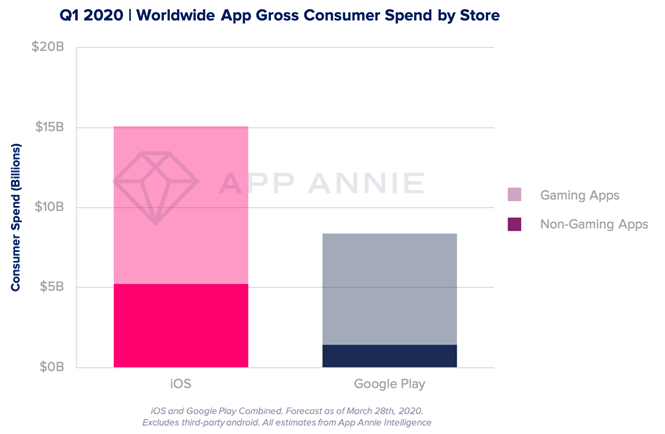
In Q1 2020, consumers worldwide spent over $23.4 billion through the app stores — the largest-ever quarter, App Annie said.

iOS accounted for $15 billion of that figure and Google Play was $8.3 billion. Both of these figures were an increase of 5% year-over-year on their respective platforms.

Non-gaming apps accounted for 35% of consumer spend on iOS and 15% on Google Play. Meanwhile, consumers spent over $16.7 billion on games in the quarter.
The U.S. and China were the largest contributors to consumer spend on iOS and the U.S., Japan, and South Korea were the largest on Google Play.

Android users spent the most on Games, Social, and Entertainment apps, thanks especially to Disney+ and Twitch.

Meanwhile, iOS users spent the most on Games, Entertainment, and Photo and Video apps, with TikTok notably breaking into the top 5 by consumer spend on iOS in the quarter, at No. 3 behind Tinder and YouTube.
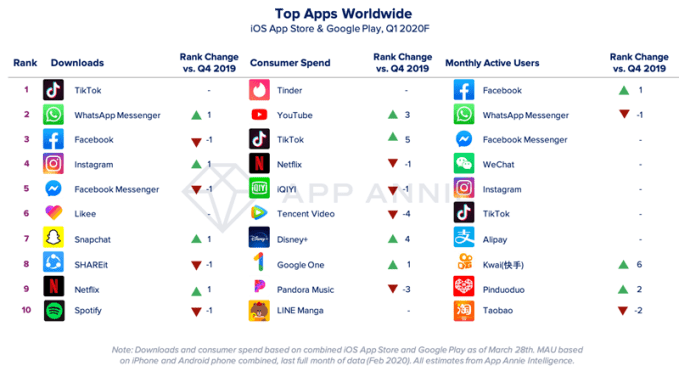
31 billion apps installed in Q1 2020

There were also 31 billion new app downloads in Q1 2020, up 15% from the fourth quarter of 2019. That’s notable, given that the fourth quarter usually sees a big boost in app installs from holiday sales of new phones, and Q1 managed to top that.
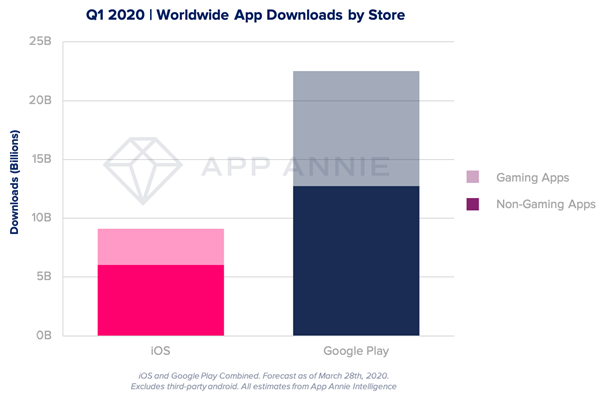
On Google Play, downloads were up 5% year-over-year to 22.5 billion while iOS downloads were up 15% year-over-year to over 9 billion.

Non-gaming apps on Google Play accounted for a majority (55%) of downloads and on iOS, they were 65% of downloads — an indication that people were looking for a variety of mobile apps to manage their newly stay-at-home and work-from-home lives, not just distractions.

The largest markets for Google Play downloads were India and Brazil, owing to their sizable populations and preference for lower-cost, Android devices. On iOS, China and the U.S. were the two largest markets by downloads and the main drivers of download growth for the quarter.

Mobile Games, Tools, and Entertainment were the largest categories for Google Play downloads while Games, Photo and Video, and Entertainment were the largest categories on iOS.

On both platforms, Games drove the most growth.

In Q1 2020, mobile game downloads grew 20% year-over-year to reach over 13 billion in the quarter. They were also up 30+% on a quarterly basis.
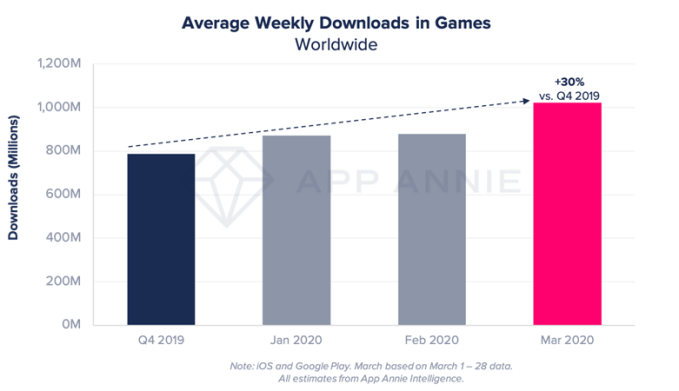
On Google Play, game downloads were up 25% to nearly 10 billion, year-over-year, and on iOS they were up 25% to top 3 billion in Q1.

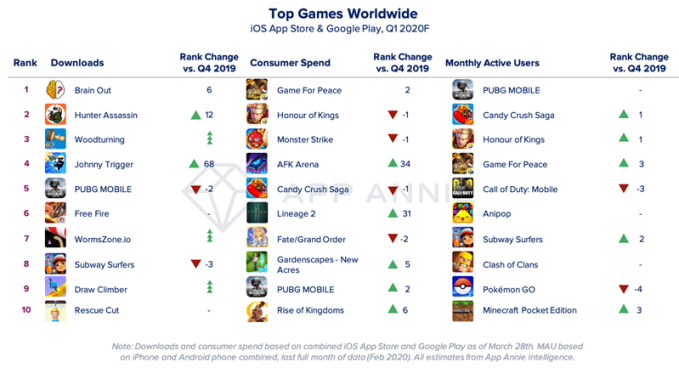
Users downloaded Puzzle, Simulation, Action, Simulation and Arcade games in the quarter, but spent the most on Role Play, Action, and Strategy games, as is typical.
Other categories seeing strong downloads across both platforms included Heath & Fitness, Education, and Business. Health & Fitness was up 40% on Google Play and 30% on iOS, quarter-over-quarter. Education was up 35% on Google Play and 40% on iOS. And Business was up was up 30% on Google Play and 35% on iOS.


Source: TechCrunch https://ift.tt/3aErVyB

T-Mobile customers on unlimited wireless family plans get a free year of Quibi

T-Mobile this morning officially announced its exclusive partnership with the new streaming service, Quibi, set to launch on April 6. The service will be made available for free for a year to T-Mobile customers on its unlimited wireless family plans.

The streaming service, founded by Hollywood media mogul Jeffrey Katzenberg, has been specifically built for on-the-go viewing on mobile devices. Its “shows” can be watched in 10 minutes or less and take advantage of the mobile device’s ability to be held different ways to enable seamless switching between portrait and landscape modes.

Thanks to Katzenberg’s industry connections, Quibi original content will feature A-Listers and other big names, including Jennifer Lopez, Chrissy Teigen, Chance the Rapper, Liam Hemsworth, Sophie Turner, Lena Waithe, Nicole Richie, Reese Witherspoon and others.

Typically, Quibi subscriptions are offered at $4.99 per month for its ad-supported plan or $7.99 per month for its ad-free option.

Quibi had confirmed last October that a deal with T-Mobile was in place, in statements made to various news outlets. But the details of the deal itself were not yet announced nor confirmed by T-Mobile at that time.

According to T-Mobile’s release, Magenta and ONE plans with taxes and fees included will be eligible for the free Quibi add-on, as will discounted First Responder, Military and Magenta Plus 55 plans, and small business customers with up to 12 lines.

T-Mobile customers can go to mytmobile.com now through July 7 to sign up, or they can use the T-Mobile Android or iOS app beginning on April 6 to add Quibi.

In addition, until April 3, T-Mobile customers who use the T-Mobile Tuesdays app for Android or iOS can get early access to three bonus episodes of the new Jennifer Lopez series, “Thanks a Million” when it launches on April 6. That means customers will have a total of 6 episodes to watch at launch. And on April 7, five people who enter the T-Mobile Tuesdays sweepstakes will win a free Google Pixel 4 XL.

“T-Mobile customers have always been ahead of the curve – streaming more data, watching more mobile video – so when we first heard about Quibi, we knew our customers would love it,” said Mike Sievert, President and CEO of T-Mobile, in a statement. “And, with more of us staying home right now, Quibi’s never been more needed. It comes on the scene with a totally different experience, made for mobile, quick to watch and as entertaining as anything you’ve ever seen!”

Teaming up with a mobile carrier to gain traction among customers for a streaming service is a viable strategy. Disney+ did it with Verizon, which ultimately accounted for 20% of its early customers.

However, Quibi isn’t Disney — it’s not a known brand with pent-up consumer demand for a streaming service. What’s more, its initial marketing no longer makes sense in the post-COVID-19 era.

Quibi has had to reposition its service in the wake of the coronavirus outbreak as something that works for at-home viewing. But in reality, the service had been intended to fill those empty moments in your on-the-go lifestyle — like riding the subway, standing in line, sitting in a waiting room before an appointment, and more. Now, with people stuck at home in government lockdowns and home quarantines, the minutes stretch out endlessly. There’s plenty of time to watch long-form content and the living room TV has more draw over the small phone screen. 

But ultimately, Quibi’s success may not come down to its technology, tricks, or episode length. It will come down the quality of its shows and their ability to capture an audience.


Source: TechCrunch https://ift.tt/2UXvGsi

Wednesday, April 1, 2020

Google to shut down its India-focused Q&A app Neighbourly

Google is shutting down Neighbourly, a Q&A social app that it launched in select parts of India two years, the company has informed users.

The app, developed by company’s Next Billion Initiative, aimed to give local communities an outlet to seek answers to practical questions about life, routine and more.

At the time of its release, Google told TechCrunch that it believed that an increase in urban migration, short-term leasing and busy lives had changed the dynamic of local communities and made it harder to share information quite so easily.

The app supported voice-based entry for questions and a range of local languages.

In an email, Google said Neighbourly helped users find answers to over a million questions, but it did not get the traction the company was hoping for. The app will shut down on May 12, but users have another six months to download their answers.

“We launched Neighbourly as a Beta app to connect you with your neighbors and make sharing local information more human and helpful. As a community, you’ve come together to celebrate local festivals, shared crucial information during floods, and answered over a million questions,” the company wrote to users.

“But Neighbourly hasn’t grown as we had hoped. In these difficult times, we believe that we can help more people by focusing on other Google apps that are already serving millions of people everyday,” it added, pointing users to explore Google Maps’ Local Guide, which also allows sharing of knowledge with local communities.

The app had such low-traction that third-party intelligence services such as App Annie and Sensor Tower don’t have any substantial data about it. But on Play Store, Neighbourly is listed to have more than 10 million downloads.

More to follow…


Source: TechCrunch https://ift.tt/2UAzHEd

In a significant change, Apple customers can now buy or rent titles directly in the Prime Video app

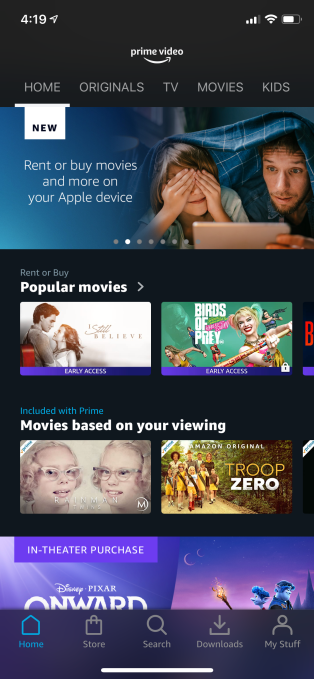
Amazon has made it easier for Apple customers to buy or rent movies from its Prime Video app with a recent update. Before, customers using the Prime Video app from an iOS device or Apple TV would have to first purchase or rent the movie elsewhere — like through the Amazon website or a Prime Video app on another device, such as the Fire TV, Roku, or an Android device. Now, Prime Video users can make the purchase directly through the app instead.

The changes weren’t formally announced, but quickly spotted once live.

Amazon declined to comment, but confirmed to TechCrunch the feature is live now for customers in the U.S., U.K., and Germany.
The change makes it possible for Prime Video users to rent or buy hundreds of thousands of titles from Amazon’s video catalog. This includes new release movies, TV shows, classic movies, award-winning series, Oscar-nominated films, and more.

This is supported on a majority of Apple devices, including the iPhone, iPad, and iPod touch running iOS/iPadOS 12.2 or higher, as well as Apple TV HD and Apple TV 4K.

Amazon for years has prevented users from directly purchasing movies and TV shows from Prime Video app on Apple devices. That’s because Apple requires a 30% cut of all in-app purchases taking place on its platform. To avoid fees, many apps — including not only Amazon, but also Netflix, Tinder, Spotify, and others — have bypassed the major app platforms’ fees at times by redirecting users to a website.

Since the news broke, many have questioned if Amazon had some sort of deal with Apple that was making the change possible — especially since it didn’t raise the cost of rentals or subscriptions to cover a 30% cut.

As it turns out, it sort of does.

Apple tells TechCrunch it offers program aimed at supporting subscription video entertainment providers.

“Apple has an established program for premium subscription video entertainment providers to offer a variety of customer benefits — including integration with the Apple TV app, AirPlay 2 support, tvOS apps, universal search, Siri support and, where applicable, single or zero sign-on,” an Apple spokesperson said. “On qualifying premium video entertainment apps such as Prime Video, Altice One and Canal+, customers have the option to buy or rent movies and TV shows using the payment method tied to their existing video subscription,” the spokesperson noted.

Amazon’s adoption (acceptance?) into this program is notable, as it comes at a time when Apple is under increased scrutiny for alleged anti-competitive behaviors — particularly those against companies with a rival product or service — like Prime Video is to Apple TV+, or Fire TV is to Apple TV, for example.

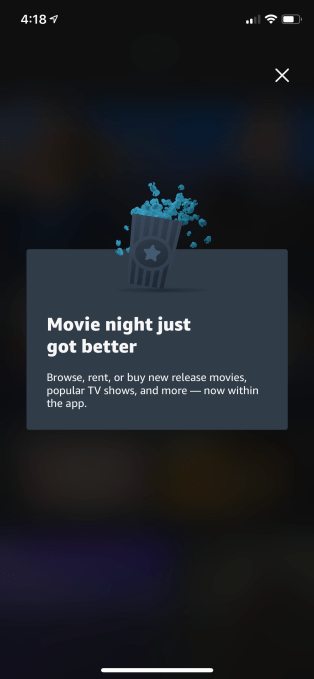
Amazon called attention to the new feature in its Prime Video app, which now alerts you upon first launch that “Movie night just got better” in a full-screen pop-up. It also advertises the easier option for direct purchases through a home screen banner.


Source: TechCrunch https://ift.tt/2R3Z9Qf

Samsung Wants You to Buy a Galaxy S20 So Bad, It Promises to Buy It Back From You in Two Years

Before the Galaxy S20 even went on sale, I predicted its high price would put a damper on sales, and due to the impact of covid-19, things have only gotten worse. So now to help spur sales, Samsung is instituting a new program that will give new S20 owners a 50 percent buy back guarantee.

Read more...


Source: Gizmodo https://ift.tt/2UNKERG

Mobile app spending to double by 2024, despite economic impacts of COVID-19

The spread of COVID-19 has already had a significant impact on the mobile app industry and that will continue in the years to come. According to a revised 2020-2024 market forecast from app intelligence firm Sensor Tower, a sizable increase in app downloads for industries like remote work and education will lead to a large surge in app installs for the early part of 2020 and beyond, despite other decreases in downloads for ride-sharing and fast food apps. However, the expected economic downturn resulting from COVID-19 will somewhat dampen revenue growth in the years ahead, the report found. Despite this, mobile app spending worldwide will continue to grow and will even double by 2024.

COVID-19’s impact on app stores’ revenue

Though COVID-19 is having an impact on the app stores’ revenue, growth remains strong.

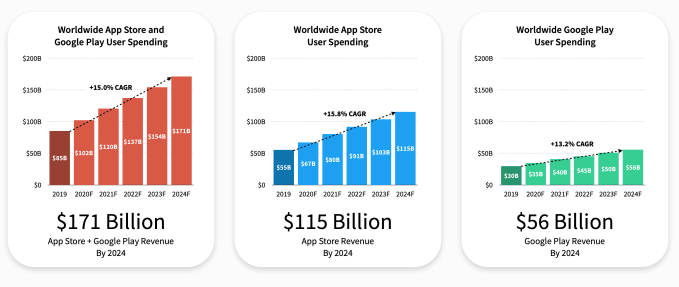
Worldwide consumer spending in mobile apps is projected to reach $171 billion by 2024, which is more than double the $85 billion from 2019. This total, however, is about $3 billion (or 2%) less than the forecast the firm had released prior to the COVID-19 outbreak.

Still, it’s notable that even the slowest-growing regions on both app stores, Apple’s App Store and Google Play, will see revenue that’s over 80% higher than their 2019 levels by the year 2024.

The app stores will also hit several milestones during the next five years.

For starters, global spending in mobile apps will surpass $100 billion for the first time in 2020, growing at approximately 20% year-over-year to hit $102 billion.

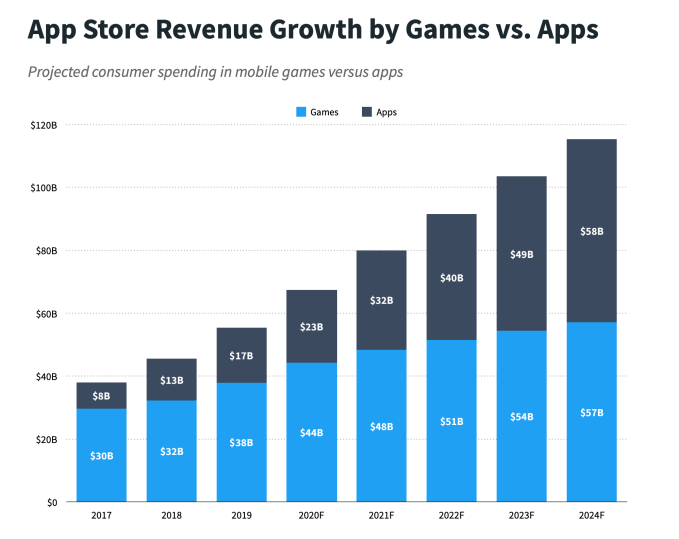
Remarkably, the forecast also predicts that revenue from non-game mobile apps is expected to surpass that of mobile games for the first time by 2024, driven by the growth in subscriptions — particularly Entertainment, Social Networking, Music, and Lifestyle app subscriptions.

By this time, mobile games will reach $97.8 billion, or around 41% of total consumer spending. The App Store will account for a sizable chunk of that spending, with ~$57 billion in mobile game revenue in 2024 vs. Google Play’s ~$41 billion.

The App Store, not as surprisingly, will also maintain its sizable lead in consumer spending through 2024, accounting for 67% of total revenue across both it and Google Play. It will grow at a compound annual growth rate of 15.8% compared with Google Play’s 13.2%.

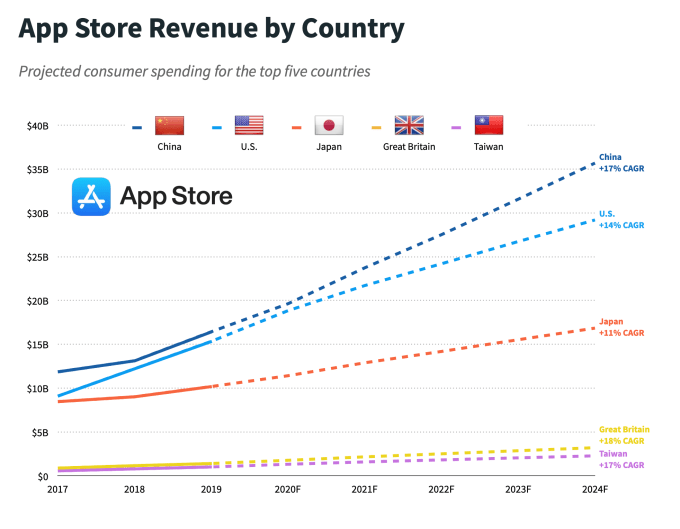
The top 5 countries by revenue will remain unchanged through 2024: China, U.S., Japan, Great Britain, and Taiwan. China will continue to be a top market, despite regulations on app and game publishing, and will reach $35 billion in App Store spending alone by 2024.

COVID-19’s impact on downloads

In terms of app downloads, the forecast predicts a lasting lift from the impacts of COVID-19.

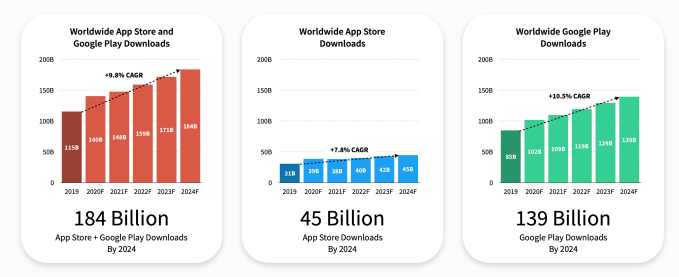
By 2024, downloads will reach 183.7 billion, up 9% from the earlier forecast that came out before COVID-19 that had initially accounted for 7 billion fewer installs.

Much of this download growth is happening this year, when first-time app downloads are poised to reach 140.3 billion, up 22% from 2019.

In addition to increases in non-game apps — like education, grocery delivery, or remote work apps — mobile game downloads will grow 30% year-over-year in 2020 to reach 56.2 billion, compared with 10.4% growth between 2018 and 2019.

By 2024, mobile games will account for 41% of new installs, or 74.8 billion.

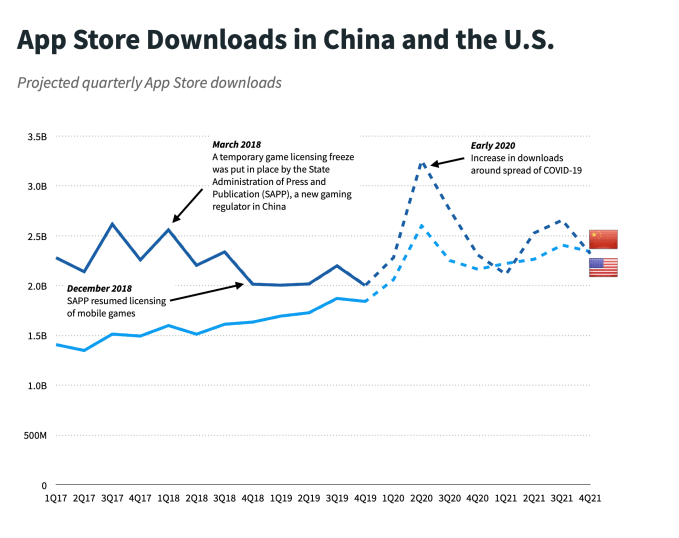
The early indication is that China will see a massive increase in downloads in 2020, particularly in Games and Education categories. This follows a drop in downloads over the past few years, due to government regulatory practices, like the games licensing freeze.

The U.S. will see a similar spike in downloads this year, also due to COVID-19. For 2020, this will lead to a 27% year-over-year increase in downloads. But by 2021 and in the years that follow, growth will settle around 7% annually from 2021 to 2024 in this market.

During the forecast time frame, download growth will slow in India and Brazil, as the markets become more saturated, while growing in Latin America (up 58%) and Asian markets outside of China (up 82%).

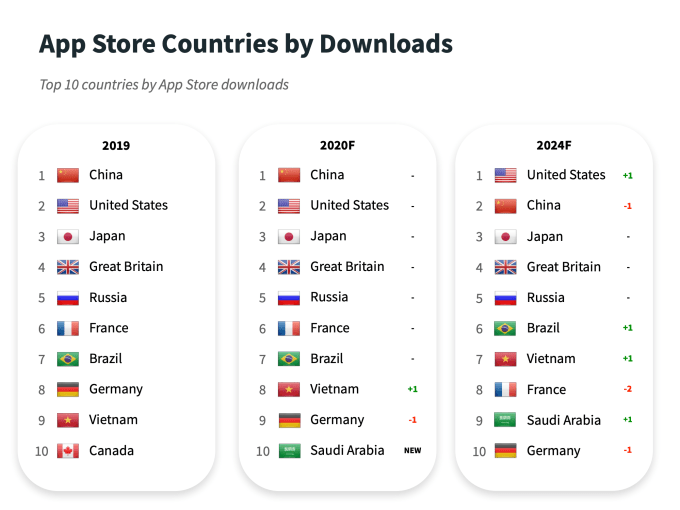
Another notable milestone may take place in 2022, when the U.S. pulls ahead of China in terms of App Store downloads to reach number one. The U.S. has been narrowing the gap between the two in recent years, from 3.5 billion in 2017 to 1.1 billion in 2019. It will continue to close the gap during parts of 2020 and 2021, as well.

Other top countries for downloads in 2024, besides the U.S. and China, include Japan, Great Britain, and Russia.


Source: TechCrunch https://ift.tt/3428k8X