Thursday, October 1, 2020

Google now has three mid-range Pixel phones

The Pixel has always been a mixed bag. The first-generation product was announced roughly this time four years ago, with Google finally offering a full-throated entry into the smartphone space after years of device partnerships.

Of course, by 2016, the market was already mature — particularly for Android phones. But while it was easy to write off those initial devices as Nexus-like references for future software updates, Google made it clear that it was taking the line seriously. It put any doubts to rest two years later, with its $1.1 billion acquisition of the design team from a struggling HTC.

But Google’s had struggles of its own. Slow Pixel 3 sales left the company in a tough spot, as the overall market took a hit. Google was able to correct the ship with the launch of the Pixel 3a, joining the likes of Apple and Samsung in offering budget versions of its smartphone flagship as consumers grew weary of premium prices.

It’s a strategy that makes sense. Two primary devices: a flagship and a budget model. Of course, the line has never been particularly clear for Google. For one thing, the company just doesn’t chase premium hardware in the same way that Apple, Samsung or Huawei does. Rather, it insists setting itself apart with its software — even for things like imaging. That often results in a less pronounced gap between devices. It also dulls the company’s edge with features that, more often than not, come to other Android devices.

But today’s hardware event blurred those lines more than ever. The dual-launch of the Pixel 5 and 4a 5G was arguably the most confusing element about a morning event with words “Launch Night” in its title.

Image Credits: Google

While pre-show rumors and leaks revealed a lot about the devices that ultimately proved true, they didn’t do much to distinguish the differences between the products. Turns out there’s an obvious reason: There really isn’t that much of a difference. If anything, the 4a 5G feels like a stepping stone toward the Pixel 5 — a device that would, perhaps, more fittingly have been named the Pixel 5a, if the company’s naming conventions worked that way.

We already knew that both devices were going to sport 5G. That seems to be Google taking advantage of Qualcomm’s aggressive push to bring the next-gen wireless technology to more budget devices. Really, the big driver here is that both devices utilize the same processors: Qualcomm’s Snapdragon 765G. It is, as I’m sure you’re aware, a mid-tier processor. It’s a step down from the 865 currently found in the majority of this year’s flagships.

Likely, the decision was a cost-cutting measure, but we’ve seen evidence from a number of manufacturers that it’s possible to produce an 865-sporting device priced in the middle six digits. Both devices also sport the same dual-camera set up on the rear and the same resolution screens — though the 4a 5G’s is actually bigger (albeit with a lower pixel density), at 6.2 inches to the 5’s 6.0.

There are some differences between the products to justify the $200 pricing gap. For starters, the 5 features a 100% recycled aluminum body, whereas the 4a 5G is polycarbonate. The cheaper phone lacks waterproofing and the reverse wireless charging found on the 5. It also sports a smaller battery, though both devices have been upgraded in that respect over the 4 and 4a. Battery life, after all, was the biggest complaint against the Pixel 4 — and either way you’re going to need more milliamp hours to handle the strains of 5G and, in the case of the 5, reverse charging.

So, are you clear on all of this? Me neither, to be honest. Google’s smartphone line now contains three devices. There’s a mid-tier handset, a slightly lower-mid-tier handset and an even lower-mid-tier handset. That’s three distinct devices with about a $300 price difference, all released within months of one another. It’s as if Google saw the 3a’s successes and decided “screw it, we’re making all of our products mid-range.” Affordability isn’t a bad thing, of course, but if you’re going to release three separate products over roughly a two-month span, you owe it to yourself and your fans to offer clearer value propositions.

Some of this is going to self-correct. For starters, it seems likely that the three devices will turn into two by this time next year. I don’t foresee the company keeping both an LTE and 5G model around in late-2021. There’s also the fact that the company has been undergoing a bit of an executive shakeup among the Pixel line — something that appears to point to a dramatic rethink of the line. It’s likely that the 4a, 4a 5G and 5 were already pretty far into development when Google started its executive shuffling.

Hopefully all of this will cause the company to rethink the Pixel line from the ground up and determine what Google can bring to the table that the competition can’t.



Source: TechCrunch https://ift.tt/3kYPxCI

How to Make It Easier to Control Smart Home Devices From Your Phone

Setting up your smart home and controlling it from your phone is easier than it’s ever been. Both Android 11 and iOS 14 include features to further simplify smart home management.

Read more...


Source: Gizmodo https://ift.tt/3jwHTPC

Google to pay out $1B to publishers to license content for new Google News Showcase

Google has long had a frenemy position with regards to the world of news: it can direct a lot of traffic to online publishers, but that’s only if people bother to click on links after getting the gist of the story from Google itself (and that’s before considering Google’s AMP approach on mobile that keeps users on Google URLs after they click). Publications built around advertising have felt beholden to the search and ad giant, leading those that have survived over the years to try to forge alternative revenue models around paid content, events, and more to offset that dependency.

Now Google is offering another, complementary, option to these publishers, or at least some of them.

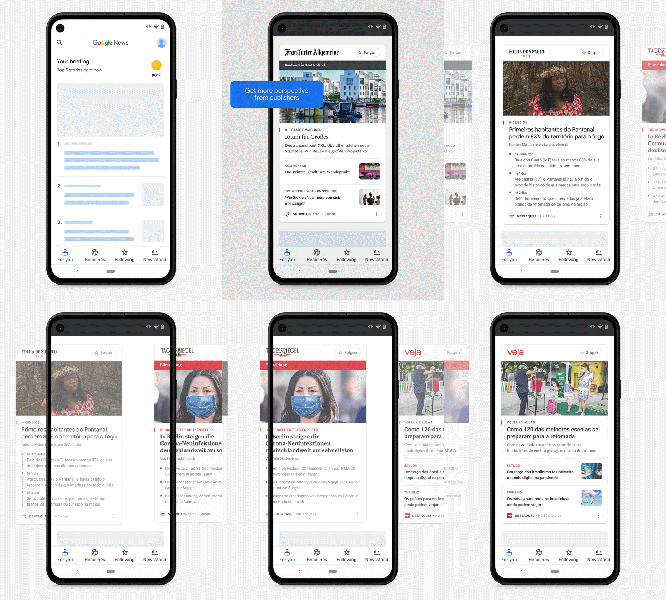
Today the company unveiled its latest effort to claw back more credibility in the news publishing world, launching the Google News Showcase. Sundar Pichai, CEO of the search giant, said in a blog post that it would collectively pay some $1 billion to news publishers in licensing fees “to create and curate high-quality content” for new story panels that will appear on Google News. Initially, these will appear on Android devices and eventually also on Google News on iOS.

The new initiative is going live today, after it was initially unveiled by Google in broad strokes earlier this summer.

Google News Showcase is rolling out first in Germany and Brazil before expanding to other markets, according to Pichai. The company has already inked deals with 200 publications in Germany, Brazil, Argentina, Canada, the U.K. and Australia. The first publications to launch will be Der Spiegel, Stern, Die Zeit, Folha de S.Paulo,Band, Infobae, El Litoral, GZH, WAZ and SooToday. India, Belgium and the Netherlands will be next on the list for expansions after the other countries go live, Pichai said.

As you can see here, Google News Showcase seems primarily to be focused on how news is consumed on mobile devices rather than desktop computers.

Like Apple with its efforts around Apple News, as a major mobile platform operator Google has worked on a number of ways to play nice with publishers and the news publishing industry over the years, some on its own steam and some in response to pressure from outside.

They have included funding local news research initiatives; its $300 million news initiative that includes providing grants to journalists and journals, as well as research; emergency grants to publications in hot water; and building tools to help journalists do their work.

Picking Germany as one of the first markets to roll this out is notable, given that publishers in the country were involved in a years-long lawsuit over copyright fees related to how their content was repurposed in Google.

Google ultimately won that case in court, but arguably, it didn’t win in the court of public opinion. Given that Google continues to face a lot of antitrust scrutiny in Europe and elsewhere, it’s important that it works (or at least appear to work!) on rehabilitating its image as too-powerful and uninterested in the fate of institutions that are central to how democratic society works — like the free press.

As Pichai notes, this latest effort is different from what Google has built before because it’s based on publishers doing the curating and creating themselves.

Google is infamous for starting a lot of projects, rolling them out, and then abandoning them when they fail to get market traction. With that understanding, and knowing that it’s one of the biggest companies in the world (not just in tech) it has in theory committed to the Showcase for three years, but Pichai said the plan is for it to “extend beyond the initial three years”, with the company “focused on contributing to the overall sustainability of our news partners around the world.”

It’s not clear how much money individual publishers will make out of this initiative, now how or if it could be used to drive business models that don’t cut Google in on the action. The latter has been a prime focus for many publishers for the last several years. At best, similar to Apple News, it could help publishers hedge their bets or even bolster them (as in the case of paywalls and driving people to using them), rather than cannibalize those other efforts. Google, at the least, seems aware of the stakes and seems to argue that it’s not the only reason publishers are feeling the heat.

“The business model for newspapers—based on ads and subscription revenue—has been evolving for more than a century as audiences have turned to other sources for news, including radio, television and later, the proliferation of cable television and satellite radio,” wrote Pichai. “The internet has been the latest shift, and it certainly won’t be the last. Alongside other companies, governments and civic societies, we want to play our part by helping journalism in the 21st century not just survive, but thrive.”


Source: TechCrunch https://ift.tt/3igYvcR

Best Christian Dating Apps

Looking for love isn’t easy at the best of times, especially in the midst of a global pandemic. Thanks to Covid-19, more people are looking for love online than ever before. For Christians looking for a new partner who shares their faith, here are the five best dating websites to use in 2020.

#1 Best Christian Dating App - eHarmony

eHarmony is one of the best-known and most successful names in the online dating industry. One of the first online dating sites to launch in 2000, eHarmony has spent the last 20 years refining its platform and growing its userbase. Numerous competitors have sprung up in that time, and many have fallen by the wayside while eHarmony continues its strong performance.

Important points:

  • First launched in 2000
  • Has a userbase of millions
  • Operates in more than 200 countries
  • Offers video dating to provide a more secure experience and verify other users
  • More than 2 million matches have been made on the platform. This rate works out as one every 14 minutes.
  • Even membership split; 51% men, 49% women.
  • Available on all platforms (Android, iOS, and via web browser).

eHarmony’s userbase consists of millions of users with an even split between men and women. This split immediately gives eHarmony an advantage over some of its competitors who tend to be dominated by one sex or the other.

One of eHarmony’s main selling points is its advanced compatibility algorithms, which have been critical to its success since it launched. These algorithms were devised by Dr. Neil Clark Warren, the founder of eHarmony and a professional clinical psychologist. Dr. Warren’s work has been revolutionary for online dating. eHarmony’s ‘dimensions of compatibility’ system is the gold standard that other online dating platforms aim for.

To calculate compatibility dimensions, eHarmony considers 29 individual criteria, which re then run through a proprietary matching algorithm. By doing this, eHarmony can rapidly compare thousands of potential matches and pick the most suitable option for the user.

The service is also truly global. eHarmony operates in more than 200 countries, with its millions of users being spread relatively evenly across them.

Costs/Fees

You can register for an eHarmony account for free, although the free tier is quite limited. You will be able to see compatible matches and send ‘ice breakers’ to any matches that look promising. However, eHarmony reserves the more “advanced” features for premium accounts. These features include some pretty basic stuff like messaging other users.

The pricing is as follows:

  • Free (with account restrictions)
  • $29.90/month for a six-month subscription
  • $29.95/month for a three-month subscription
  • $59.95 for a one-month subscriptions

Overall, eHarmony is one of the more dependable online dating sites out there and is one of the best choices for Christians. However, it is not aimed directly at Christians, meaning you will need to navigate around non-Christian users.

Pros

  • Enables you to search for matches by geographic region so you can focus on singles in your area.
  • Their matching system is second-to-none, and their compatibility algorithms are leaps and bounds ahead of competitors.
  • Different membership tiers for you to choose from.
  • A large userbase that contains many Christians.

Cons

  • The free tier is severely limited in its capabilities
  • You will have to navigate around non-Christian users to find your match.
  • eHarmony is one of the oldest and most reliable online dating sites in the world. Their service is one of the most consistently highly-rated in the world.

#2 Best Christian Dating App - ChristianCafe

ChristianCafe is one of the largest online dating sites aimed exclusively at Christians. It actually predates eHarmony, having first launched in 1999, making it one of the oldest and most successful Christian dating sites available.

Important points:

  • In operation for 21 years

  • Caters exclusively to Christian users, so you don’t have to wade through the userbase looking for them

  • Operates globally with users in Europe, North America, Australia, and Pacific nations with significant Christian populations

  • Claims responsibility for more than 25,000 marriages so far

  • Offers a 10-day free trial for new members

  • Available on iOS and Android

If you don’t have the time or willpower to sift through non-Christian users when using online dating services, ChristianCafe is one of the best options available to you. ChristianCafe is an online dating website exclusively for Christians. It features users from around the globe; ChristianCafe operates just about everywhere with a significant Christian population. The userbase isn’t as big as larger sites like eHarmony. However, because ChristianCafe’s users are all Christians, you’re more likely to find a suitable match.

Their name might not be as widely-known as eHarmony, but ChristianCafe has a well-deserved reputation as one of the best online dating sites available. As you would expect from any service with decades of experience doing what they do, ChristianCafe has refined its platform over time. There are now a plethora of testimonials from throughout the website’s history that attest to the excellent service they provide. The 10-day free trial on offer enables you to verify the service is right for you before you commit any money to it.

After registering for ChristianCafe, you will need to fill in a detailed user profile. Filling in this page takes a while, but it is more than worth it. Whereas eHarmony runs this data through a proprietary algorithm to find you a match, ChristianCafe depends on users browsing each other’s profiles instead.

Costs/Fees

The aforementioned 10-day free trial enables you to test the full service before deciding whether to commit to a subscription or not. This freedom is relatively generous compared to ChristianCafe’s competitors. Once the 10-day trial period expires, users can either subscribe or proceed with a limited free account. If you choose to subscribe, you can save yourself a significant sum by purchasing a longer subscription.

  • $34.97 for a two-week subscription
  • $44.97 for a one-month subscription
  • $69.97 for a three-month subscription
  • $109.97 for a six-month subscription


Pros

  • The 10-day free trial enables you to test out the full service before deciding whether to subscribe or not.
  • Encourages users to create detailed profiles that provide lots of information.
  • Provides users with an extensive range of interactive tools.

Cons

  • Relies on manually browsing profiles instead of an automated matchmaking system.
  • Once the 10-day trial is over, you will either need to pay or proceed with a severely limited account.

Users that want to avoid wasting time searching through non-Christian users will find ChristianCafe to be an excellent time-saver. A large userbase and a global reach make ChristianCafe one of the biggest and best Christian dating sites and the oldest.

#3 Best Christian Dating App - CatholicMatch

Enter your tFor users looking exclusively for a Catholic partner, CatholicMatch is leaps and bounds ahead of the competition. The platform caters exclusively to Catholics, so you don’t have to worry about filtering out other denominations or faiths. It is also the largest dating site just for Catholics.ext here...

Important points:

  • Launched in 2004

  • They reached their millionth subscriber in 2013. The platform has continued to grow steadily since then.

  • While it only caters to Catholics, CatholicMatch is one of the largest Christian dating sites out there, beating out numerous sites that cater to all denominations.

  • The biggest and best site exclusively for Catholics.

  • The service is explicitly for people who are looking for marriage. You can use the platform however you wish, but the features and algorithms actively push users towards long-term relationships and marriage.

  • Available on iOS and Android

  • Limited free account available

There are lots of reasons to like CatholicMatch. Its extensive feature set helps it to stand out in a relatively saturated marketplace. Because the platform is exclusively for Catholics, it is the best option for Catholics that want to meet other Catholics. The large userbase and global reach mean that your chances of finding a match are excellent.

All the users of CatholicMatch are Catholics, but this isn’t the only thing that enables users to connect with one another. CatolicMatch is eager to emphasize that the detailed profiles users create will allow them to connect and bond over a variety of shared interests. Searching for suitable matches is made considerably easier thanks to these detailed profiles.

CatholicMatch also holds a unique honor: it is the only religiously-focussed dating service with a church’s backing. Prominent Catholics around the globe have advocated for the app, thanks to its marriage-focused approach. There are plenty of glowing testimonials attesting to the service’s quality and its success in facilitating marriages.

Costs/Fees 

Like most of their competitors, CatholicMatch offers a free account tier, albeit a very limited one. You can look for matches without having to pay, but if you want to reach out to other users, you will need to upgrade to a premium account.

  • $29.99/month for a one-month subscription
  • $14.99/month for a six-month subscription
  • $9.99/month for a 12-month subscription

Pros

  • Far and away the best dating website for people looking exclusively for Catholics
  • The whole service focusses on long-term relationships and marriage; you don’t need to second guess other users’ intentions.
  • The intuitive and straightforward interface makes the site easy to use
  • Getting started as a new user is easy despite the need to fill in a detailed profile.

Cons

  • The free account tier is so limited that it’s all but useless to most people.

#4 Best Christian Dating Apps - Spiritual Singles

Spiritual Singles is another well-established player in the online dating market. They promote their service as being all about forming deeper connections with other users. This website isn’t focussed on Christians or religious people, but it is aimed at people with a general spiritual dimension to their personality.

Important points:

  • Founded in 2000
  • Thousands of users and a rapidly-growing user base
  • Operates around the globe
  • In-depth profile personalization makes it much easier to find a match quickly
  • The free account is limited
  • The website is easy to navigate and features an excellent user interface

Spiritual Singles is a faith-based dating website. However, in this case, faith doesn’t necessarily equate to religion. For Christians who are looking for a spiritual partner, not necessarily a Christian one, will find plenty of options on Spiritual Singles. Even if you are looking exclusively for other Christians, there are lots of reasons to like the service.

New users create detailed profiles that tell visitors everything they need to know to decide whether to make contact or not. It’s not just spirituality that connects the users of Spiritual Singles. According to the website, the traits that most of their users identify with are being ‘compassionate, joyful, honest, authentic, and caring.’ 

Over the last 20 years, Spiritual Singles has learned a lot. Today, they are one of the best faith-based dating services available. There are thousands of positive testimonials online, and the website seems to have a higher-than-average success rate. This success is no doubt in charge due to the fact that it fosters deep and genuine connections between its users.

Spiritual Singles also boasts a unique design and interface, which is incredibly effective. The original design means Spiritual Singles stands out from the rest of its competitors. There are fewer account interaction tools than many of its competitors are offering. However, this encourages users to message one another and places a priority on genuine interactions between users.

Costs/Fees 

As you’ve probably guessed, Spiritual Singles offers a free account tier. And it’s not as lacking in features as most of their competitors’. Even after upgrading, the tools available are basic. However, the quality of the userbase and matches is high.


  • $19/month for a one-month subscription
  • $39/month for a three-month subscription
  • $60/month for a six-month subscription

Pros

  • Intuitive navigation makes it easy to navigate the service
  • A service focused on fostering genuine connections and interactions between users
  • You can actually use the free account

Cons

  • The minimalist toolset won’t appeal to everyone

#5 Best Dating App for Christians - EliteSingles

EliteSingles is an online dating service aimed exclusively at busy professionals, many of whom don’t have much free time to dedicate to their love life. A busy professional life can make finding love a real challenge.

Important points:

  • A rapidly-growing userbase with roughly 173,000 new users registering every month.
  • It advertises itself as a streamlined service that aims to offer users multiple matches every day.
  • Claims to be matching 2,000 couples every month.
  • It is aimed specifically at 30-55-year-olds.
  • It isn’t a faith-based service, but it is one of the best for professional Christians looking for a Christian partner.
  • Available on both iOS and Android

EliteSingles is among the best websites out there for busy professionals. Because the other users are in the same situation, you don’t have to worry about their response to your busy lifestyle. The service is aimed at 30-55-year-olds, which makes it slightly more niche than its competitors. However, the focus on this specific age group is a selling point for many people, especially as there aren’t many competitors in the same space.

EliteSingles provides numerous features that its competitors don’t. The standout of these is the proprietary matchmaking system. With an intuitive and streamlined interface, the platform has a highly-professional vibe and is simple to use.

The userbase is continuing to expand at a high rate. According to EliteSingles, they are adding 173,000 new users every single month, a rate they have sustained since launch. The service isn’t cheap, but it is one of the best around.

If you are looking specifically for other Christians, you will need to spend some tie looking through the userbase to find them. But EliteSingles prioritizes long-term relationships rather than flings or casual hookups. Users can expect high-quality matches. The majority of users on the platform are also well-educated.

Costs/Fees 

The free tier account is limited. However, it gives you the opportunity to verify that the service works for you. You will need a premium account to access all the features. You also need to pay to access the platform from a mobile device.


  • $39.95/month for a six-month subscription
  • $52.95/month for a three-month subscription
  • $99.95/month for a one-month subscription

Pros

  • The perfect service for users looking for a professional partner
  • Aimed specifically at 30-55-year-olds.
  • Boasts a huge userbase that is constantly growing.

Cons

  • Includes non-Christian users.
  • No mobile access without paying for a premium account.

These are the best dating websites available to Christians in 2020. Whether you are looking to meet other Christians or you are open to other possibilities, the five platforms above will provide you with the best online dating experience around.

The post Best Christian Dating Apps appeared first on Digitizd.


Source: Digitizd https://ift.tt/2SeBk8v