Thursday, November 5, 2020

A better look at Apple’s iPhone 12 Pro Max and iPhone Mini

The various iterations of the new iPhone were announced 800 million years ago. Actually, wait, I just double checked — it was only about two or so weeks ago, but it turns out that time has no meaning anymore. Another cursory glance at my calendar tells me that, while the iPhone 12 and iPhone 12 Pro were released in late-October, not long after being announced, the iPhone 12 Pro Max and iPhone Mini, meanwhile, won’t be available for sale for another week or so.

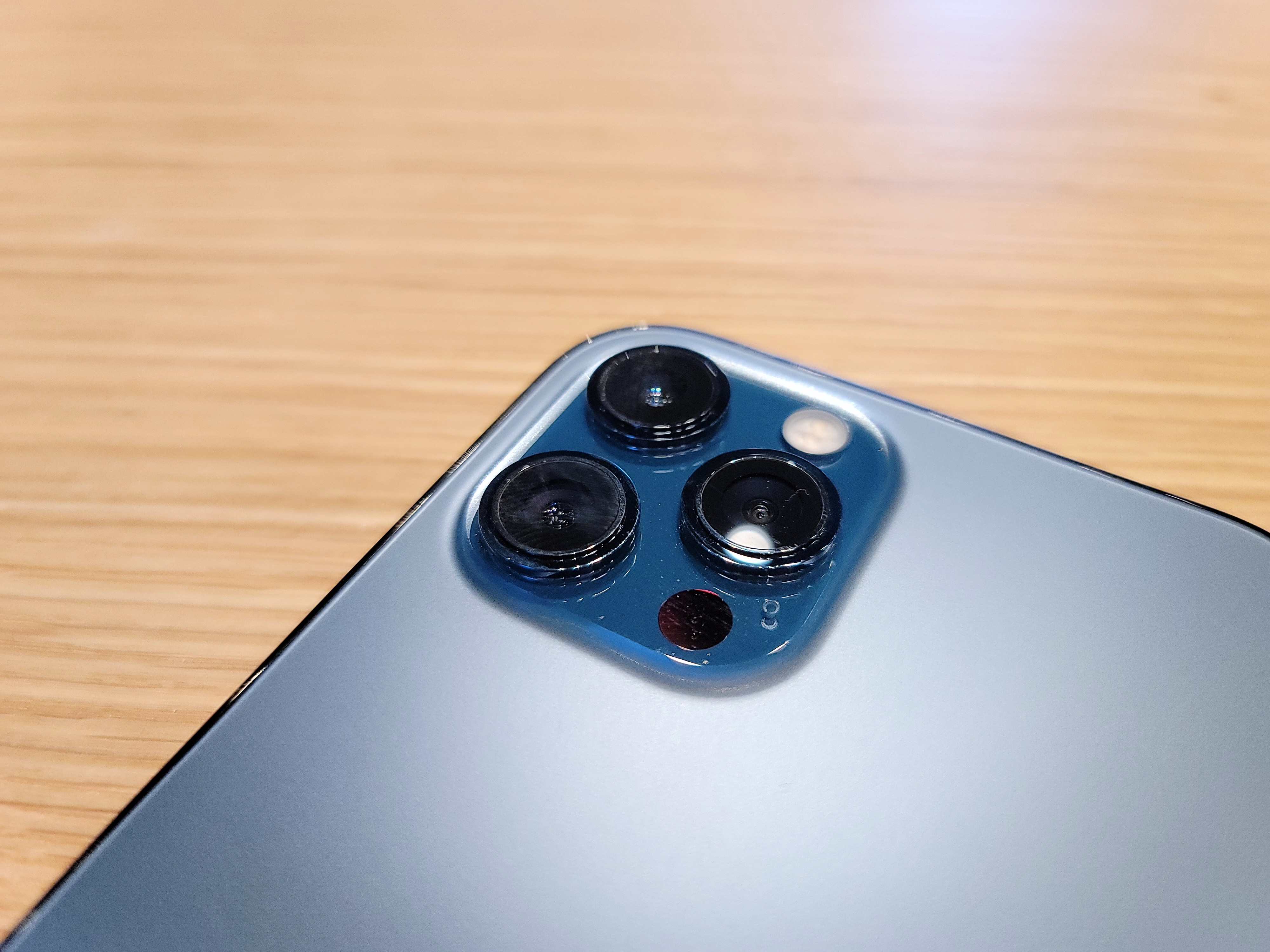
You can check out Matthew’s substantial review of those middle of the line devices here. And while we wait for the low and high end of the line to arrive, I spent a little time with the devices and snapped a couple of photos with the products, which you can check out below.

Image Credits: Brian Heater

Again, we can talk more in-depth write-ups at some point in the future, likely, but for now a smattering of thoughts and images. Consider this a kind of make up for the sorts of hands-ons with products we used to do at Apple’s in-person events, back in the before times, when Apple had in-person events.

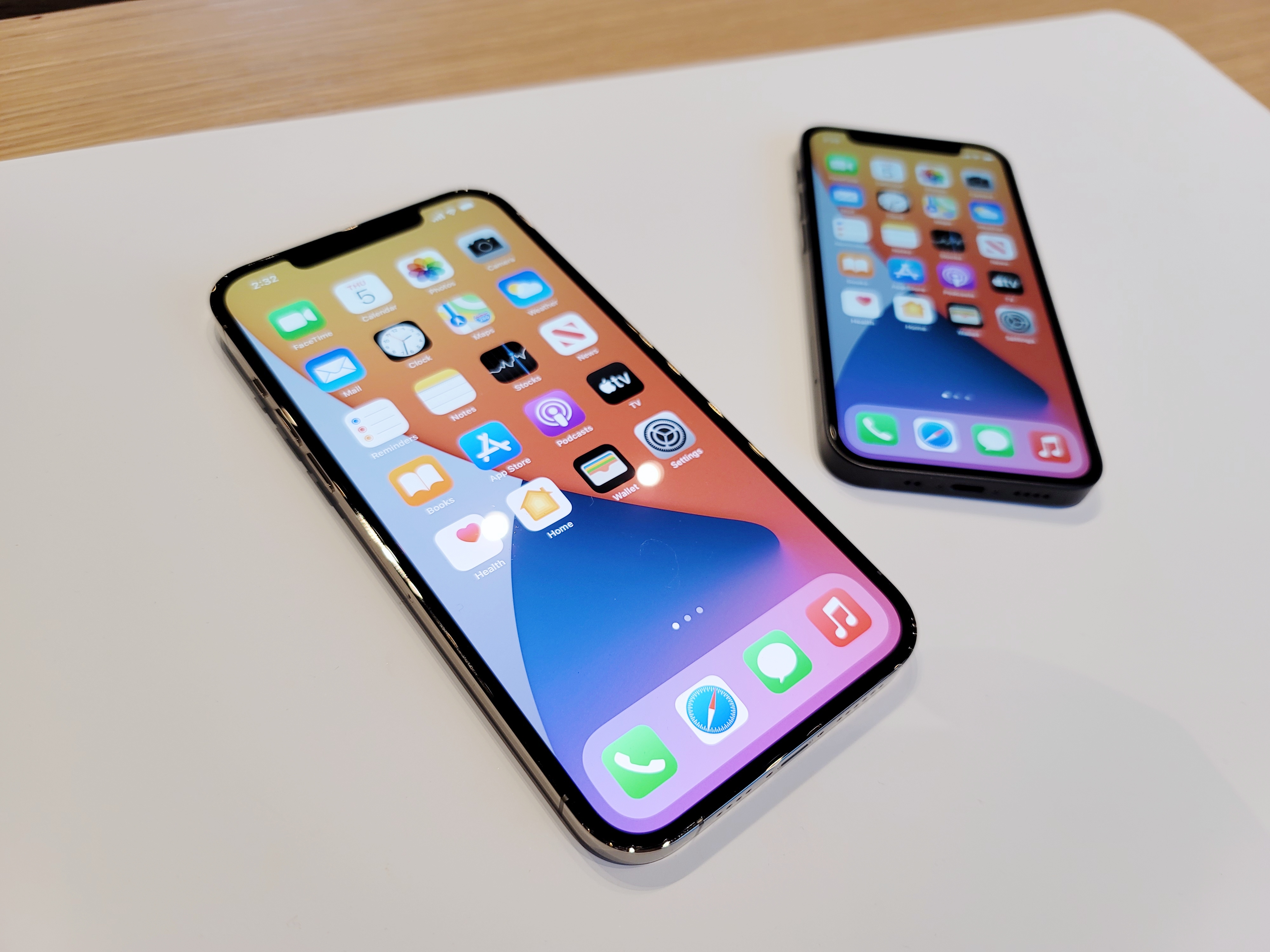
All of the four sizes were present and accounted for. As someone who’s been testing a fair number of large Android devices in recent months, the 6.7-inch Pro Max doesn’t appear exceptionally large. As you can see in that top photo, however, the difference between it and the Mini is pretty pronounced.

Image Credits: Brian Heater

It’s amazing how quickly our perceptions of screen sizes have shifted over the years, that a handset sporting a screen two inches larger than the original iPhone is now considered “mini” by a fairly considerable margin. Heck, even the 6-inch Pixel 5 I’ve been using off and on feels pretty small by today’s standards.

The standard iPhone 12 and 12 Pro’s 6.1-inch display seem like a pretty good sweet spot for many or most users. Many of the key specs are surprisingly consistent, given the $400 price difference between the high and low end. All sport 5G connectivity, the new magnetic MagSafe connector, OLED displays and an A14 chip.

[gallery ids="2070393,2070392,2070391,2070390,2070389,2070388,2070387,2070386,2070385,2070384,2070383,2070382"]

Beyond size, storage and battery capacity, the big differentiator are the cameras. No huge surprise there, as that continues to be where most smartphone manufacturers are making their biggest strides. Here’s a chart we made to break down those distinctions:

The iPhone 12 Pro Max and iPhone 12 Mini hit retail November 13.


Source: TechCrunch https://ift.tt/3k5x8mW

WhatsApp Brings Disappearing Messages To Its Platform

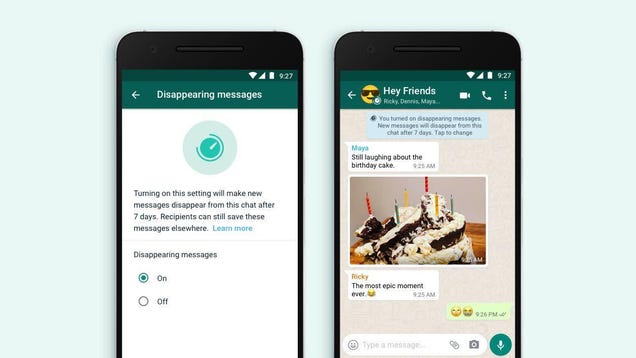
Good news for WhatsApp users who might want to keep their chat history a bit less permanent: the company announced a new “disappearing messages feature,” which will start rolling out to its more than one billion iOS and Android customers worldwide starting today.

Read more...


Source: Gizmodo https://ift.tt/32cLegg

Nvidia reportedly bringing Fortnite back to iOS through its cloud gaming service

Nvidia is bringing Fortnite back to iPhones and iPads, according to a report from the BBC.

The British news service is reporting that Nvidia has developed a version of its GeForce cloud gaming service that runs on Safari.

The development means that Fortnite gamers can play the Epic Games title off of servers run by Nvidia. What’s not clear is whether the cloud gaming service will mean significant lag times for players that could effect their gameplay.

Apple customers have been unable to download new versions of Epic Games’ marquee title after the North Carolina-based company circumvented Apple’s rules around in-game payments.

Revenues and rules are at the center of the conflict between Epic and Apple. Epic had developed an in-game marketplace where transactions were not subject to the 30% charges that Apple places on transactions conducted through its platform.

The maneuver was a clear violation of Apple’s terms of service, but Epic is arguing that the rules themselves are unfair and an example of Apple’s monopolistic hold over distribution of applications on its platform.

The ongoing legal dispute won’t even see the inside of a courtroom until May and it could be years before the lawsuit is resolved.

That’s going to create a lot of hassles for the nearly 116 million iOS Fortnite players, especially for the 73 million players that only use Apple products to access the game, according to the BBC report.

Unlike Android, Apple does not allow games or other apps to be loaded on to its phones or tablets via app stores other than its own.

Nvidia already offers its GeForce gaming service for Mac, Windows, Android and Chromebook computers, but the new version will be available on Apple mobile devices as well, according to the BBC report.

If it moves ahead, Nvidia’s cloud gaming service would be the only one on the market to support iOS users. Neither Amazon’s Luna cloud-gaming platform, nor Google’s Stadia service carry Fortnite.


Source: TechCrunch https://ift.tt/3k2B73A

WhatsApp now lets you post ephemeral messages, which disappear after 7 days

Facebook recently announced that WhatsApp passed the whopping milestone of 100 billion messages sent per day, but not everyone wants those chats to stick around forever. Now, Facebook’s wildly popular messaging app with 2 billion users is adding a feature to give people more control on how their words and pictures live within the app. From today, messages — including photos and videos — can now be marked to disappear after 7 days.

The feature is being rolled out globally across Android and iOS starting today, WhatsApp said. While it’s starting with a 7 day lifespan, it is already looking at playing around with the time limits.

“We will keep an eye on feedback about how people are using it and liking it and see if it needs adjusting in the future,” a spokesperson said. “For now we are starting with seven days, because it feels like a nice balance between the utility you need for global text based conversations and the feeling of things not sticking around forever.”

And just to be clear, the 7-day limit will exist regardless of whether the message gets read or not. (The clock starts counting when the message is sent, as it does on other apps like Telegram.)

“The way it’s currently designed is to give the sender confidence that after 7 days their message is gone. The messages have no concept of being seen, for them to disappear, so they will disappear regardless of read status,” said the spokesperson.

Users can turn on the feature for direct messages, but in groups it’s the admin that has to enable disappearing messages for it to work.

Although today is the “official” announcement, eagle-eyed WhatsApp watchers had spotted the company posting FAQs on the feature some days ago. And tests of the feature actually first started to appear — and,  fittingly, disappear — as early as March of this year.

This isn’t WhatsApp’s first rodeo with disappearing content.

In 2017, the company first dabbled in the idea with the launch of Status — an encrypted clone of Snapchat’s Stories feature, which let people set up short updates on themselves — in the form of some text and/or a GIF — as essentially a “profile” for all of their contacts to see for a set period of 24 hours, with the Statuses existing in their own tab in the app separate from your chats.

It’s not clear how popular the Status feature is these days: we’ve reached out to ask. Anecdotally, I’ve seen younger people using it a lot, where it lives as a proxy, pared-down version of updating your status on Facebook or Snapchat, older people less so.

WhatsApp said that one of the reasons it’s taken its developers so long to bring the ephemeral feature to the wider chat experience is in part because of the encrypted aspect of the app:

“[End-to-end encryption] was partly why it took us so long to implement this feature, because we wanted to retain the e2e capabilities that WhatsApp users expect and love,” the spokesperson said.

But in any case it’s a very long time in coming.

Ephemerality has been one of the most radical and sticky features in messaging in years — it has now been around for close to a decade. And it has arguably been the defining feature for one of the runaway, viral hits of the genre, Snapchat — so much so that clones of the feature have popped up in a number of other apps, from those focused first and foremost on privacy like Signal and Telegram, through to those that are aimed at more casual consumer audiences, like WhatsApp today.

And there could be signs that Facebook is may be looking to roll this out in other apps in its stable, too. Earlier this year it tested disappearing messages in Instagram, which now works officially. However in Messenger the most recent tests for disappearing text seem to be from 2015, but it does have a “secret” messaging feature (launched in 2016) that lets the sender control how long a message remains. This however is not quite the same as something baked into the main messaging experience.

The new disappearing messaging feature is coming amid some other notable additions in the app that appear to be in aid of the general purpose of giving more control to users.

Earlier this week, WhatsApp announced that it would enable a new storage feature in the app: specifically, an easier way to control how and where photos and other media that you are sent live. This is especially important for active (but perhaps not deep) users of the app, who find their storage is getting gobbled up by innocuous GIFs, photos and videos sent over the app by friends and acquaintances.

At the same time, it has also been beefing up the services it offers to businesses, and testing out business models for charging them, one way to stick to their commitment not to put ads into the service. The acceleration we’re seeing in adding more features to the app in recent times is notable, too, given how Facebook didn’t do much to update the features for years at a time before this, possibly to its detriment as the app faced a string of controversies over how it got abused by some.

As with the storage changes, the new disappearing feature will not be switched on for users by default: you have to proactively change the settings.


Source: TechCrunch https://ift.tt/2I6UaMS
Wednesday, November 4, 2020

Aveine’s Smart Wine Aerator is a huge upgrade for wine lovers – and could create some new ones, too

You might have very good reason to be on a wine kick right now – along with plenty of the rest of the country – so it’s perhaps timely to take a look at the Aveine Smart Aerator, a gadget from a French startup that offers variable, instant aeration and a connected app platform for determining just the right amount of aeration that any particular wine you happen to be drinking requires. The Aveine Smart Wine Aerator is premium-priced, but you might be surprised at just how much of a difference it can make.

The basics

The Aveine Smart Wine Aerator began life as did many other startup devices – as a crowdfunding project. The France-based team ended their campaign in 2018, having surpassed their funding goal, and spend the next couple of years working on finalizing, producing and shipping their design. The Aveine is now available to order, in both the original, full-performance version at $449, and an ‘Essential’ edition introduced this year that offers half the maximum aeration time (12 hours vs. 24) for $299 (reviewed here).

Both work the same way: You place them on top of the bottle you want to aerate once it’s opened, and they connect via Bluetooth to your phone and the Aveine app, which is available for iOS and Android. Through the app, you can take a photo of your wine’s label and it will try to match it from its growing database to automatically set the Aveine to the optimal aeration time.

Image Credits: Aveine

In practice, I found that most of the wines I was testing with weren’t in the database – which Aveine expects, and that’s why it provides a simple survey that you can fill out to get an approximate best aeration time, by supplying information like vintage, grapes used, region and whether the wine is organic or biodynamic. You can also manually set the aeration, and taste test small amounts to find your preferred amount.

Aveine includes a soft carrying case for the Smart Aerator in the box, as well as a charging base that connects to any standard USB wall plug for via micro USB. The built-in battery is rated for around 12-hours of standby, with occasional aeration use while pouring, when it’s actively injecting air into the flow using a built-in motor.

Design and performance

The Aveine feels quite heavy, and it’s clear that a lot of care went into ensuring that all of its smart internals fit comfortably inside the relatively small device. It fits easily over the vast majority of wine bottle tops, and grips while pouring without any special attachment process required. The touchscreen activates when you swipe it, showing you the adjustable aeration screen in simple black and white.

Getting started with the Aveine is simple, and doesn’t require the app at all in fact. Just adjust the scale to your desired aeration level, and pour. The aeration automatically begins when you tip the bottle, and you can hear it working as the motor works to inject air while the wine flows through. If you do use the app, it’ll ask you to connect the Aerator (if you’ve woken up the device by activating the display, it should instantly show up in the app’s device list when it’s within Bluetooth range of your phone).

If you have a wine that’s in Aveine’s database, taking a picture of the label will return a recommended aeration time, and if you’re connected to the aerator, it’ll also automatically set the aerator’s aeration time to that level. As mentioned, you can also answer a few questions about the wine if it’s not in the database to return an estimated aeration time, which will also be automatically set if you’re connected to the device.

Image Credits: Aveine

Now let’s talk performance: Let me say that I understand sticker shock when you see the asking price of the Aveine – I had the same thing. But actually using the Smart Aerator goes a long way to proving its worth. The effect is immediate and non-ambiguous: It makes just about any bottle of wine taste a whole lot better, without you having to decant it and let it sit for hours in advance.

My testing is admittedly non-scientific, but I did poll a wide swath of friends and families who enjoyed bottles aerated via the Aveine during socially distanced visits, and to a one they all noted a vast improvement between before and after aeration tastings. At least one even went out and immediately purchased an Aveine of their own based on the experience.

Sometimes you have to do a bit of experimentation to get the aeration right, adjusting the levels and doing contrasting taste tests – but that’s actually also part of the fun.

Bottom line

Aerator gadgets are plentiful, and often cheaply acquired in the checkout line at the local wine shop for well under $100. But the Aveine is the first one I’ve tried that makes such a clear and demonstrable difference it can convince novices and pros alike about its efficacy. It’s a high price to pay, yes, but what you get in return is a device that consistently makes life better for wine lovers – and that make some new wine lovers out of skeptics, too.


Source: TechCrunch https://ift.tt/3mOCWmE

Tuesday, November 3, 2020

Gaming rules the entertainment industry, so why aren’t investors showing up?

As gaming’s popularity reaches epic heights, venture investors’ activity in the industry doesn’t seem to equate with the overall size of the games market. Spurred by an unreal year where traditional entertainment has been upended by the COVID-19 pandemic and consumers find unity in virtual worlds like Animal Crossing and Fortnite, gaming has never been more popular.

Late-stage investors have shown that they have a tremendous appetite for businesses in the gaming industry. They’ve been pouring capital into established gaming companies like Scopely, which on Wednesday announced a $340 million investment round at a $3.3 billion valuation. But venture capital simply hasn’t given the gaming industry and the broader synthetic market the attention it deserves given its place in the entertainment and cultural firmament.

Just ask LeBron “Bronny” James Jr., the son of the NBA’s biggest star, who became a professional athlete this week — as a gamer with one of the most popular teams in online gaming, FaZe Clan. Or look at Unity, the creator of a popular game development engine, whose stock price has nearly doubled since its public offering in mid-September. Since opening trading at $56 per share, the stock has nearly doubled in value and is now trading at $100 per share.

In the first half of the year gamers spent $36.8 billion on games through both the Android and iOS app stores, according to data from SensorTower. New game installs are also up for the year. The app analytics company said that new game installs were up to 28.4 billion over the first half of the year. Annually the 15 billion new game downloads in the second quarter represented a 45.2% year-on-year growth in gaming.

Then there’s Bitkraft, one of the only venture firms to focus on the totality of the gaming industry, which announced the close of its most recent fund, a $165 million investment vehicle. The firm, which added a former Goldman Sachs managing director earlier in the year to capitalize on the opportunity in what the firm calls “synthetic reality” investments, raised $25 million more than its $140 million target. One of these things is not like the others.

“I’ve been in the games industry for 23 years now [and] I’ve always had this huge fundamental conviction of video games not only dominating the entertainment industry but sort of taking up a big part of what society is — where video games create the digital identities that define evermore of what we understand of ourselves,” said Jens Hilgers, Bitkraft’s founding general partner. “We feel that these are times of acceleration … it’s great to see how we’re leapfrogging one or two or three years of the games industry in this crisis and it makes it more exciting to invest in these times.”

The Unity public offering, and its emphasis on markets outside of gaming, seems to prove Hilgers point and show just how much opportunity remains around the notion of synthetic reality in business and entertainment.

“Their thesis around democratizing access to gaming tools by letting hobbyists use the tools for free is smart, if you want to win the market,” said Alice Lloyd George, founder of Rogue Ventures, a new investment firm focused on frontier technologies and gaming investments.

Lloyd George compared Unity’s business to its biggest competitor, Epic Games, and noted that both have broad aspirations. “Both of them want to use their game engines beyond pure gaming,” Lloyd George said of the two big new gaming platform developers. “Unity is really well-positioned because they’re so strong on mobile. That positions them well for AR and VR. And you need onramps for the developers for AR and VR.”

Engagement and the future of entertainment

When Scopely’s co-chief executive Walter Driver talks about the attraction of gaming properties for players — and the reason investors have been willing to value his Los Angeles-based company in the billions of dollars — he talks about the connections between players. “People have found — and investors looking at the space have found also — that people value the connection they’re getting from interactive experiences. It’s not just our relationship with the players, but their relationships with each other,” Driver said. “Inside of most passively consumed media experiences, you don’t have an identity. You don’t have friends.“


Source: TechCrunch https://ift.tt/2JyN9W5

The Onyx Boox Max Lumi Is a Giant E Ink Tablet I Almost Love

I desperately want a Remarkable 2. It looks so slim and so lovely, and my colleague Andrew will not shut up about the writing experience on it. But the Remarkable 2 is a $450 device that’s just good for writing by hand and marking up documents. The 13.3-inch Onyx Boox Max Lumi can do all of those things, and play…

Read more...


Source: Gizmodo https://ift.tt/2I4dydP

Monday, November 2, 2020

Haystack News adds 16 live news channels ahead of Election Day

Ad-supported streaming news platform Haystack News is announcing a significant expansion ahead of U.S. Election Day. The company this morning introduced sixteen 24/7 live streaming news channels, including ABC News Live, CBSN, Al Jazeera, Euronews, Newsmax, Yahoo Finance and several more live local news broadcast stations across the U.S.

These are the first live news channels Haystack News has added to its previously video-on-demand (VOD) only news service.

The expansion follows another recent update to Haystack News that brought its service to over 350 total news sources, thanks to the addition of Fox owned-and-operated local stations. This change allowed Haystack News to reach 100% of the top 30 DMAs (designated market areas).

With today’s update, Haystack News aims to become a one-stop shop for live Election Night coverage, as well  — particularly for cord cutters looking for a service offering a combination of both national and local news coverage.

Haystack News has particularly benefited from the rapid shift to over-the-top streaming and rise of cord cutting.

Earlier this year, the company rebranded from Haystack TV to Haystack News to better reflect its position as a destination for ad-supported video news coverage. And in June, Haystack News reported record growth for its service with “millions” of new users signing up year-to-date, and 145% audience growth year-over-year. It also said the app was on pace to more than double usage in 2020, exceeding millions of hours monthly.

As part of its rebrand, Haystack News updated its app’s user interface and rolled out Newsline — a personalized and dynamic news TV ticker.

Today, Haystack News tells us the company has doubled its net new users for each of the past five years and that number has reached about 3 million users for 2020.

It also offered a new data point, noting for the first time that Haystack News has surpassed 2 billion minutes of news content consumed in 2020.

As a free service, Haystack News is supported through advertising, but claims its ad load is less than of traditional TV. This makes the service appealing to cord cutters in particular, who may have lost access to TV news when they dropped their traditional pay TV subscription and are looking for a free replacement.

While there are a number of ways to access streaming news from a smart TV or streaming media device, Haystack News’ advantage is that it now, as of this update, offers a variety of content — including both on-demand and live streaming news, and both national and local news coverage.

However, the company tells us its larger competitive advantage will continue to be how it personalizes the news to the end users — a feature that will help to differentiate itself from other streaming rivals, it says.

Haystack News is offering across a range of smart TVs, including Hisense, LG, Samsung, Sony, TCL and Vizio Smart TVs, as well as on Amazon Fire TV, Android TV, Apple TV, Roku, and Android and iOS mobile devices. On the web, it’s available at haystack.tv.

To date, Haystack News has raised $6.5 million, including its most recent round of funding that closed in 2019. The service is backed by AltaIR Capital, the National Association of Broadcasters (NAB), Stanford University’s StartX Fund, SVLinks, Uhuru Capital, and Zorlu Ventures.


Source: TechCrunch https://ift.tt/34PJg7q

Walmart’s PhonePe zips past Google Pay in India as UPI tops 2B monthly transactions

UPI, a four-year-old payments infrastructure built by India’s largest banks, surpassed 2 billion transactions last month, exactly a year after hitting the 1 billion monthly transactions milestone.

Driving the transactions for UPI — which has become the most popular digital payments method in India thanks to its open architecture that allows interoperability among all participating payments apps — are Walmart’s PhonePe, Google Pay, Paytm, and Amazon Pay.

“Unlike China, we have given equal opportunities to both small and large domestic and foreign companies,” said Dilip Asbe, chief executive of NPCI, the payments body behind UPI, in an earlier interview.

But for the first time in more than a year, Google Pay did not drive the most volume of UPI transactions. PhonePe recorded 835 million UPI transactions in October, it said, while Google Pay hit about 820 million, according to people familiar with the matter.

Paytm recorded about 245 million transactions, while Amazon Pay settled with about 125 million, the people said.

In a statement, PhonePe confirmed that it assumed the “market leading position” with over 40% of all UPI transactions last month. Google and Paytm did not immediately respond to a request for comment.

TechCrunch could not determine how many unique monthly transacting users these payments firms have amassed in the country. In May, Google Pay had about 75 million transacting users, ahead of 60 million of PhonePe and 30 million of Paytm.

Unlike Google Pay, both Paytm and PhonePe also operate a wallet service. The wallet service is not powered by UPI. PhonePe said overall it processed 925 million transactions last month and had over 100 million monthly active users.

PhonePe has recently seen a surge in its transactions as more offline shops open and merchants and consumers opt for a digital alternative to complete transactions. The app has also added a range of financing services, including 600,000 insurance policies, it said.

“We are on a mission to make digital payments a way of life for every Indian citizen, and our next target is to cross 500 million registered users by Dec 2022. In line with our brand ethos of ‘Karte Ja. Badhte Ja,’ (Hindi for keep working and growing) we continue to launch new and innovative products for every strata of Indian society, as well as enable digital payment acceptance across every merchant in every village and town in India,” said Sameer Nigam, chief executive and founder of PhonePe, in a statement.

As the market grows, some top payments firms in the country have also had differences among themselves. Google temporarily pulled the app of Paytm, India’s most valuable app, in September for repeated violations of Play Store guidelines. Paytm alleged that Google’s Pay app engages in a similar set of practices and has since launched its own store and formed an informal coalition with other top startups in India to cut reliance on Android maker.

Industry executives have also claimed that Google Pay, which like other popular payments app in India bandies out cashback to users for making some transactions, uses UPI payments for such payments — a move they said helps Google increase the volume of UPI transactions it processes through its app. India’s mobile payments market is estimated to reach $1 trillion by 2023, according to Credit Suisse.

But these are not all the issues that these payments firms confront today. At least those on UPI are also struggling to make any money from it. At an event in Bangalore late last year, Sajith Sivanandan, managing director and business head of Google Pay and Next Billion User Initiatives, said current local rules have forced Google Pay to operate in India without a clear business model.

And things are about to get tougher as more players are expected to join the race. WhatsApp, which has over 400 million users in India, started testing UPI payments on its app in 2018. It remains stuck in a regulatory maze, however, which has prevented it from rolling out WhatsApp Pay to most of its users in the country.


Source: TechCrunch https://ift.tt/3812gSn