Wednesday, April 25, 2018

Dolo delivers on the Foursquare prophecy of hyper-local tips

Dolo is the kindness of strangers as an app. Where’s the prettiest place in the park? What’s the best thing on the menu? How do I skip the line? Dolo lets you leave helpful suggestions for anyone nearby. The new social app launches out of beta today to augment the world with serendipitous tips from strangers. Built by two ex-Apple employees and backed with pre-seed funding from Floodgate, Dolo could reveal the secrets and potential friends hidden in the ether around us.

Like any new social app, Dolo will have a steep uphill climb to user growth. There are also apps like Foursquare, guide books like Lonely Planet, and social networks like Facebook and its Recommendations feature to compete with. But they’re often bloated, outdated, or unfocused. Dolo hopes to build a new community around turning the whole world into a bulletin board.
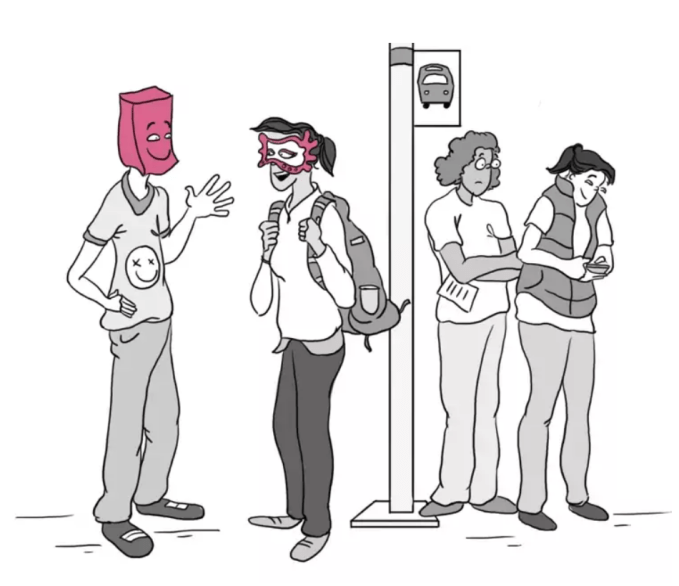
“If you take the construct of a cocktail party or a neighborhood bar, people feel more naturally ‘allowed’ to just mingle, eavesdrop, start a conversation, or even meet someone new” says Dolo co-founder and CEO Raja Haddad. “In larger spaces (a park, a neighborhood, a city), there are no vehicles today that allow such frictionless, comfortable, fun socializing.” That means a local expert’s knowledge ends up trapped while tourists and first-timers wander aimlessly.

Haddad and co-founder Benjamin Vigier met when they joined Apple in 2010 and worked on its Apple Store App before Haddad move on to Apple Watch marketing and Vigier helped develop Apple Pay. They later met Andy Mai at Coachella, who grew the Men’s Fashion Advice subreddit to over a million users. Together they set out “to enable serendipitous ways for people to socialize with other people around them, regardless of their pre-existing social bubbles.”
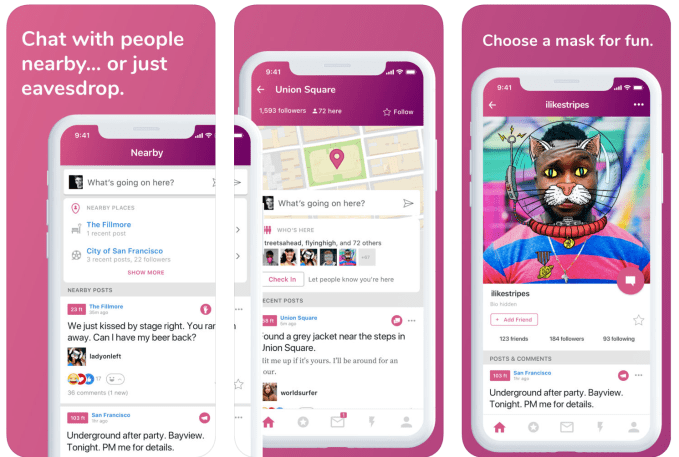
Dolo’s iOS and Android apps are now open everywhere, but it’s currently focusing on the San Francisco Bay Area where it centered its 4000 user beta. The app start with a feed of the closest tips that automatically re-sort as you move around. Anyone can post that “I need some info or a favor”, “folks need to know this!”, “I’m proposing an event”, or “just chatter and banter”. For example, my first contribution was that you can skip the line at famously overpopulated ice cream shop Bi-Rite Creamery by walking down the block to its soft-serve froyo window near SF’s Dolores Park.

That popular hipster picnic spot is actually where Dolo gets its name. And no, it’s not the same as the now defunct “bespoke app” called Dolo from 2013 that just helped you locate your friends in that park.
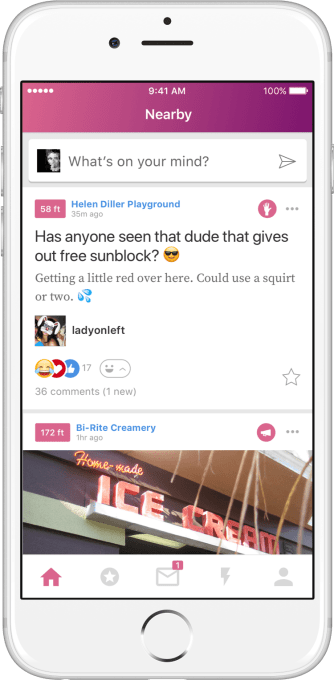
I was impressed by Dolo’s approach to safety and moderation that other anonymous and hyper-local apps like Yik Yak and Secret neglected until bullying led to their demise. You can use your real name or a pseudonym on Dolo, and choose a pixelated filter or mask sticker to obscure your face from the public. But then if you connect as friends with someone on the app, “the masks come off” Haddad says, and your profile’s bio is revealed. Meanwhile, users are empowered to moderate comments on their own posts by getting alerted to flags that Dolo reviews too. And all photos get reviewed by a crowdsourced moderation service.

Dolo smartly plans to “focus on achieving density vs. going directly for top-line scale” Haddad explains. That mirrors Facebook’s growth strategy that tried to get lots of users at specific colleges or locations so they don’t enter a ghost town, rather than immediately striving for global scale. It’s already raised $680,000 in a pre-seed round a year ago, but will try to raise a seed round early this summer. It hopes to put that cash into product development, and marketing activations at colleges and public places in the fall. 

Advertisers might be keen to reach potential customers when they’re super close-by and looking for local information. But that will require plenty of users as well as a tough-to-scale local ads sales team. Haddad admits “It’s obviously very challenging to get a social platform off the ground, particularly one that relies on location and density.”

NextDoor has at least proven that people are interested in local info, given it’s active in 160,000 neighborhoods. The question is if an app designed to alert you to what’s around you anywhere, rather than just close to home, will have the same legs. Dolo will also have to outlast specialized apps like Wildfire for celebrity sightings and safety alerts, Citizen for crime mapping, and Hive Social for interest-based communities.

It’s somewhat depressing, but an app like Facebook that already has ubiquity, frequent use, and local ad relationships might be better equipped to build this product than a startup. Dolo will have to figure out how to make adding and observing tips a constant enough behavior that users don’t forget about it.

But at least Dolo isn’t burdened by a hundred other features crowding out the local recommendations for attention, nor is it constrained by relying on your existing friend graph. A dedicated app for the insights of passersby holds the promise of not only illuminating what’s around us, but also mending our polarized society.


Source: TechCrunch http://j.mp/2JrZZAa

Google Tasks Is a Barebones (But Effective) To-Do App That Makes Gmail More Useful

Google may have paused development on Allo, but it seems the company can’t quite quit its habit of churning out apps just to keeps the wheels moving. Today it launched Google Tasks on Android and iOS, which actually rises above Google’s overloaded app cycle thanks to a clean UI and handy integration with Gmail and…

Read more...


Source: Gizmodo http://j.mp/2HqxLZP

Apple TV and Android see increase in streaming video viewership in Q1

Conviva, a video AI platform with visibility into the streaming market through clients like HBO, Turner, Hulu, CBS, NBC, ESPN, BT and Sky, is reporting today 114 percent year-over-year growth in streaming video hours in Q1 2018 to reach nearly 5 billion hours of video viewing. Even though streaming is growing worldwide, North America saw the largest growth in viewing hours, with a 174 percent increase quarter-over-quarter. Other platforms seeing notable increases included Apple TV and Android, the report found.

Much of today’s streaming takes place in apps on mobile devices and internet-connected TVs, as opposed to the web. That led to these platforms seeing significant growth in the quarter, with app-based viewing up 136 percent since last year.

Device makers which provide the apps, including Apple and Roku, also benefited from the growth in streaming, the report found. Apple TV, for example saw 709 percent growth in viewing hours over last year, while viewing hours on Roku grew by 87 percent.

Keep in mind that growth is not the same as popularity – that is, it’s not about how many total hours are being viewing on those platforms. Roku is still far in the lead on that metric, with over a billion hours streamed versus Apple TV’s 256 million. (Conviva’s numbers, because of the source of its data, are only a window into the market, we should note. Roku users streamed a little under 15 billion hours last year, so they’re streaming more than a billion per quarter. But Conviva’s report does speak to the bigger picture where Roku is outpacing rivals on streaming hours, including Apple TV, Chromecast, Fire TV, and others.)

Another interesting finding for the quarter was the growth in streaming on Android devices. On Android, device plays were up 168 percent quarter-over-quarter, versus iOS’s 138 percent increase.

More details are below:


Source: TechCrunch http://j.mp/2qXPHAQ

Google debuts a standalone to-do app, Google Tasks

Along with today’s big reveal of the redesigned version of Gmail, Google also more quietly introduced a new app that ties into its suite of productivity applications: Google Tasks. The app, as the name implies, offers you a dedicated place to create, view and edit your task list and to-do’s, including those created from within the new Gmail or from Google Calendar.

While Gmail had before supported task creation, it was more buried in its user interface. With the revamp, however, Tasks gets a bigger billing – it, along with Google Keep notes and Google Calendar – can be popped up right in Gmail’s sidebar with just a click.

With the influx of new users coming from Gmail, it makes sense to create a dedicated Google Tasks app, as well. After all, to-do’s aren’t something you only access or think about while in your inbox.

The app itself is a fairly standard take on to-do lists. You can create and manage your task list in the app, and break down tasks into subtasks. The drag-and-drop interface lets you prioritize your tasks, and you can set a “due date” for reminders on those you don’t want to forget. The app keeps things simple by not allowing you to set a time to be reminded – just a the date. That’s not going to work for everyone, though – some people will want to configure things more precisely.
[gallery ids="1628243,1628244,1628245,1628246,1628247"]

On its own, none of what Google Tasks offers is that remarkable. Instead, what makes the app worthwhile is its integration with the other Google services you use, like Gmail and Calendar. Being able to access the tasks you created elsewhere is useful, as is syncing your changes back to the inbox. Plus, you’re able to trace a task back to its source email in Gmail, and view them on your Google Calendar.

The app is also now considered a part of Google’s G Suite, which means Google doesn’t consider this some sort of mobile “experiment” that it will later ditch, leaving you to find a different to-do list app yet again.

The app is available as a free download on iOS and Android.


Source: TechCrunch http://j.mp/2I16eeQ

New Harry Potter game, launching today, lets players enroll in Hogwarts

In the first step of what could be an endless exploration of the wizarding world of Harry Potter, the Los Angeles mobile games studio Jam City  is releasing its Harry Potter: Hogwarts Mystery game on the App Store and Google Play.

Developed in partnership with Warner Bros., the game will launch under Warner Bros. Interactive Entertainment’s Portkey Games — a label dedicated to creating first-person gaming experiences for mobile devices and consoles based on J.K. Rowling’s Harry Potter series.

No one could accuse me of being a gamer, but as a fan of both the books and the movies, I was intrigued by the prospect that the Hogwarts Mystery game presents. The animation (from the demo I’d seen) is well done and the plot was compelling.

Set in the 1980s, the game follows the player as they develop a character, enroll in Hogwarts, select one of the school’s four houses and begin to navigate the world of Hogwarts. Players can create personalized characters and customize their avatars by learning magical skills and developing relationships with other students.

Certain choices in the game will change the trajectory of the story, and over time, the game developers envision expanding the world well-beyond Hogwarts to track characters as they navigate life in the Harry Potter universe.

But it all starts with Hogwarts School of Witchcraft and Wizardry and the mystery at the heart of game’s plot. The player’s avatar had an older sibling who attended Hogwarts but vanished mysteriously. Part of the narrative that propels the game will be investigating what happened, and why.

Within the game, players can expect to see some familiar faces (and hear some familiar voices). Dame Maggie Smith is reprising her role as Professor McGonagall and Michael Gambon is back voicing Professor Dumbledore. Other actors from the movies include Warwick Davis as Professor Flitwick, Gemma Jones as Madam Pomrey and Zoe Wanamaker as Madam Hooch.

“Our goal with Harry Potter: Hogwarts Mystery is to make players really feel for the first time like they’re attending Hogwarts,” said Chris DeWolfe, co-founder and CEO of Jam City, in a statement. “By including these iconic and incredibly talented actors in the game, we come one step closer to truly giving fans their own Hogwarts experience.”

Players will also meet original game characters like Penny, a popular Hufflepuff potions expert, Tulip, a rebellious Ravenclaw prankster, and Merula, a Slytherin with a dark past.

As for the gameplay itself, users can duel with characters, learn spells, and interact with students to gain different points that correspond to certain skills and attributes.

Mechanisms for interaction are similar to those developers have been using since Kim Kardashian: Hollywood, and some reviewers have wondered (rightly) whether the dream of a wizarding world that’s mostly open for exploration will be perverted by a cash grab.

The developers of the game I spoke with seem to be just as excited as the players they want to attract, and will ideally acknowledge the not-so-fine line between commercial viability and opportunistically extortionate in-game economics.


Source: TechCrunch http://j.mp/2vJKfpX

Opera launches a new mobile browser

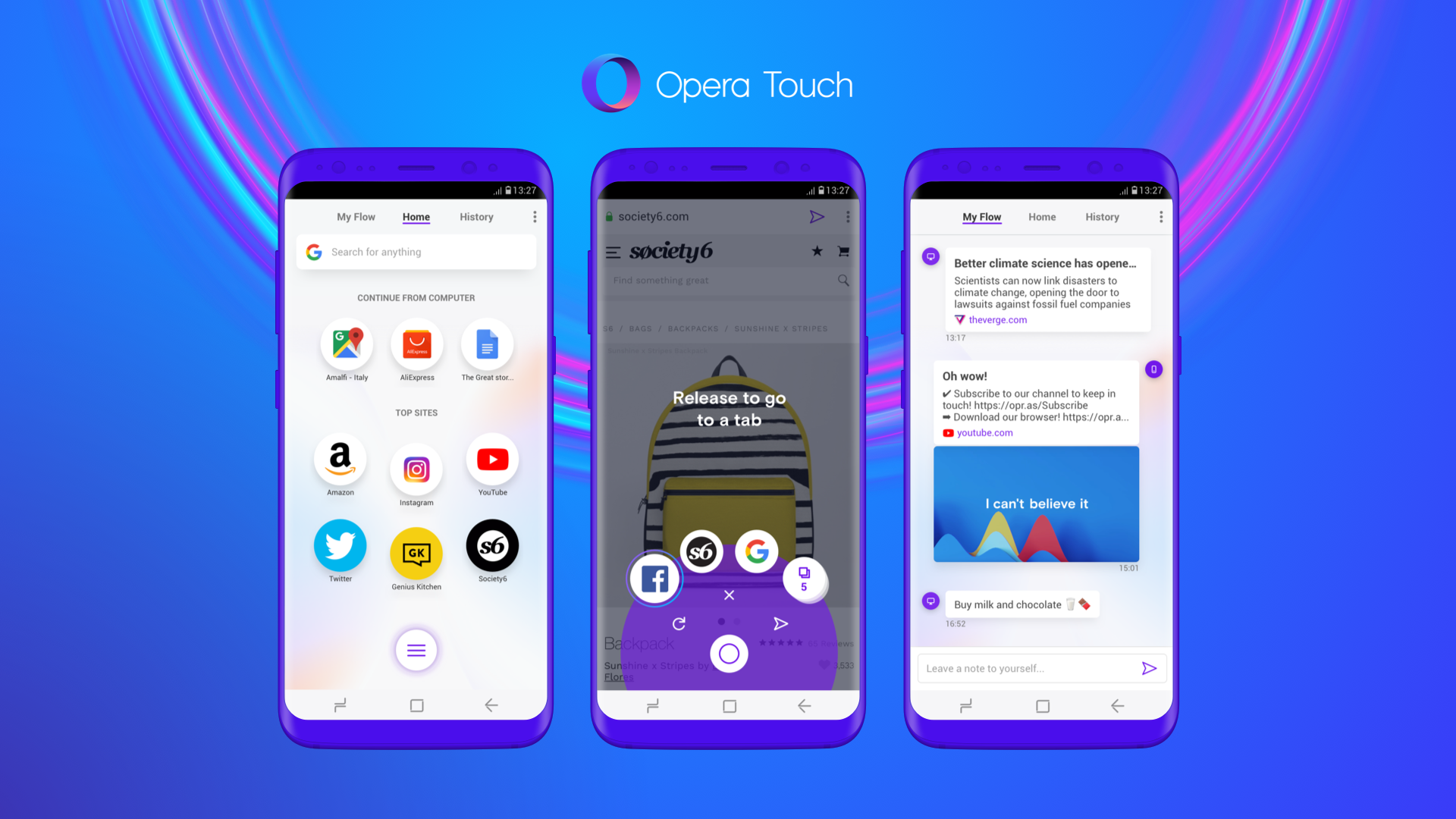
Opera today announced a new mobile browser, Opera Touch, that shows that there’s still plenty of room for a competitor in the mobile browsing world. Opera Touch takes some ideas from the company’s experimental Opera Neon desktop browser and packages it into a highly usable package for Android, with an iOS version coming soon.

It’s not so much that Touch reinvents the wheel, but that it seems to have been designed with the idea of putting the user first. This starts with small touches, like putting the tab switcher and access to your bookmarks at the bottom of the page, so that you never have to do some finger gymnastics to reach the top of your screen again (or use two hands, which I guess is also an option…). Safari users are surely quite familiar with having access to these features at the bottom of the screen, but on the main Android browsers, it’s been oddly absent.

When you hold it down, this ‘fast action’ button also gives you easy access to your tabs and a simple tap lets you quickly start a search or type a URL.

“We have moved the browser’s key functions within your thumb’s reach,” said Maciej Kocemba, product manager at Opera, in today’s announcement. “This means that, unlike in most other browsers, you can more easily browse and search the web when on the move.”

The browser also comes with Opera’s ad blocker, if that’s your thing, as well as cryptojacking protection.

What’s maybe most important, though, is that the Opera desktop browser (version 52 is launching today) and Opera Touch can now easily share information with each other without the need for logins and passwords. You simply scan a QR code from the desktop version with Opera Touch and you should be ready to go.

This new feature, dubbed ‘Flow,’ didn’t quite work for me when I tested the new mobile and desktop browsers ahead of the launch, but I assume that’s just pre-launch jitters. When it works, though, it should free you from having to email links to yourself, something too many people still do, despite that face that most mobile browsers to support some kind of syncing with the desktop counterparts. Often, though, those features are rather hidden.

Of course, not everything can be perfect. One feature I sorely  miss in Opera Touch is the ability to actually manage my bookmarks. Touch automagically fills in your list of most often used sites, but there is no way to pin a bookmark to a specific spot in that list. To be fair, most people probably just type the first few letters of the site they want to go to and that’s fine, but a bit more flexibility here would be nice.

If you’re interested in looking at an alternative browser, Opera Touch is definitely worth a try. It works best in combination with the desktop version, but it’s also perfectly fine as a stand-alone mobile browser.


Source: TechCrunch http://j.mp/2JpRWUm

Tuesday, April 24, 2018

Instagram Now Lets You Export Your Photos, Videos, and Embarrassing DMs

Instagram is finally giving users the ability to download some of their data. After teasing the tool a few weeks ago, the Facebook-owned service released a data export feature today, and it does more than just let you retrieve a copy of your filtered photos.

Read more...


Source: Gizmodo http://j.mp/2HGsIEb

Instagram launches “Data Download” tool to let you leave

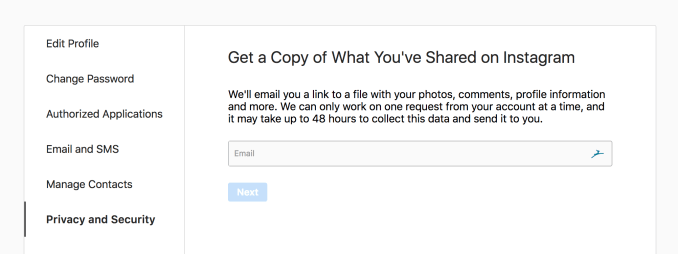
Two weeks ago TechCrunch called on Instagram to build an equivalent to Facebook’s “Download Your Information feature so if you wanted to leave for another photo sharing network, you could. The next day it announced this tool would be coming and now TechCrunch has spotted it rolling out to users. Instagram’s “Data Download” feature can be accessed here or through the app’s privacy settings, and lets users export their photos, videos, Stories, profile, info, comments, and messages.

An Instagram spokesperson now confirms to TechCrunch that “the Data Download tool is currently accessible to everyone on the web, but access via iOS and Android is still rolling out.”

The tool’s launch is necessary for Instagram to comply with the data portability rule in European Union’s GDPR privacy law that goes into effect on May 25th. But it’s also a reasonable concession. Instagram has become the dominant image sharing social network with over 800 million users. It shouldn’t need to lock up users’ data in order to keep them around.

Instagram hasn’t been afraid to attack competitors and fight dirty. Most famously, it copied Snapchat’s Stories in August 2016, which now has over 300 million daily users — eclipsing the original. But it also cut off GIF-making app Phhhoto from its Find Friends feature, then swiftly cloned its core feature to launch Instagram Boomerang. Within a few years, Phhhoto had shut down its app.

If Instagram is going to ruthlessly clone and box out its competitors, it should also let users choose which they want to use. That’s tough if all your photos and videos are trapped inside another app. The tool could create a more level playing field for competition amongst photo apps.

It could also deter users from using sketchy third-party apps to scrape all their Instagram content. Since they typically require you to log in with your Instagram credentials, these put users at risk of being hacked or having their images used elsewhere without their consent. Considering Facebook launched its DYI tool in 2010, six years after the site launched, the fact that it took Instagram 8 years from launch to build this means it’s long overdue.

But with such strong network effect and its willingness to clone any popular potential rival, it may still take a miracle or a massive shift to a new computing platform for any app to dethrone Instagram.


Source: TechCrunch http://j.mp/2HqC9Uy