Tuesday, October 30, 2018

Waze’s new audio player supports Pandora, Stitcher and more

Drivers can now listen to their favorite tunes without having to leave the Waze navigation app.

This week, Waze added an audio player to its crowdsourced navigation app that aims to deliver music, podcasts and other content from seven major platforms, including Pandora, Deezer, iHeartRadio, NPR, Scribd, Stitcher and TuneIn. These partners have integrated their audio experience into Waze by using a new suite of developer tools, called the Waze Audio Kit.

A beta versionof its Android and iOS apps that include the embedded audio player, called Waze Audio Player, was released this week to members of Waze’s beta community. Waze Audio Player will begin rolling out to all Waze users in the coming weeks, the company said.

The decision to bring audio into the popular navigation app was inspired by the positive feedback the company received after its first audio integration with Spotify that launched in March 2017, Waze said.

Here’s how it will work. Once users open Waze, the app will detect any of the supported music apps installed on their smartphones. Users can tap the music note icon to select their audio app within Waze. To switch from one audio app to another — say from NPR to iHeartRadio — users tap the music note icon again and then hit “change app.”

Users will be able to control whatever content their listening to using forward, backward and pause icons. They’ll also be able to save content to a library.


Source: TechCrunch http://j.mp/2zixqRZ

Monday, October 29, 2018

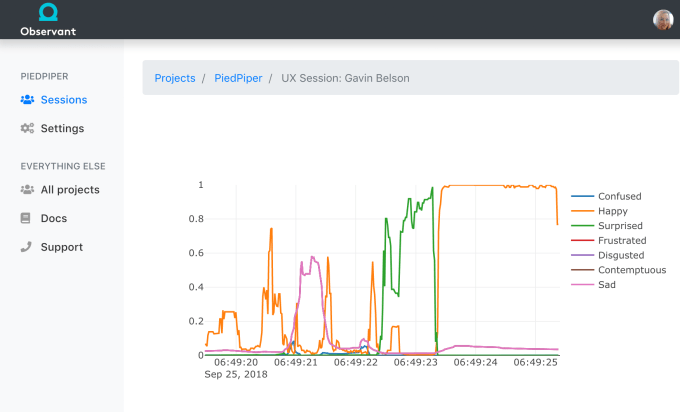
YC-backed Observant uses the iPhone’s infrared depth sensors to analyze user emotions

Observant has found a new way to use the fancy infrared depth sensors included on the iPhone X, XS and XR: analyzing people’s facial expression in order to understand how they’re responding to a product or a piece of content.

Observant was part of the winter batch of startups at accelerator Y Combinator, but was still in stealth mode on Demo Day. It was created by the same company behind bug reporting product Buglife, and CEO Dave Schukin said his team created it because they to find better ways to capture user reactions.

We’ve written about other startups that try to do something similar using webcams and eye tracking, but Schukin (who co-founded the company with CTO Daniel DeCovnick) argued that those approaches are less accurate than Observant’s — in particular, he argued that they don’t capture subtler “microexpressions,” and they don’t do as well in low-light settings.

In contrast, he said the infrared depth sensors can map your face in high levels of detail regardless of lighting, and Observant has also created deep learning technology to translate the facial data into emotions in real-time.

Observant has created an SDK that can be installed in any iOS app, and it can provide either a full, real-time stream of emotional analysis, or individual snapshots of user responses tied specific in-app events. The product is currently invite-only, but Schukin said it’s already live in some retail and ecommerce apps, and it’s also being used in focus group testing.

Observant

Of course, the idea of your iPhone capturing all your facial expressions might sound a little creepy, so he emphasized that as Observant brings on new customers, it’s working with them to ensure that when the data is collected, “users are crystal clear how it’s being used.” Plus, all the analysis actually happens on the users’ device, so no facial footage or biometric data gets uploaded.

Eventually, Schukin suggested that the technology could be applied more broadly, whether that’s by helping companies provide better recommendations, introduce more “emotional intelligence” to their chatbots or even detecting sleepy driving.

As for whether Observant can make achieve those goals when it’s only working on three phones, Schukin said, “When we started working on this almost a year go, the iPhone X was the only iPhone [with these depth sensors]. Our thinking at the time was, we know how Apple works, we know how this technology propagates over time, so we’re going to place a bet that eventually these depth sensors will be on every iPhone and every iPad, and they’ll be emulated and replicated on Android.”

So while it’s too early to say whether Observant’s bet will pay off, Schukin pointed to the fact that these sensors have expanded from one to three iPhone models as a sign that things are moving in the right direction.


Source: TechCrunch http://j.mp/2zcL4X0

Civil servant who watched porn at work blamed for infecting a US government network with malware

A U.S. government network was infected with malware thanks to one employee’s “extensive history” of watching porn on his work computer, investigators have found.

The audit, carried out by the U.S. Department of the Interior’s inspector general, found that a U.S. Geological Survey (USGS) network at the EROS Center, a satellite imaging facility in South Dakota, was infected after an unnamed employee visited thousands of porn pages that contained malware, which downloaded to his laptop and “exploited the USGS’ network.” Investigators found that many of the porn images were “subsequently saved to an unauthorized USB device and personal Android cell phone,” which was connected to the employee’s government-issued computer.

Investigators found that his Android cell phone “was also infected with malware.”

The findings were made public in a report earlier this month but buried on the U.S. government’s oversight website and went largely unreported.

It’s bad enough in this day and age that a government watchdog has to remind civil servants to not watch porn at work — let alone on their work laptop. The inspector general didn’t say what the employee’s fate was, but ripped into the Department of the Interior’s policies for letting him get that far in the first place.

“We identified two vulnerabilities in the USGS’ IT security posture: web-site access and open USB ports,” the report said.

There is a (slightly) bright side. The EROS Center, which monitors and archives images of the planet’s land surface, doesn’t operate any classified networks, a spokesperson for Interior’s inspector general told TechCrunch in an email, ruling out any significant harm to national security. But the spokesperson wouldn’t say what kind of malware used — only that, “the malware helps enable data exfiltration and is also associated with ransomware attacks.”

Investigators recommended that USGS enforce a “strong blacklist policy” of known unauthorized websites and “regularly monitor employee web usage history.”

The report also said the agency should lock down its USB drive policy, restricting employees from using removable media on government devices, but it’s not known if the recommendations have yet gone into place. USGS did not return a request for comment.


Source: TechCrunch http://j.mp/2Pw8sss

Google employees will walk out on Thursday to protest company’s handling of sexual misconduct

Days after a New York Times investigation revealed Google gave Android creator Andy Rubin a $90 million exit package despite multiple relationships with other Google staffers and accusations of sexual misconduct, some 200 employees at the search giant are planning a walkout, per BuzzFeed News.

We’ve reached out to Google for comment.

The walkout, or “women’s walk,” as it’s been referred to in internal company forums, is planned for Thursday.

Following the NYT report, Google chief executive officer Sundar Pichai and its vice president of people operations Eileen Naughton co-signed a company memo admitting that 48 people had been terminated at the company for sexual harassment in the past two years, 13 of which held a senior management position or higher. None of them, according to the memo, received an exit package.

“Today’s story in the New York Times was difficult to read,” they wrote. “We are dead serious about making sure we provide a safe and inclusive workplace. We want to assure you that we review every single complaint about sexual harassment or inappropriate conduct, we investigate and we take action.”

Rubin left Google in 2014 after an internal investigation found accusations of sexual misconduct against him to be credible. The details of his exit, however, were never disclosed. It wasn’t until The Information published its own bombshell report on Rubin’s wrongdoings last fall that details of his history of sexual harassment began to emerge. In the wake of The Information’s story, Rubin took a leave of absence from Essential to “deal with personal matters.”

After leaving Google, Rubin went on to found Essential Products, a smartphone company that raised heaps of venture capital funding only to cancel development of its next phone, lay off 30 percent of its staff and reportedly put itself up for sale.

In a tweet last week, Rubin claimed NYT’s story contained “numerous inaccuracies.”

“Specifically, I never coerced a woman to have sex in a hotel room. These false allegations are part of a smear campaign to disparage me during a divorce and custody battle. Also, I am deeply troubled that anonymous Google executives are commenting about my personnel file and misrepresenting the facts,” he wrote.


Source: TechCrunch http://j.mp/2zcvqe5

Delightful Google Bug Seemingly Gives Pixel 3 XLs an Extra Helping of Notches

Until Apple, Google, and the like find a way to hide front-facing cameras and sensors beneath their smartphones’ displays, notches are a hideously unfortunate design solution to maxing out screen real estate. The Pixel 3 has one of the worst notches, and making matters even worse for some Pixel 3 XL users is a bizarre…

Read more...


Source: Gizmodo http://j.mp/2yEsYOf

Google Discover begins to replace the iconic search box on mobile

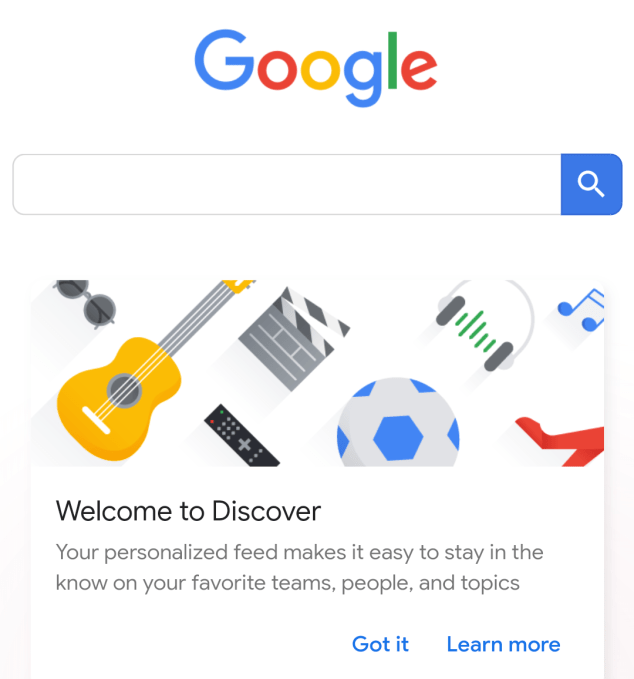
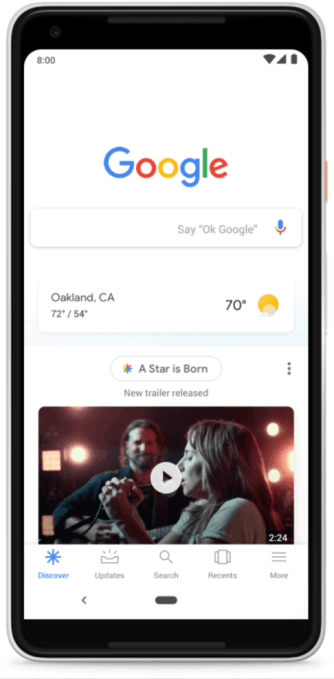
It’s not broke, but Google is fixing it. As it announced last month, Google is rebranding Google Feed, its news landing page on Android and in the Google app, to be called Google Discover. Throwing minimalism out the window, Google Discover will replace the iconically spartan Google.com homepage on mobile.

Discover is rolling out now on Google.com across both iOS and Android devices. For Android users, Discover is already baked into the interface, accessible by swiping right from the home screen. Anyone using the Google app on iOS or Android will also be met with the Discover homepage, which should be familiar at this point. We’ve reached out to Google for more details on who will see Discover when.

For a company that at times struggles with filtering disinformation out of its search results, making Discover so prominent might not be a well timed choice. The Discover results generally resurface stuff that a user has already expressed interest in, but those results are culled from a broad enough pool of sources that they don’t always feel relevant. Hopefully Google has enough sentient humans on its teams to avert future algorithmic catastrophy, though we’re not holding our breath for Google or any social platform on that count.

If you’re using Discover through the Google app, you can customize your feed further, adding topics to subscribe to, weather, commute info and more. If you’re a sports fan, the “teams” feature is genuinely useful. If Google’s vast collective knowledge of your predilections creeps you out (and it should) but you still like the Google app, you can disable “Web & App Activity” for a bit more peace of mind by following these instructions — just do them backward.


Source: TechCrunch http://j.mp/2JmnBaB

OnePlus 6T Review: The No Bullshit Best Deal in Smartphones

Since its inception, OnePlus has danced around the fringes of the smartphone market, catering to nerds and enthusiasts with spec-laden devices for reasonable prices. And unlike the Apples and the Samsungs of the world, OnePlus has thrived even though it really only makes one product a year, typically released in the…

Read more...


Source: Gizmodo http://j.mp/2D9nIpv

Vimeo subscribers can now publish videos directly to LinkedIn

Vimeo announced today a new feature that will allow videos to be published directly to LinkedIn. The added support is a part of the company’s “Publish to Social” feature, which already offers publishing to Facebook, Twitter, and YouTube, and is available to paid subscribers. The expansion to LinkedIn is another example of the company’s shift in focus from being a video destination site to one that sells tools and services to professional and semi-professional video creators.

The company last year scrapped its plans for a subscription video-on-demand service, promoted its creator business lead Anjali Sud to CEO, and acquired live video streaming platform Livestream, as a part of its broader plan to serve the video creator community through services.

Earlier this year, it announced “Publish to Social,” a tool that support uploading videos to multiple sites at once, as a part of all Plus, PRO, Business, and live plans.

Now it’s adding LinkedIn to its list of supported sites, which makes it the first video platform to integrate with LinkedIn, the company says.
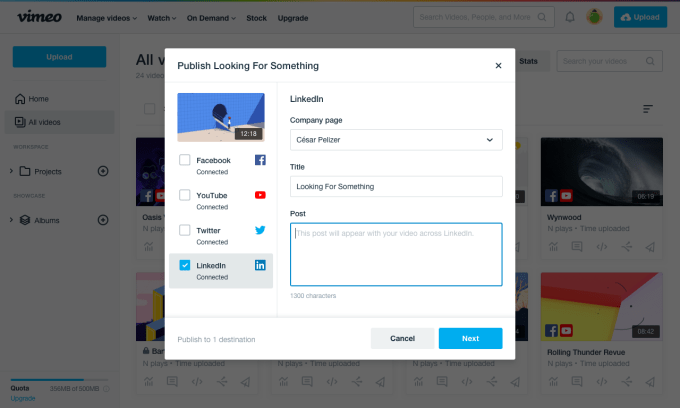
The move also follows Microsoft’s earlier announcement that LinkedIn would open to video uploads as part of a larger video push on its part. Last summer, LinkedIn launched a new feature that allowed users to upload videos to the site from its iOS or Android mobile app – the idea being that users could highlight their work  projects or demonstration products, for example.

With Vimeo’s integration, however, the focus is on uploading to Company Pages, where businesses may be using video in a variety of ways to connect with their customers, prospective employees, and others.

“Video has become one of the key drivers for member engagement on LinkedIn, and businesses who want to start a conversation with their audiences are increasingly turning to Company Page videos,” said Peter Roybal, principal product manager at LinkedIn, in a statement about the partnership with Vimeo. “Our new integration with Vimeo is an exciting step for anyone who wants to gain more exposure, and understand their reach to LinkedIn’s highly-engaged professional audiences,” he added.
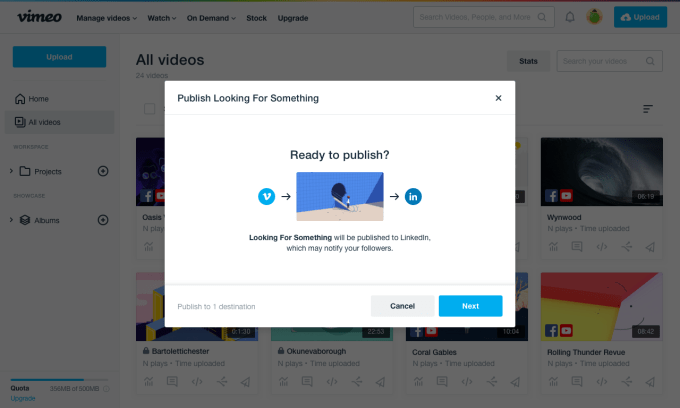
In addition to the ability to publish to LinkedIn, Vimeo will also provide creators with analytics on the videos, including things like video viewership, engagement, and performance stats. These are available on the Vimeo dashboard, alongside the metrics for other social platforms, as well as other websites and blogs, allowing creators to compare their campaigns’ performance across various destinations.

Creators can also take advantage of Vimeo’s other marketing tools from this dashboard to further customize and monetize their content, the company says.

Using video on LinkedIn can be a big boost for businesses. According to LinkedIn’s own data, LinkedIn Company Page videos see 5x the engagement than any other type of post. And because today’s social platforms favor native uploads, the ability to push a video from Vimeo to sites like LinkedIn, Facebook, Twitter and YouTube in that same manner means creators are likely also expanding their reach, rather than using embeds or links.


Source: TechCrunch http://j.mp/2qisdpo

The Red Hydrogen One Is a Phone Made for an Alternate Reality

Jim Jannard is an interesting guy. After starting a one-man business selling motorcycle parts, he decided to pivot into goggles and eyewear. Fast forward about 25 years, and Oakley had become one of the biggest sunglass brands in the world. Then in 2007, after selling Oakley for $2.1 billion, Jannard turned to his…

Read more...


Source: Gizmodo http://j.mp/2CLjfZg