Monday, November 9, 2020

Mirror founder Brynn Putnam on life with Lululemon — and whether or not she sold too soon

Brynn Putnam has a lot to feel great about. A Harvard grad and former professional ballet dancer who opened the first of what have become three high-intensity fitness studios in New York, she then launched a second business in 2016 when — while pregnant with her son — she was exercising at home and couldn’t find a natural way watch a class on her laptop or phone. Her big idea: to install mirrored screens in users’ homes that are roughly eight square feet and through which they can exercise to all manner of streamed and on-demand exercise classes, paying a monthly subscription of just $39 per month.

If you’ve followed the home fitness craze, you already know these Mirrors quickly took off with celebrities, who gushed about the product on social media. Putnam’s company also attracted roughly $75 million in venture funding across several fast rounds. Indeed, by the end of last year, people had bought  “tens of thousands” of Mirrors, according to Putnam, and she was beginning to envision Mirrors as content portals that might feature fashion, enable doctors’ visits, and bring both kids’ classes and therapy into users’ homes. As she told The Atlantic back in January, “We view ourselves as the third screen in people’s homes.”

Then, in June, the company revealed it had sold for $500 million in cash — including a $50 million earn-out — to the athleisure company Lululemon. For Putnam, the deal was too compelling, allowing her to secure the future of her company, which continues to run as a subsidiary. Investors might have liked it, too, given that it meant a fast return on their investment, not to mention that Mirror had steep competition, including from Peloton, a growing giant in the home fitness market.

The deal seems to be clicking. Just today, Lululemon announced that it is installing Mirrors in 18 of its now 506 U.S. locations, including in San Francisco, Washington, D.C., and Miami. Lulemon hasn’t started selling products directly through Mirror yet, but “shoppable content” is “certainly on our radar” too, says Putnam. Meanwhile, Mirror’s revenues, expected earlier this year to reach $100 million, are now on target to surpass $150 million in revenue, she says.

Still, as the pandemic has raged on, it’s easy to wonder what the young company might have grown into given the amount of time that people and their children are spending at home and in front of their screens. Late last week, we put the question to Putnam, who continues to manage a team of 125 people. Our chat, lightly edited, follows. You can listen to the full conversation here.

TC: People who follow the company know why you started Mirror, but how, exactly, did you start Mirror?

BP: In the case of Mirror, I had this concept for the product, and then really, the first step was buying a Raspberry Pi, a piece of one-way glass, and an Android tablet, and assembling it in my in my kitchen to see if this idea in my mind would be able to work and come to life.

TC: Did you take any coding classes? People might not imagine that a former ballet performer with a chain of fitness studios would put something together like that in her kitchen.

BP: No, I’ve been very fortunate to have a husband who has a bit of a development background. And so he helped me to put the first little bit of code into the Mirror and just really ensure that the concept I had in my mind could be brought to life. And then from there, obviously, over time, we hired a team.

TC: Are they manufactured in the States? In China? How did you start figuring out how to put those pieces together?

BP: I had heard a lot of hardware horror stories about teams working with design agencies to design these beautiful products and who, by the time they actually got to manufacturing, found out that something wasn’t feasible about their design when it came to commercialization or just running out of money in the process. So I actually went backwards. I drew a sketch on a napkin and did a small set of bullets of the things that I thought were really just crucial to make the product a success. And then I went to find factories in China that were familiar with digital signage, working with large pieces of glass, large mirrors, learned about their systems and processes, and then brought it back to the U.S. to a local manufacturer here on the East Coast to refine into a prototype. And then we eventually moved to Mexico when we were ready to scale.

TC: The mirror is about $1,500 dollars. How did you go about winning the trust of consumers that would lead them to make such a sizable investment?

BP: When you’re when you’re building an innovation product, you can’t really compete on specs and features like you do with phones or laptops. So you’re really building building a brand, which means that you’re telling stories. And in our case, we spent a lot of time, from the very early days, really imagining the life of our members and figuring out how to craft that story and tell that story.

And then we were fortunate early on to have members fall in love with the product. And then they started to tell our story for us. So once you have that customer flywheel that starts to kick in, your job becomes much easier.

TC: You had actors, celebrities, designers, and social media influencers talking about their Mirrors. Was it just a matter of sending it off to a few people who started getting online and sharing [their enthusiasm for the product] with their followers? Was it that simple?

BP: We knew that we wanted to make big bets early on to make the Mirror brand seem larger and more established than it was, because it’s a premium product in a new category. And we wanted people to trust in us and the brand. And so we did things like out-of-home advertisements quite early, we moved into television quite early, and we also did some very strategic early celebrity placements. But the way in which the celebrity placements grew and expanded was very much not intended and was just kind of a fascinating early example of the network effects of the product. One celebrity would get it and then another would see it in their home. Or they would see it in their stylist’s home or their agent’s home. And it spread through that community very, very quickly in one of the earliest examples of member love for us.

TC: How did you convince early adopters that your business had staying power, and were investors persuaded as quickly?

BP: Trying to assure customers that they wouldn’t invest in this Mirror, and then the company would go out of business in a few years and they would be they’d be left with a piece of hardware but no access to the content or the community that they’d fallen in love with was very important. It was one of the factors in deciding to partner with Lululemon and have the incredible brand stability and love of such a premium global brand.

In terms of fundraising, I think we were we were really fortunate to have a product that once you saw it, you got it and fell in love with it in a market that was clearly big and growing, with a really good competitive data point in Peloton.

TC: Who started that conversation with Lululemon? Were you talking to Peloton and other potential acquirers?

BP: I’ve been really fortunate to actually work with Lululemon for my entire fitness career. There was a team of Lululemon educators here in New York who were the very first clients of my studio business, and frankly, in many ways were responsible for helping that business to grow and thrive and to give me confidence as a first-time small business owner. Then we reconnected with Lululemon about a year before the acquisition as an investor; they made a small minority investment in the company. And we began to work together on various projects . . .From there, really, the partnership just grew. Mirror was not for sale. We were not looking for an acquirer. But it’s really your responsibility as a founder to always be weighing your vision, your responsibility to your team and your responsibility to your shareholders. And so when the opportunity presented itself — before COVID actually — it felt like really just too good an opportunity to pass up.

TC: But you also you had ambitions of turning this into a much broader content portal where you would maybe have doctor visits and other things, which I would think won’t happen now.

BP: The vision for Mirror very much remains the same and we’re excited to continue to expand the types of content that we offer via the Mirror platform, really with an eye toward any type of immersive experience that makes you a better version of yourself. So I think you will see a broader range of content from us in the coming years.

TC: You’ve mention in the past as a selling point that Mirror is a product that’s used by families. Is there children’s programming or is that coming soon?

BP I think one of the things that surprised us but delighted us about Mirror has been the number of households that have over two members. More than 65% of our households have over two members, which means that you’re often getting younger members of the household involved. I do think that is a function of both the versatility of the platform and the fact that multiple people can participate in more content. At the same time, we’ve actually seen the number of users under 20 grow about 5x during the COVID months as young adults have returned home to be with their their families or teenagers have started doing remote schooling. So we’ve leaned into that with what we call “family fun” content that’s designed to be performed by the whole family together.

TC: Do you see a secondary market for refurbished Mirrors in the future? Will there be a second version, if there isn’t already?

BP: We’ll obviously continue to to refine the hardware over time, but the real focus of the business is through improving the content, community and experience, and so for us — unlike Apple, where the goal is to really release a new model every year and continue to have folks upgrade the hardware — we focus on providing updates via the software and the content, so that we’re continuing to add value onto the baseline experience.

TC: What can people look forward to on this front?

BP: We’re taking a major step toward  building a connected community through our community feature set launching this holiday, including a community feature that enables members to see and communicate with each other and their instructor; face offs that allow members to compete head-to-head against another member of the community and earn points as you hit your target heart rate zones; and friending, so you can find and follow your friends in the Mirror community to share your favorite workouts, join programs together and cheer each other on.

TC: Are you still selling Mirrors to hotels and businesses outside of Lululemon?

BP: We do have B2B relationships. You can find mirrors in hotels, small gyms, buildings, residences, and then obviously direct-to-consumer through the Mirror website, the Lululemon website, and both of our [offline] stores.

TC: When you look at Peloton now and how its stock has completely exploded this year,  do you think ever that you should have hung on a little longer? Do you ever think ‘maybe I sold too soon?’

I’ve woken up every day really for my entire career kind of focused on the same mission but trying to solve the problem and achieve my vision and in different ways. Which is: I really believe that confidence in your own skin is the foundation of a good and happy life. And fitness is an incredible tool for building that confidence that carries over into your personal relationships, your work performance, your friendships. And so for me, that’s always really been the North Star, which is, ‘How do we get more Mirrors into more homes and provide more access to to that self confidence?’ So I spend very little time comparing to competitors and much more time focused on our members’ needs and how to meet them.


Source: TechCrunch https://ift.tt/35cmEhr

All Slingbox devices will stop working in two years

Back before just about every major TV network built a streaming app of their own, watching live TV on your smartphone was… tricky.

One of the first relatively simple options was the Slingbox. You’d set it up between your cable box and your TV, plug it into your network, and bam: you’re streaming live TV, from your TV, wherever you might be. You could even control it as if you were actually there, thanks to a spiderweb of IR transmitters you’d wire up in your entertainment center to act as your extra-remote remote control.

In the mid-2000s, it seemed like magic. In 2020, it’s… not quite as necessary. As a result, the company behind the Slingbox has announced that all Slingbox products are now discontinued, and will become less and less functional leading up to a full shutdown two years from today.

Writes the company in an announcement FAQ:

Slingbox servers will be permanently taken offline 24 months after the discontinued announcement date (November 9, 2020), at which point ALL Slingbox devices and services will become inoperable.

Until then, most Slingbox models will continue to work normally, but the number of supported devices for viewing will steadily decrease as versions of the SlingPlayer apps become outdated and/or lose compatibility.

As for anyone who wants to keep using their Slingbox until the servers are shuttered? That’s a bit trickier.

The company says that (for now) they’ll continue to offer the required SlingPlayer app for iPhones, iPads, older versions of macOS, Windows, and Amazon Fire TV and tablets — but don’t expect any updates, and even those apps could vanish suddenly. The free Android app seems to still be available, whereas the paid version is gone, as are the Roku and Windows Phone (RIP) apps.

Of course, the writing has been on the wall here for years now. Slingbox was acquired by EchoStar for $380 million in 2007; by 2017, they’d stopped manufacturing new hardware and were mostly focusing on integrating the technology directly into Dish Network boxes. Hell, they haven’t even tweeted in nearly two years. If you’ve still got a Slingbox setup that seems to be working, you’ve got a little under two years (max) to figure out something else.


Source: TechCrunch https://ift.tt/3kh6pUu

How to Block Spam Calls on iPhones and Android

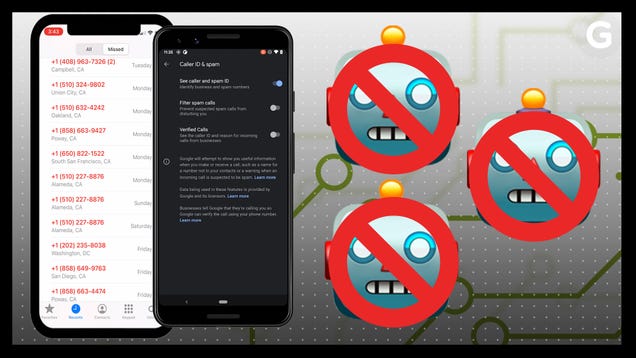
Who among us does not love receiving call after call that looks like it’s coming from somewhere important but is actually just spam about an extended car warranty? So fun! Dealing with spam calls is kind of like playing whack-a-mole, but until we figure out how to put the companies behind them out of business, there…

Read more...


Source: Gizmodo https://ift.tt/3nbR5uv

‘Free speech’ social network Parler tops app store rankings following Biden’s election win

Chafing at new misinformation safeguards and a lost election, dejected Trump supporters flocked to the alternative social network Parler over the weekend.  Parler’s homepage promises that users can “Speak freely and express yourself openly, without fear of being ‘deplatformed’ for your views.”

Parler shot up the charts across Apple’s App Store and the Google Play Store in the days following official election results. An Android app called “Parlor” was also trending Monday, likely due to misspelled searches for Parler.

Joe Biden prevailed on Saturday, picking up the critical state of Pennsylvania to become president-elect. Biden’s win followed a tense five days of vote tallying, as Trump repeatedly attacked the U.S. election process.

Parler sat at #7 in the App Store on Saturday, November 7, according to mobile app market analysis from Sensor Tower. By the next day, it shot up to #1 — a first for the app. It remains in the top slot now, in contrast to its position a week ago as the 1023th most downloaded app.

The story is similar in Google’s own app marketplace, where Parler climbed from #51 on Saturday to #5 on Sunday, topping out in the #1 slot today. The Fox News competitor Newsmax TV and the self-described “next-gen social network” MeWe also sat in Google’s top 5.

Parler’s ascent is notable but not totally new. Accounts anticipating a ban have been pointing their followers toward Parler and other far-right havens with every new platform policy change that Twitter and Facebook make. Gab, which describes itself as “the free speech social network” is also vying for Trump loyalists.

“It’s crazy to believe that only a handful of Silicon Valley companies will have complete control over the flow of information, communication, and news forever,” Gab CEO Andrew Torba wrote in a blog post Sunday.  Torba was booted from Y Combinator’s alumni network for threatening comments and harassment shortly after the 2016 election.

But in spite of calls for a mass exodus, many prominent conservative figures accusing Twitter and Facebook of censorship have maintained their presences on the platforms, knowing that their reach would be dramatically limited on the alternative social networks.

Fox News contributor and Trump enthusiast Dan Bongino called for his own supporters to move to Parler last week, warning that “Fakebook” might act against his page. On Facebook, Bongino’s content regularly ranks in the top performing posts on the platform and his page has nearly four million followers. Notably, Bongino announced an ownership stake in Parler earlier this year.

Over on Parler, the Trump campaign is raising donations for an “election defense task force,” but according to the fine print half of every donation will go toward existing debt. The campaign doesn’t appear to have made much original content on the niche social network lately, instead reposting very similar messages over and over.

For the many Trump supporters pushing dangerous false claims about the election, the writing was on the wall. Facebook made a rapid-fire series of policy changes in the months preceding the election, banning QAnon, cracking down on violent militias and introducing new tools to slow the spread of misinformation, which metastasized on the social network over the last four years.

As it became clear that Trump’s effort to delegitimize the election was picking up steam, Facebook cracked down. The company began hiding search results for the #StopTheSteal hashtag and removed one of its popular groups over “calls for violence” made by some members.

In spite of his loss, President Trump has refused to concede the election. But by Monday, Biden’s transition team had already kicked into high gear, announcing members of a coronavirus task force that will seek to rein in the deadly virus where Trump has failed.

With election results settled, the vast machinery of the U.S. government moved steadily toward January’s transfer of power, as it has in every other election.


Source: TechCrunch https://ift.tt/36neMsG

India opens antitrust case against Google over its payments app

India’s antitrust watchdog has opened an investigation into Google for allegedly abusing the dominant position of its app store and Android mobile operating system to promote its payments service in the world’s second largest internet market.

In its Monday announcement (PDF) about opening an antitrust case against Google, Indian watchdog Competition Commission of India (CCI) said it would review claims whether Google “unfairly” skews the search results on the Play Store in favor of Google Pay app over others; prominently promotes Google Pay during the setup of an Android smartphone; and if Play Store’s billing system is designed “to the disadvantage of both i.e. apps facilitating payment through UPI, as well as users.”

The informant, who has not been identified, alleged that in addition to Google Play Store’s billing system favoring Google Pay app, in-app purchases for apps downloaded through Play Store are also mandated to support Google Pay app “if they want to be listed on the Play Store.”

Google “rigs its feature app lists such as ‘Editor’s Choice Apps’, ‘User Choice Apps’ and ‘Top Free apps’ … demonstrating clear bias in favor of its own app; by manipulating the search advertisements algorithm on the Play Store in favour of Google Pay; and by pre-installing and prominently placing Google Pay on Android smartphones at the time of initial set-up resulting in a ‘status-quo bias’ to the detriment of other apps facilitating payments through UPI as well,” the informant was quoted as saying by the Indian watchdog.

“The informant pointed out similarities between the conducts of Apple in Europe and Google in India i.e. like Apple (as set out in the Press Release of EC), as a mandatory requirement for listing on the Play Store, Google requires the app developers to exclusively use Google Play Store’s payment system and Google Play In-App Billing for charging users who purchase apps on the Play Store or buy goods/services from inside an app (i.e. IAP), and further like Apple, Google charges app developers a 30% commission for allowing them to use the Play Store’s payment system and Google Play In-App Billing,” the Indian watchdog said.

Google told CCI that Android “is not dominant in India and it faces significant competition from feature phones operating systems,” the Indian watchdog revealed. According to research firm Counterpoint, Android powers 99% of all smartphones in India. Google also disputed all the other allegations as well. For instance, it said, “Google’s 30% (and in certain circumstances, 15%) service fee is not arbitrary. It is market based, legitimate, and pro-competitive as the service fee allows Google to cover third party fees and support its significant and continued investments in Play, including the vast resources it develops for developers.”

If the allegations provided by the informant are found credible, Google’s practices could be in violation of various provisions of Section 4 of India’s Competition Act of 2002.

Google Pay, formerly known as Tez, is one of the most popular payments services in India. It competes with Walmart’s PhonePe, Paytm, and a range of other apps. As of last month, Walmart’s PhonePe was slightly ahead of Google Pay in India. Both the apps individually process roughly 40% of all transactions on UPI, a payments infrastructure built by large banks in the country. UPI is the most popular digital payments solution in India.

Google Play Store supports a range of payments methods, including credit cards, mobile wallets, internet banking, and UPI. But, as the informant alleges, “UPI based digital payment apps are more convenient, secured, economical, etc. over other digital payment solutions.” Based on such distinct features, the Indian watchdog said, “the Informant has averred that the market for apps facilitating payment through UPI is a separate relevant market as users do not regard apps facilitating payment through UPI as interchangeable or substitutable with other modes of digital payment.”

The new antitrust case is the latest headache for Google in India, its biggest market by users. In recent months, the dominant position of Android has also irked many startups in the country, who have formed an informal coalition to fight back the Android maker.

Google did not immediately respond to a request for comment.

More to follow…


Source: TechCrunch https://ift.tt/2Ub2Q7K

Review: The iPhone 12 Pro Max is worth its handling fee

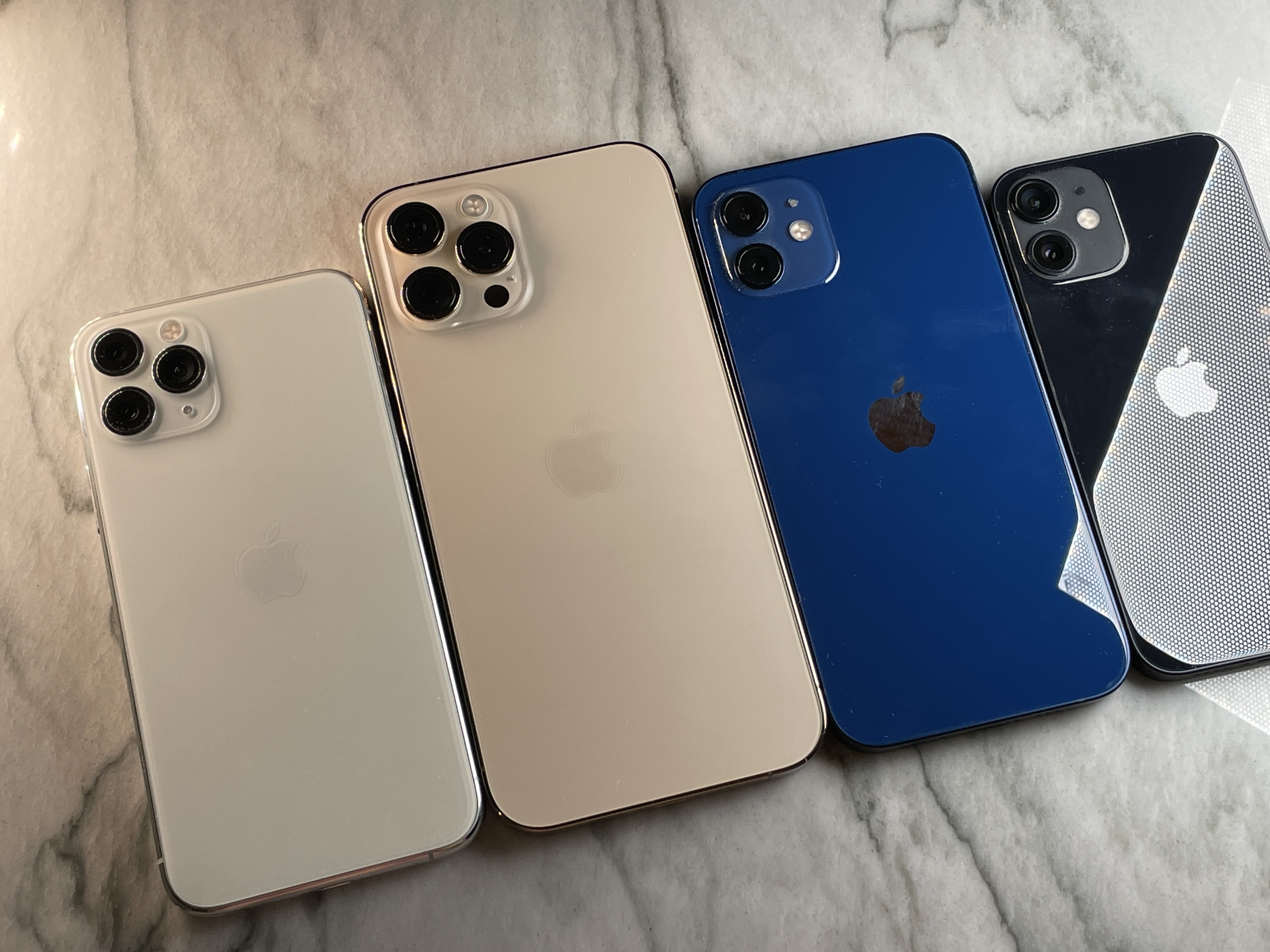
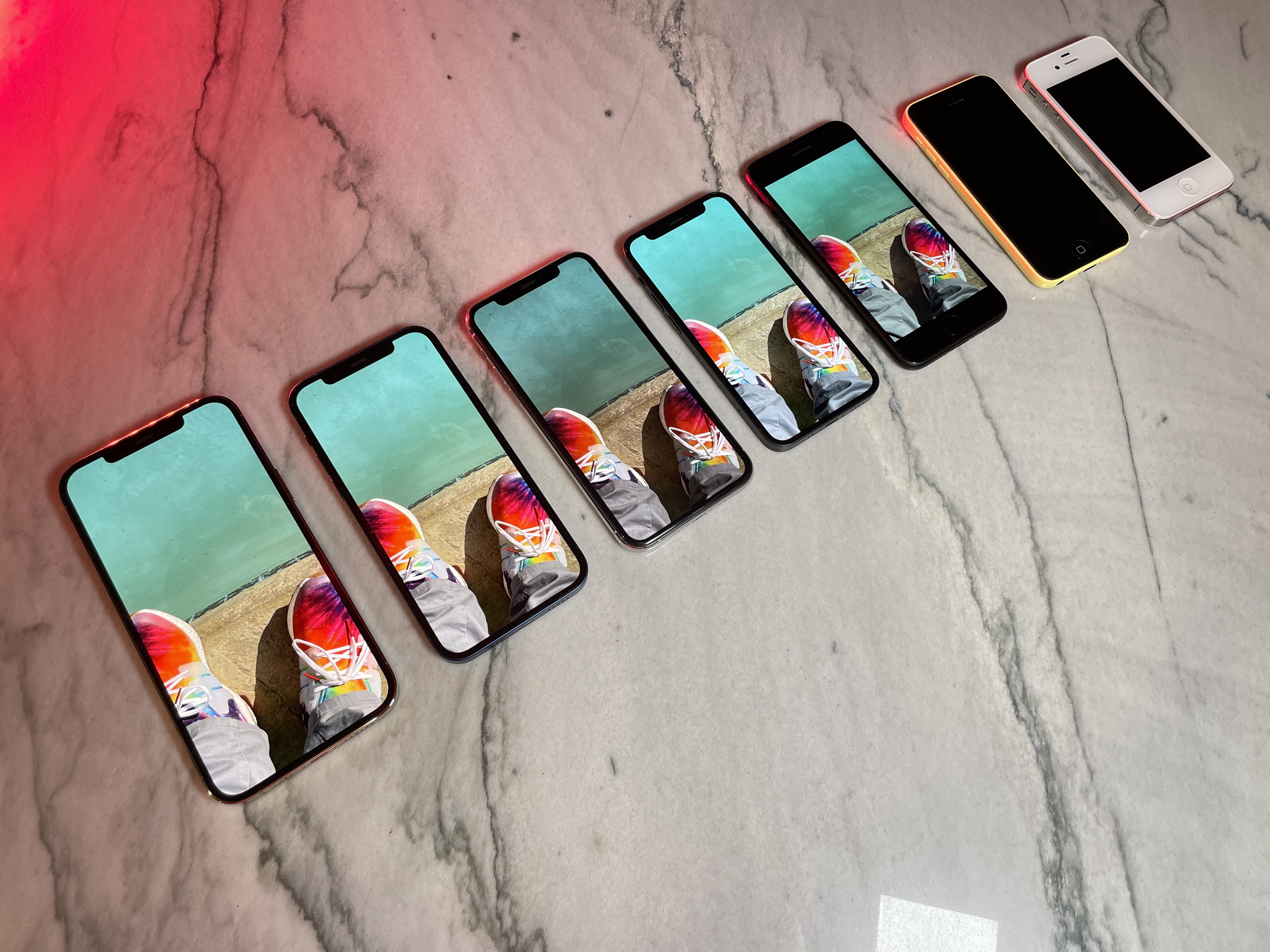
The iPhone 12 Pro Max is probably the easiest of all of the new iPhone 12 models to review. It’s huge and it has a really, really great camera. Probably one of the best cameras ever in a smartphone if not the best. For those of you coming from an iPhone “Max” or “Plus” model already, it’s a no brainer. Get it, it’s fantastic. It’s got everything Apple has to offer this year and it’s even a bit smaller than the iPhone 11 Pro Max. 

For everyone else — the potential upsizers — this review has only a single question to answer: Do the improvements in camera and screen size and potentially battery life make it worth dealing with the hit in handling ergonomics from its slim but thicc build?

The answer? Yes, but only in certain conditions. Let’s get into it.

Build

I’m not going to spend a ton of time on performance or go through a feature-by-feature breakdown of the iPhone 12 Pro Max. I’ve published a review of the iPhone 12 and iPhone 12 Pro here and just today published a review of the iPhone 12 mini. You can check those out for baseline chat about the whole lineup. 

Instead, I’m going to focus specifically on the differences between the iPhone 12 Pro Max and the rest of the lineup. This makes sense because Apple has returned us to a place that we haven’t been since the iPhone 8. 

Though the rest of the lineup provides a pretty smooth arc of choices, the iPhone 12 Pro Max introduces a pretty solid cliff of unique features that could pull some people up from the iPhone 12 Pro. 

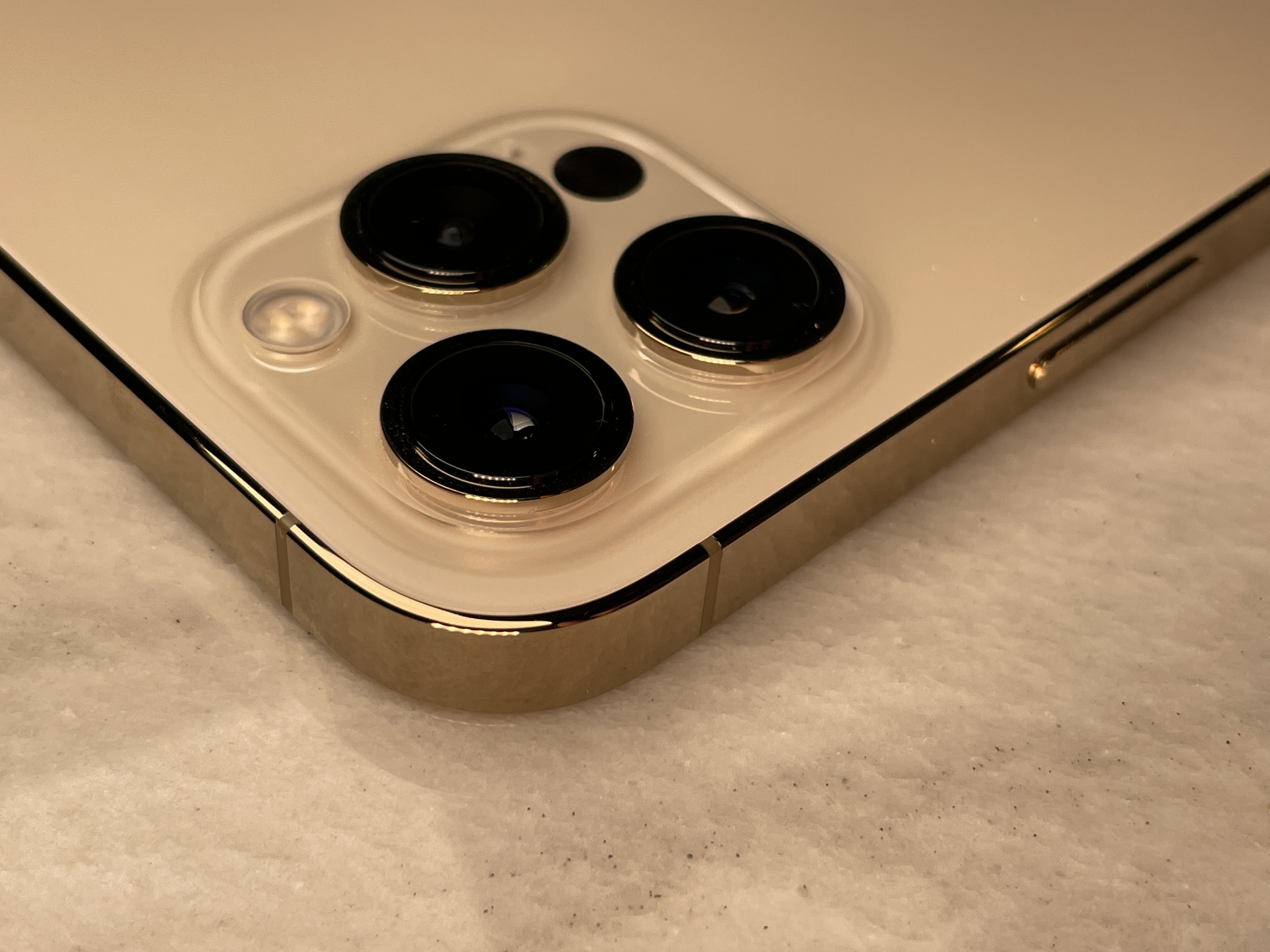
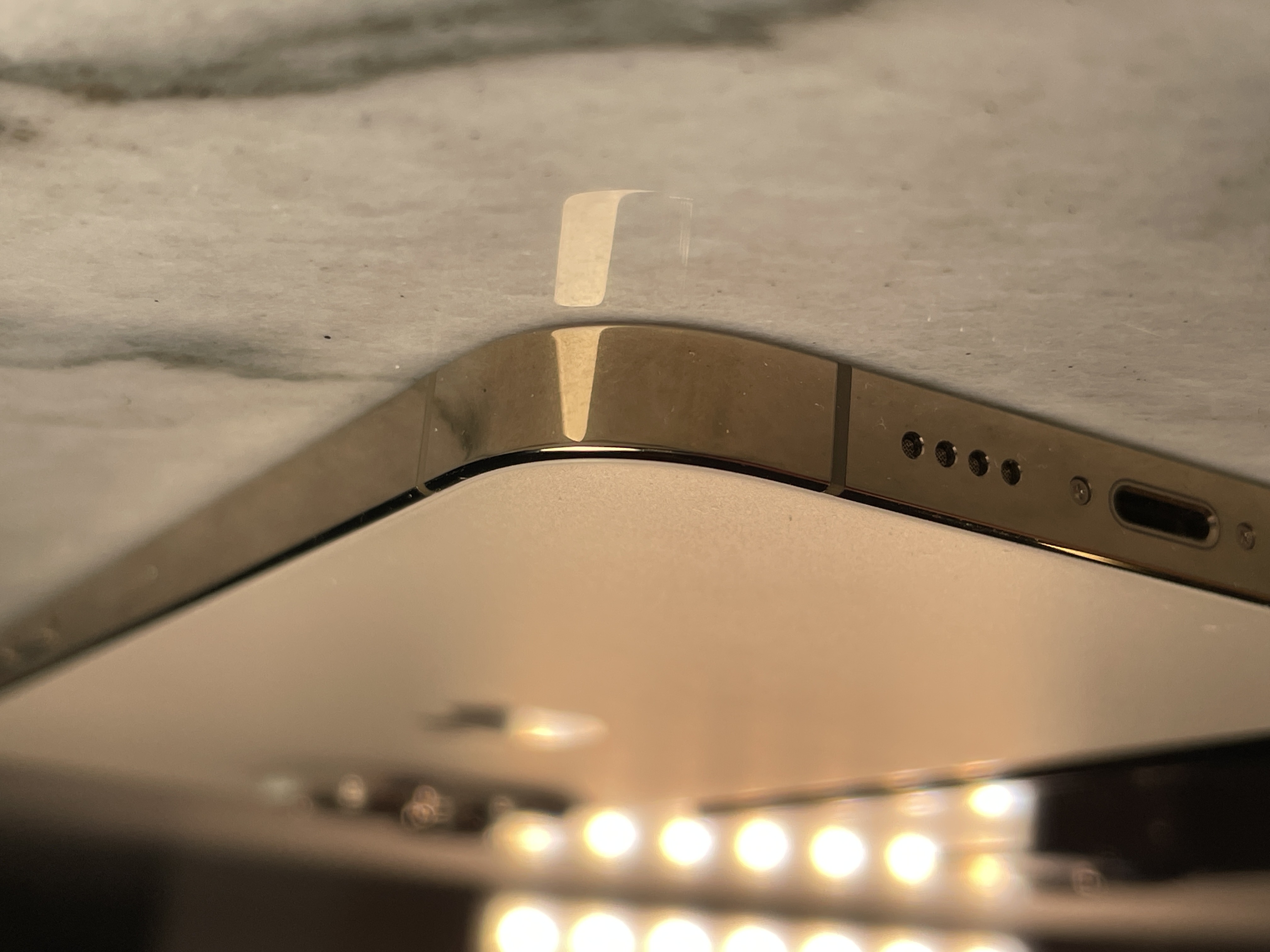
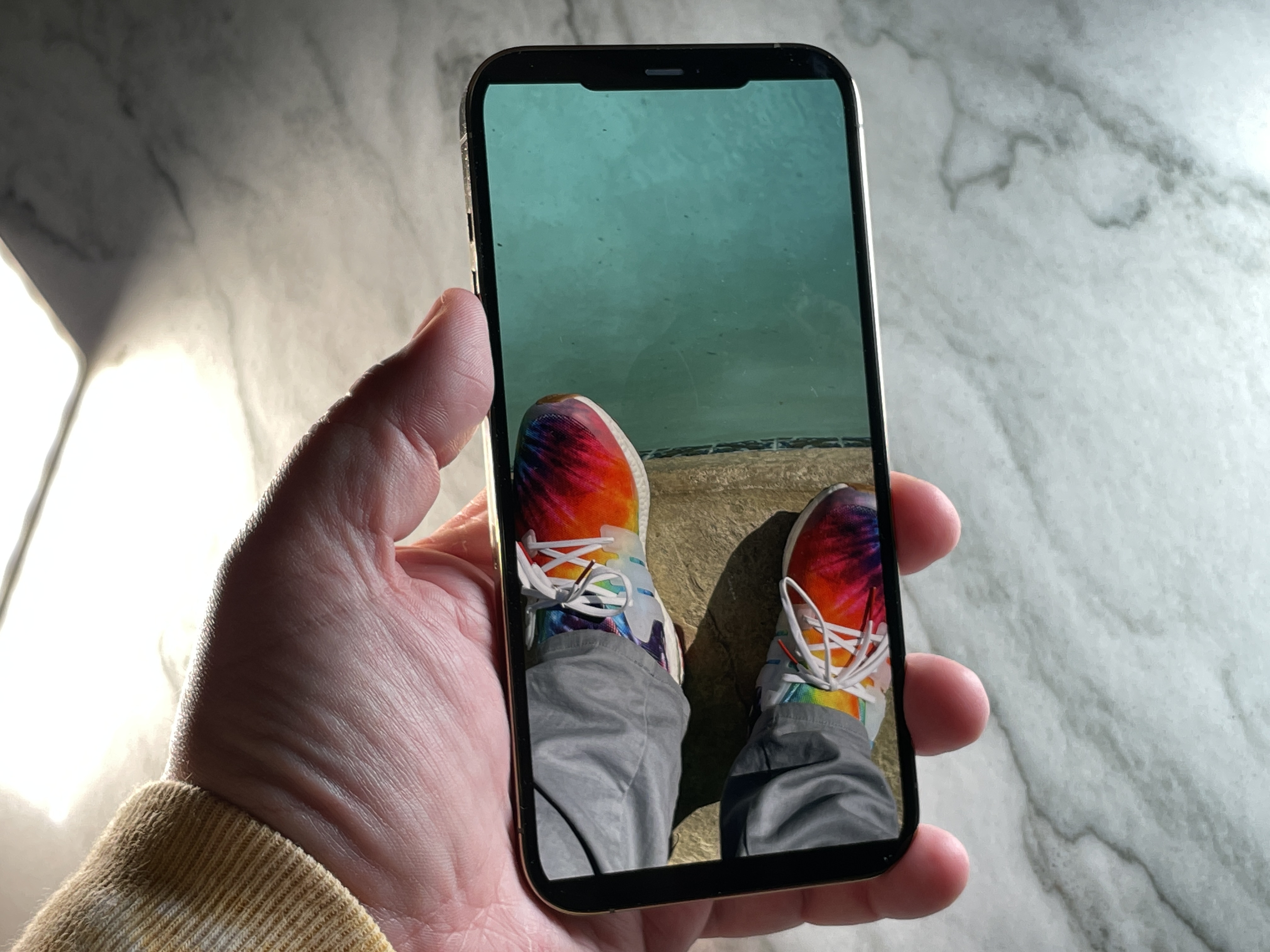
The larger size sets off all of the work Apple did to make the iPhone 12 Pro look like a jewel. Gold coated steel edges and the laminated clear and frosty back with gold accent rings around the cameras and glossy logo. All of it screams posh. 

Some of you may recall that there was a period of time where there existed a market for ultra-luxury phone makers like Vertu to use fine materials to “elevate” what were usually pretty poorly implemented Symbian or Android phones at heart. Leather, gold, crystal and even diamond were used to craft veblen goods for the über rich just so they could stay ‘above’ the proles. Now, Apple’s materials science experimentation and execution level is so high that you really can’t get anything on the level of this kind of pure luxe manifestation in a piece of consumer electronics from anyone else, even a ‘hand maker’. 

To be fair, Vertu and other makers didn’t die because Apple got good at gold, they died because good software is needed to invest life into these bejeweled golems. But Apple got better at what they did faster than they could ever get good at what Apple does. 

This is a great piece of kit and as mentioned even smaller than previous Max models with the same size screen. But in my opinion, the squared off edges of this year’s aesthetic make this phone harder to hold, not easier at this size. This is essentially the opposite effect from the smaller models. For a phone this size I’d imagine everyone is going to use a case anyway so that’s probably moot, but it’s worth noting. 

My feelings on the larger iPhones, which I haven’t used as a daily driver since the iPhone 8, remain unchanged: these are two-handed devices best used as tablet or even laptop replacements. If you run your life from these phones then it makes sense that you’d want a huge screen with plenty of real-estate for a browser and a pip video chat and a generous keyboard all at once. 

The differences 

When we’re talking about whether or not to move up to this beast I think it’s helpful to have a list of everything here that is different, or you think might be but isn’t, from the iPhone 12 Pro. 

Screen. The 6.7” iPhone 12 Pro Max screen has a resolution of 2778×1284 at 458 ppi. That’s nearly identical but slightly under the iPhone 12 Pro’s 460ppi. So though this is a difference I’d count it as a wash. The screen’s size, of course, and the software support that some Apple and third-party apps to take advantage of the increased real-estate are still a factor. 

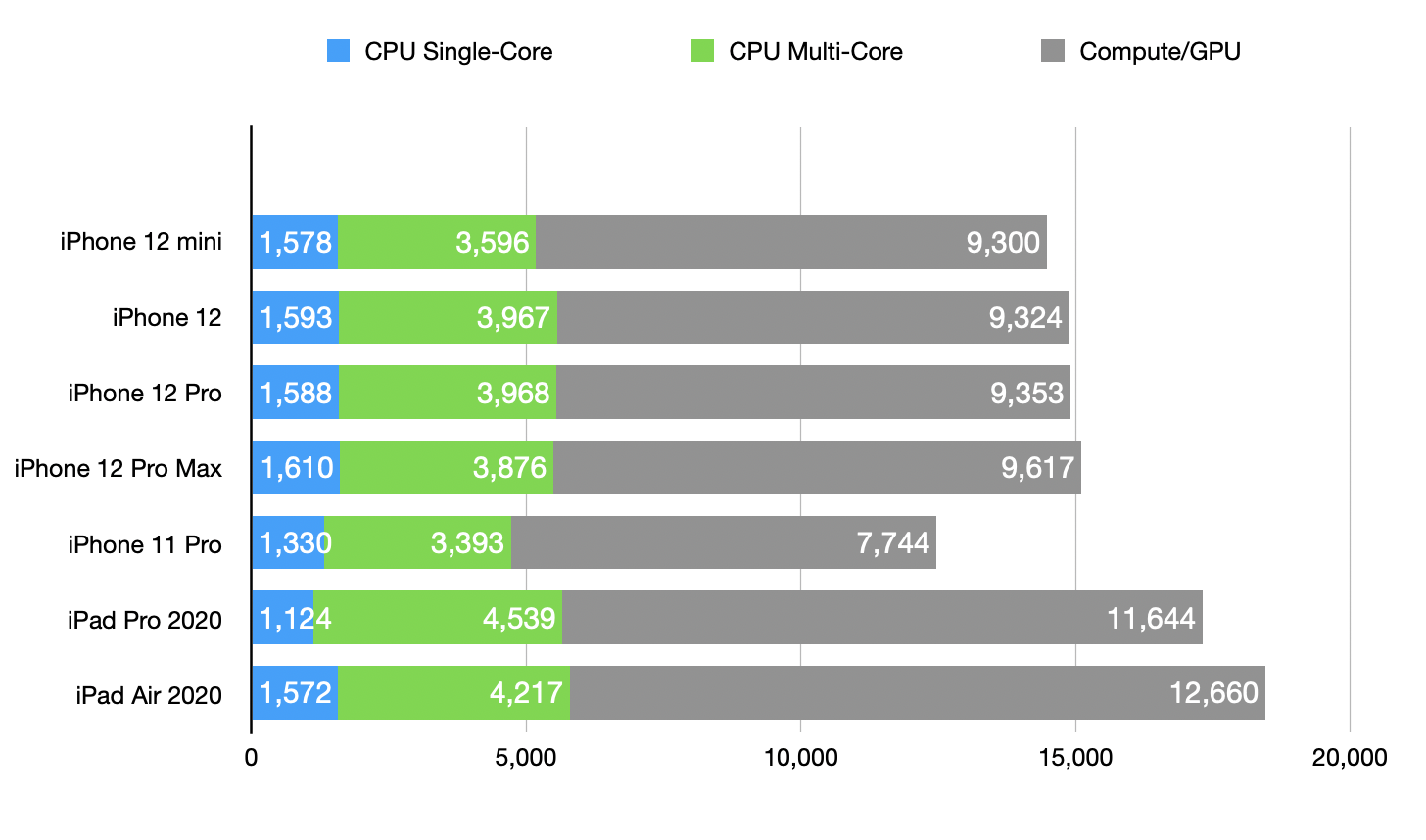
Performance. The iPhone 12 Pro Max performs exactly as you’d expect it to in the CPU and GPU department, which is to say exactly the same as the iPhone 12 Pro. It also has the same 6GB of RAM on board. Battery performance was comparable to my iPhone 11 Pro Max testing which is to say it outlasted a typical waking day though I could probably nail it in a long travel day. 

Ultra wide angle camera. Exactly the same. Improved over the iPhone 11 Pro massively due to software correction and the addition of Night Mode, but the same across the iPhone 12 Pro lineup.

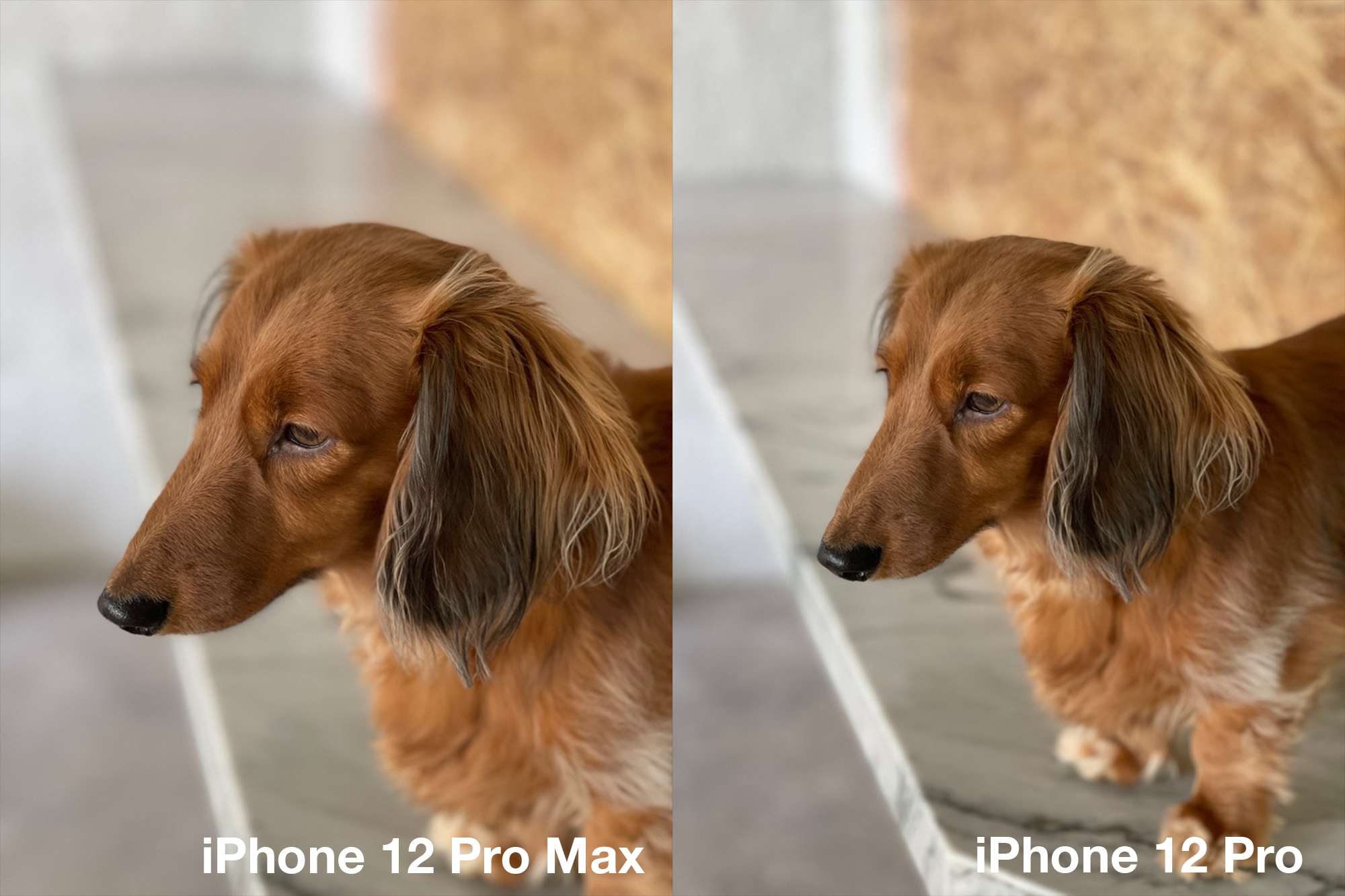
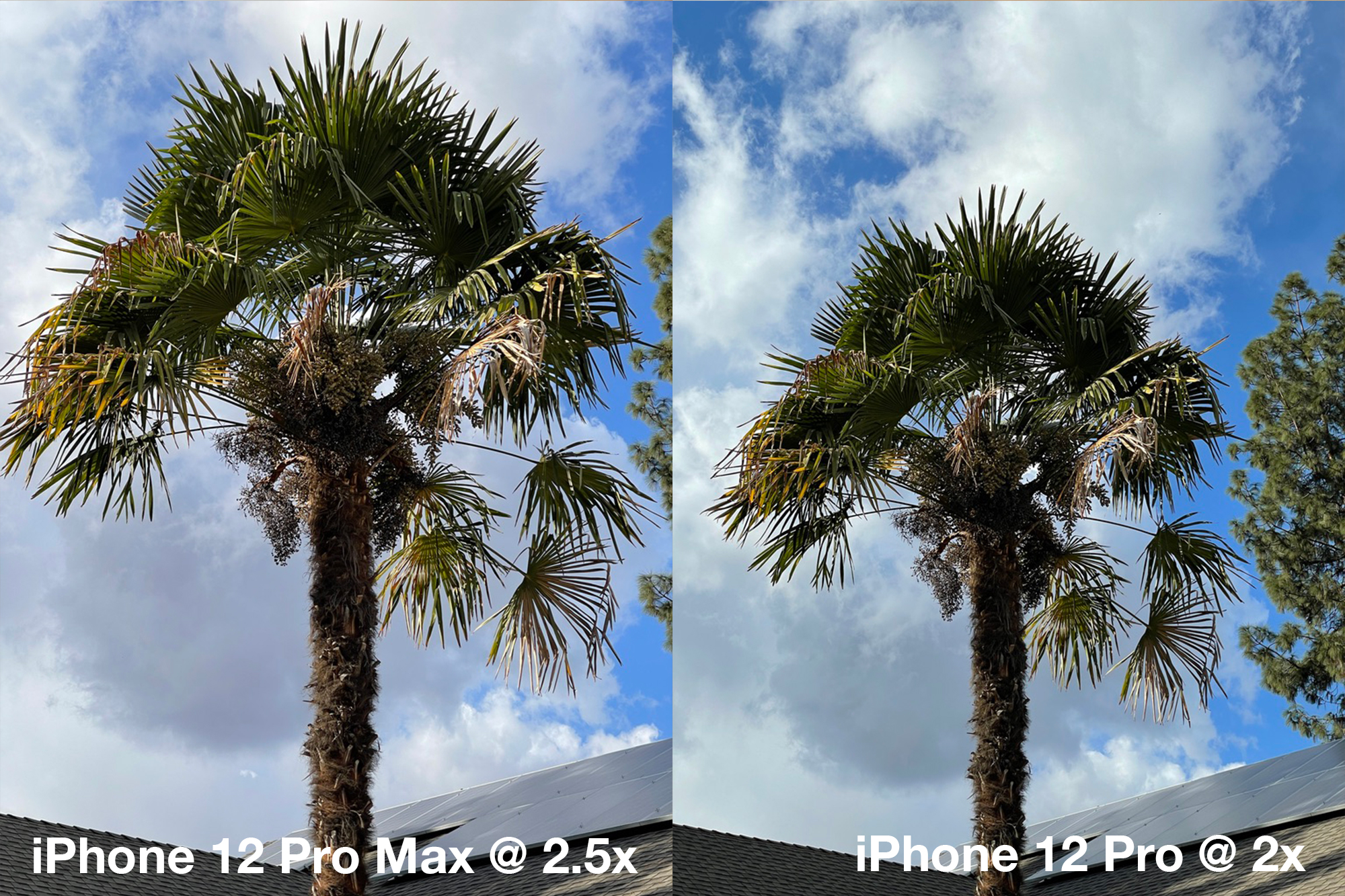
Telephoto camera. This is a tricky one because it uses the same sensor as the iPhone 12 Pro, but features a new lens assembly that results in a 2.5x (65mm equivalent) zoom factor. This means that though the capture quality is the same, you can achieve tighter framing at the same distance away from your subject. As a heavy telephoto user (I shot around 30% of my pictures over the last year in the iPhone 11 Pro’s telephoto) I love this additional control and the slightly higher compression that comes with it. 

The framing control is especially nice with portraits. 

Though it comes in handy with distant subjects as well.

There is also one relatively stealthy (I cannot find this on the website but I verified that it is true) update to the telephoto. It is the only lens other than the wide angle across all of the iPhone 12 lineup to also get the new optical stabilization upgrades that allow it to make 5,000 micro-adjustments per second to stabilize an image in low light or shade. It still uses the standard lens-style stabilization, not the new sensor-shift OIS used in the wide angle lens, but it goes up 5x in the amount of adjustments it can make from the iPhone 11 Pro or even the iPhone 12 Pro. 

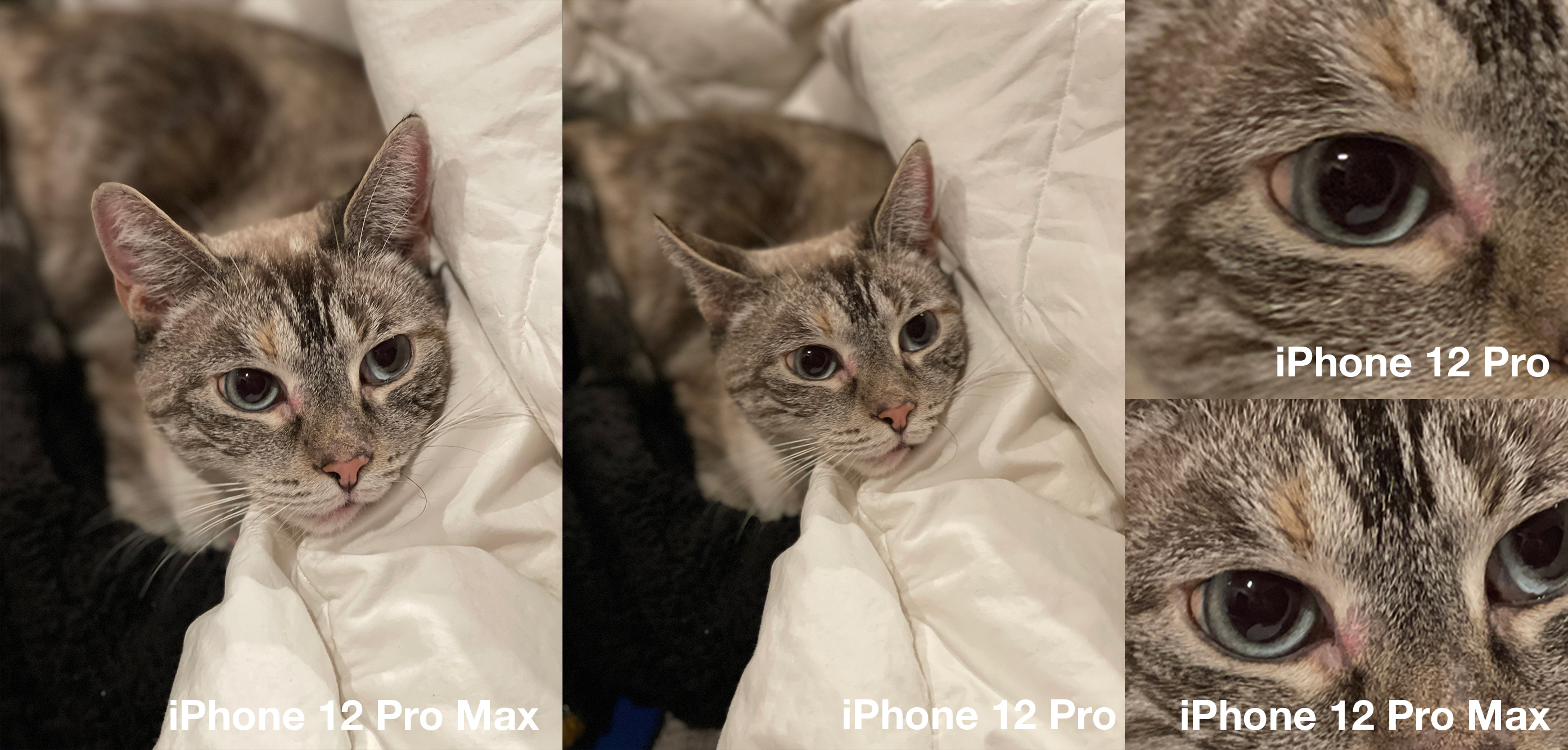
The results of this can be seen in this shot, a handheld indoor snap. Aside from the tighter lens crop, the additional stabilization adjustments result in a crisper shot with finer detail even though the base sensor is identical. It’s a relatively small improvement in comparison to the wide angle, but it’s worth mentioning and worth loving if you’re a heavy telephoto user.  

Wide angle camera. The bulk of the iPhone 12 Pro Max difference is right here. This is a completely new camera that pushes the boundaries of what the iPhone has been capable of shooting to this point. It’s actually made up of 3 big changes:

  • A new f1.6 aperture camera. A larger aperture is plain and simple a bigger hole that lets more light in.
  • A larger sensor with 1.7 micron pixels (bigger pixels mean better light gathering and color rendition), a larger sensor means higher quality images.
  • An all-new sensor-shift OIS system that stabilizes the sensor, not the lens. This is advantageous for a few reasons. Sensors are lighter than lenses, which lets the adjustments happen faster because it can be moved, stopped and started again with more speed and precision. 

Sensor-shift OIS systems are not new, they were actually piloted in the Minolta Dimage A1 back in 2003. But most phone cameras have used lens shift technology because it is very common, vastly cheaper and easier to implement. 

All three things work together to deliver pretty stellar imaging results. It also makes the camera bump on the iPhone 12 Pro Max a bit taller. Tall enough that there is actually an additional lip on the case meant for it made by Apple to cover it. I’d guess that this additional thickness stems directly from the wide angle lens assembly needing to be larger to accommodate the sensor and new OIS mechanism and then Apple being unwilling to let one camera stick out further than any other. 

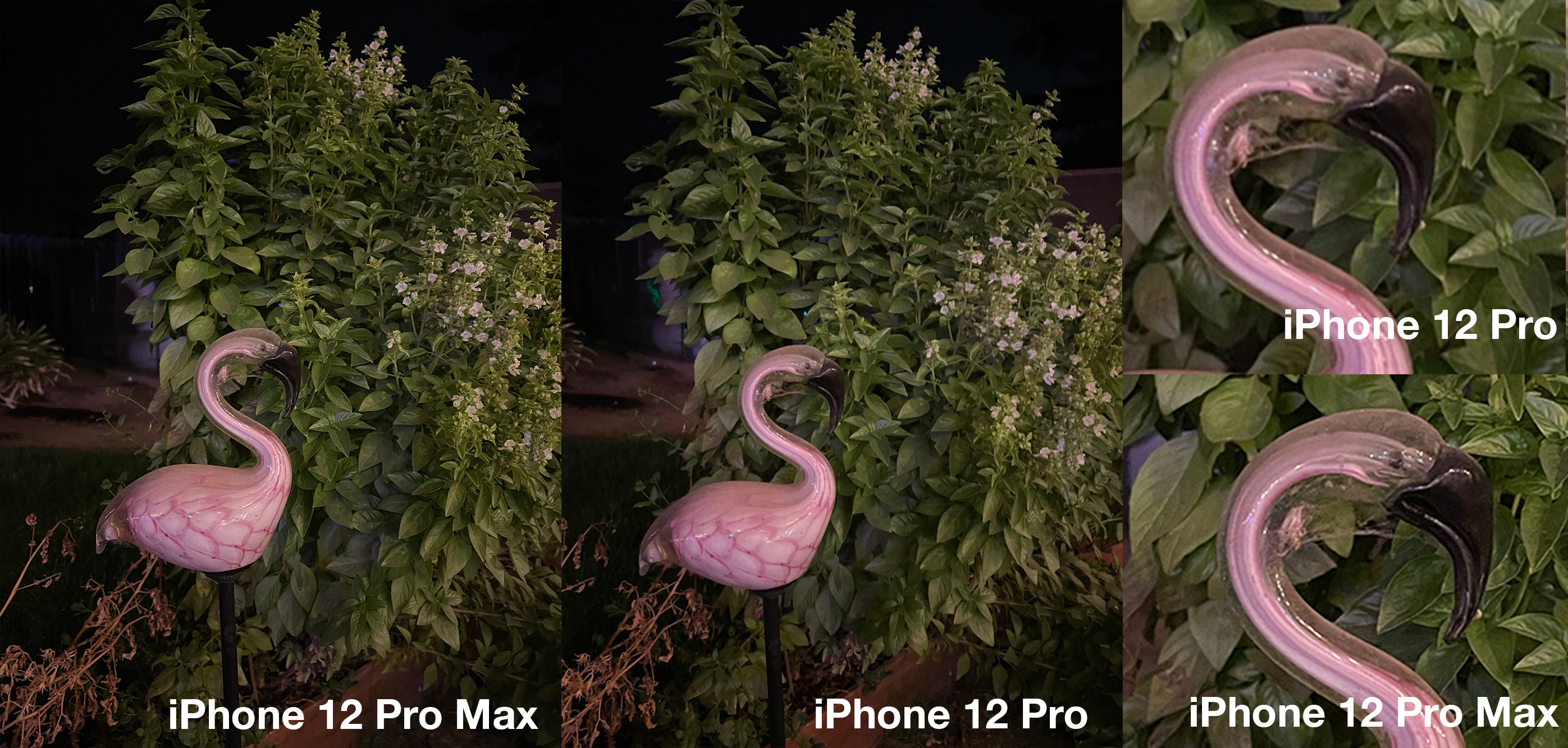
These are Night Mode samples, but even there you can see the improvements in brightness and sharpness. Apple claims 87% more light gathering ability with this lens and in the right conditions it’s absolutely evident. Though you won’t be shooting SLR-like images in near darkness (Night Mode has its limits and tends to get pretty impressionistic when it gets very dim) you can absolutely see the pathway that Apple has to get there if it keeps making these kinds of improvements. 

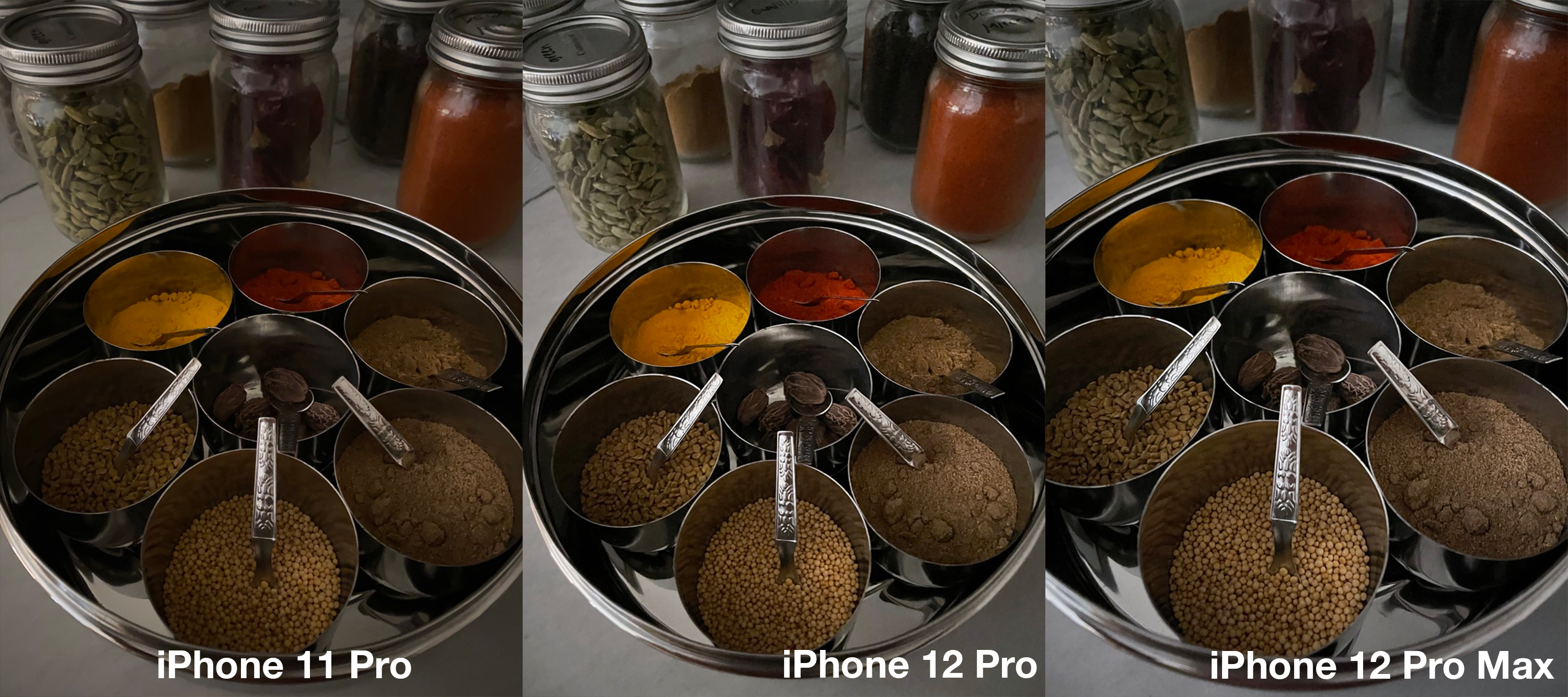
Wide angle shots from the iPhone 12 Pro Max display slightly better sharpness, lower noise and better color rendition than the iPhone 12 Pro and much more improvement from the iPhone 11 Pro. In bright conditions you will be hard pressed to tell the difference between the two iPhone 12 models but if you’re on the lookout the signs are there. Better stabilization when handheld in open shade, better noise levels in dimmer areas and slightly improved detail sharpness. 

The iPhone 12 Pro already delivers impressive results year on year, but the iPhone 12 Pro Max leapfrogs it within the same generation. It’s the most impressive gain Apple’s ever had in a model year, image wise. The iPhone 8 Plus and the introduction of Apple’s vision of a blended camera array was forward looking, but even then image quality was pretty much parity with the smaller models that year. 

A very significant jump this year. Can’t wait for this camera to trickle down the lineup.

LiDAR. I haven’t really mentioned LiDAR benefits yet, but I went over them extensively in my iPhone 12 Pro review, so I’ll cite them here.

LiDAR is an iPhone 12 Pro and iPhone 12 Pro Max only feature. It enables faster auto-focus lock-in in low light scenarios as well as making Portrait Mode possible on the Wide lens in Night Mode shots. 

First, the auto-focus is insanely fast in low light. The image above is what is happening, invisibly, to enable that. The LiDAR array constantly scans the scene with an active grid of infrared light, producing depth and scene information that the camera can use to focus. 

In practice, what you’ll see is that the camera snaps to focus quickly in dark situations where you would normally find it very difficult to get a lock at all. The LiDAR-assisted low light Portrait Mode is very impressive, but it only works with the Wide lens. This means that if you are trying to capture a portrait and it’s too dark, you’ll get an on-screen prompt that asks you to zoom out. 

These Night  Mode portraits are demonstrably better looking than the standard portrait mode of the iPhone 11 because those have to be shot with the telephoto, meaning a smaller, darker aperture. They also do not have the benefit of the brighter sensor or LiDAR helping to separate the subject from the background — something that gets insanely tough to do in low light with just RGB sensors.

As a note, the LiDAR features will work great in situations under 5 meters along with Apple’s Neural Engine, to produce these low-light portraits. Out beyond that it’s not much use because of light falloff. 

Well lit Portrait Mode shots on the iPhone 12 Pro Max will still rely primarily on the information coming in through the lenses optically, rather than LiDAR. It’s simply not needed for the most part if there’s enough light.

The should I buy it workflow

I’m straight up copying a couple of sections for you now from my iPhone 12 Pro and iPhone 12 mini reviews because the advice applies across all of these devices. Fair warning.

In my iPhone 12/12 Pro review I noted my rubric for selecting a personal device:

  • The most compact and unobtrusive shape.
  • The best camera that I can afford.

And this is the conclusion I came to at the time:

The iPhone 12 Pro is bested in the camera department by the iPhone 12 Pro Max, which has the biggest and best sensor Apple has yet created. (But its dimensions are similarly biggest.) The iPhone 12 has been precisely cloned in a smaller version with the iPhone 12 mini. By my simple decision-making matrix, either one of those are a better choice for me than either of the models I’ve tested. If the object becomes to find the best compromise between the two, the iPhone 12 Pro is the pick.

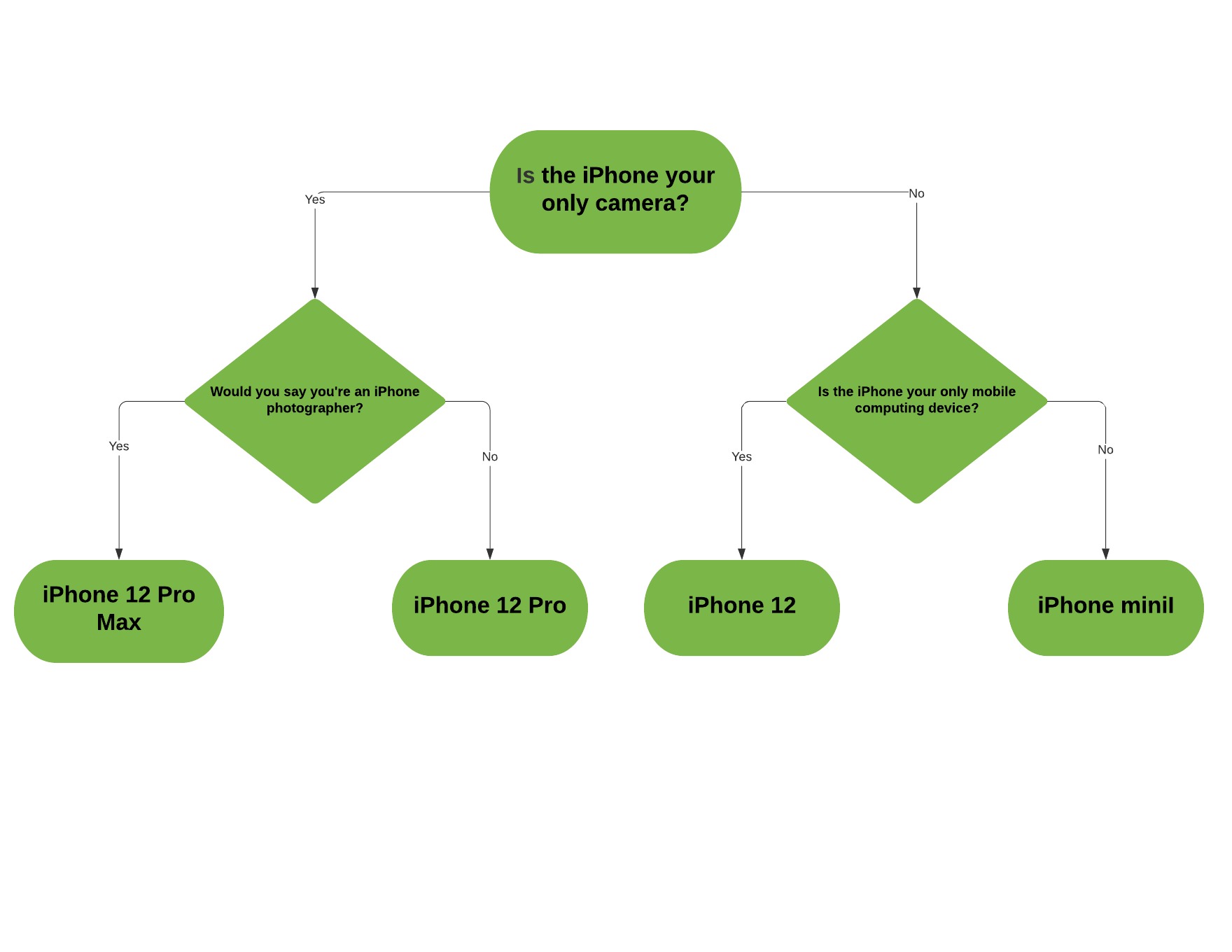
But now that I’ve had time with the Pro Max and the mini, I’ve been able to work up a little decision flow for you:

If you haven’t gathered it by now, I recommend the iPhone 12 Pro Max to two kinds of people: the ones who want the absolute best camera quality on a smartphone period and those who do the bulk of their work on a phone rather than on another kind of device. There is a distinct ‘fee’ that you pay in ergonomics to move to a Max iPhone. Two hands are just plain needed for some operations and single-handed moves are precarious at best. 

Of course, if you’re already self selected into the cult of Max then you’re probably just wondering if this new one is worth a jump from the iPhone 11 Pro Max. Shortly: maybe not. It’s great but it’s not light years better unless you’re doing photography on it. Anything older though and you’re in for a treat. It’s well made, well equipped and well priced. The storage upgrades are less expensive than ever and it’s really beautiful. 

Plus, the addition of the new wide angle to the iPhone 12 Pro Max makes this the best camera system Apple has ever made and quite possibly the best sub compact camera ever produced. I know, I know, that’s a strong statement but I think it’s supportable because the iPhone is best in class when it comes to smartphones, and no camera company on the planet is doing the kind of blending and computer vision Apple is doing. Though larger sensor compact cameras still obliterate the iPhone’s ability to shoot in low light situations, the progress over time of Apple’s ML-driven blended system.

A worthy upgrade, if you can pay the handling costs.


Source: TechCrunch https://ift.tt/35e9pNj